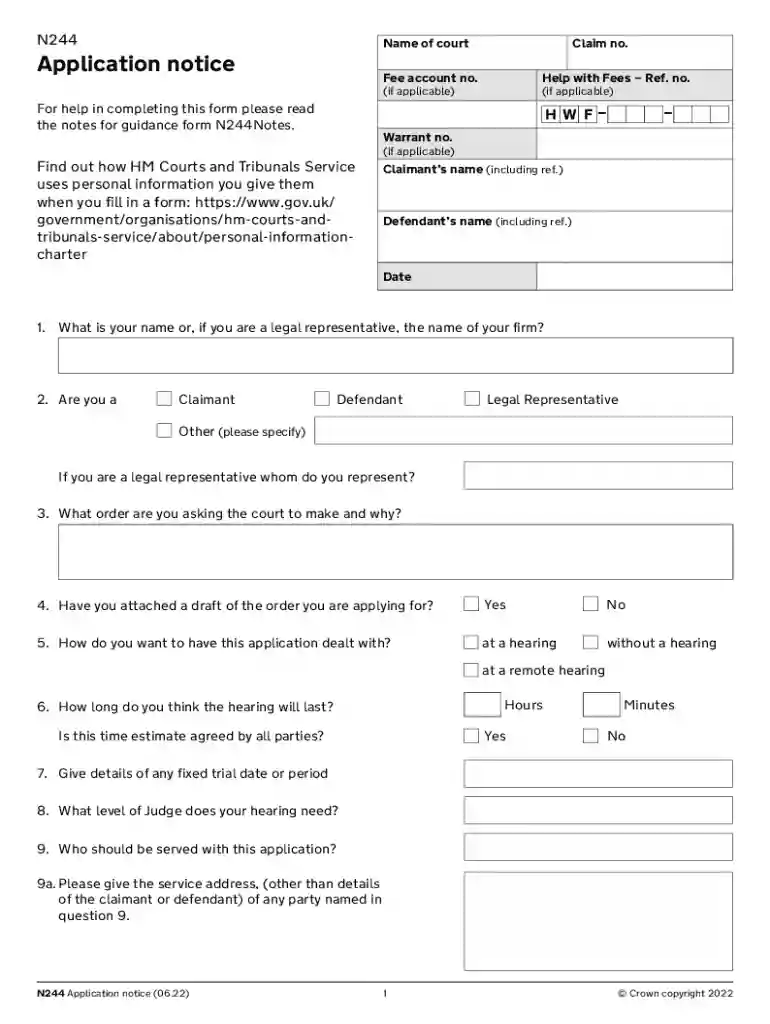
Definition and Purpose of the N244 Application Notice
The N244 Application Notice is a legal document used in the United Kingdom, typically in court proceedings, to request a specific order from the court. It is not directly applicable to the United States but serves as an example of a procedural tool used in British courts. The form allows the claimant or the defendant to apply for various orders, like amending a claim or issuing an injunction.
- Details the parties involved: Includes sections to identify the claimant and defendant, ensuring clarity on who is making the request.
- Outlines the requested order: Applicants must describe the specific order they wish the court to make.
- Ensures accuracy: A statement of truth is required to declare the information provided is accurate.
How to Use the N244 Application Notice
To effectively use the N244 Application Notice, one must follow a series of procedural steps, ensuring compliance with legal standards.
- Identify the Need: Determine why the order is necessary, such as amending case details or requesting urgent hearings.
- Complete the Form: Fill out all required sections, including personal details, the court where the case is held, and explicit details of what is being requested.
- Provide Evidence: Attach any supporting documents that justify the need for the court order.
- Submission: Submit the completed form and attached documents to the appropriate court via mail, online, or in person, depending on the court's rules.
Steps to Complete the N244 Application Notice
When completing the N244 Application Notice, attention to detail is crucial to ensure the application is not rejected for technical reasons.
- Section Filling:
- Identify parties involved correctly.
- Detail the requested court order.
- Statement of Truth: Affirm that the provided information is factual to the best of your knowledge.
- Attachment of Supporting Documents: Include necessary documentation such as receipts, contracts, or previous court orders that support the application.
- Submission and Fee Payment: Pay any applicable court fees and submit the form to the specified court.
Key Elements of the N244 Application Notice
The N244 form is structured to capture all essential information required for the court to consider the request.
- Parties Information: Complete names and addresses of the claimant and defendant.
- Order Details: Precise specifications of the requested order and its implications.
- Statement of Truth: A mandatory declaration affirming the honesty of the provided information.
- Supporting Documentation: Documents backing the need for the court order.
Legal Use of the N244 Application Notice
Legally, the N244 Application Notice plays a vital role in the judicial process by allowing modifications and requests during a litigation process.
- Court Sanctioned Modifications: Allows for lawful adjustments to claims, hearings, or mandates.
- Procedural Requests: Used to fast-track or delay proceedings based on justifiable reasons.
- Compliance With Legal Standards: Ensures any modifications or requests adhere to existing legal frameworks and due processes.
State-Specific Rules for the N244 Application Notice
While the N244 is specific to UK courts, hypothetical adaptations might consider state-specific rules for similar forms.
- Jurisdictional Variations: Different courts may have unique requirements or interpretations of similar procedural forms.
- Submission Protocols: Variations in acceptance methods (e.g., physical vs. electronic submissions) across state lines.
- Fee Structures: Court fees linked to the submission of such forms can differ significantly depending on the state or specific legal context.
Digital Versus Paper Version
Utilizing either a digital or paper version of legal forms like the N244 can have implications depending on the context and court regulations.
- Digital Convenience: Online submissions offer ease of access, quicker processing times, and less physical paperwork.
- Paper Protocols: Some cases or jurisdictions may still require paper submissions due to traditional record-keeping practices.
- Security and Authenticity: Digital forms with electronic signatures must ensure strong encryption and adherence to legal standards to be as binding as paper versions.