




01. Edit your n244 word version online
Type text, add images, blackout confidential details, add comments, highlights and more.

Type text, add images, blackout confidential details, add comments, highlights and more.

Draw your signature, type it, upload its image, or use your mobile device as a signature pad.

Send n244 form word via email, link, or fax. You can also download it, export it or print it out.
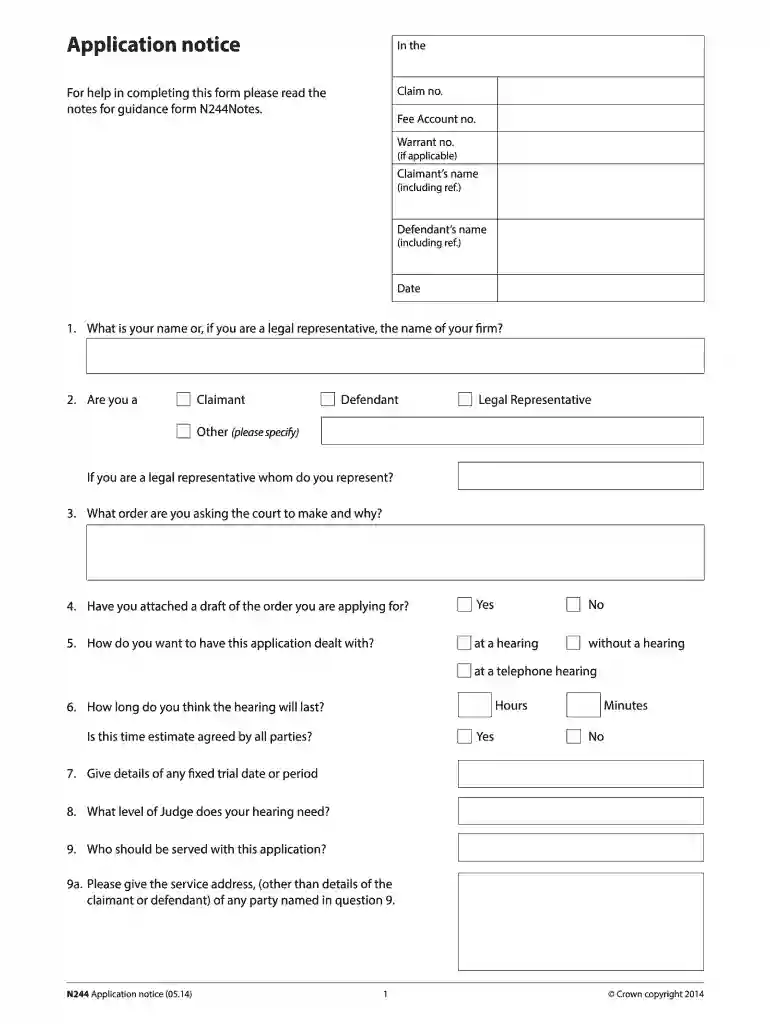
The N244 form is a court application used mainly in the United Kingdom to make various requests in civil proceedings, such as applying for permission to appeal or requesting a stay of proceedings. This form is essential for individuals who wish to challenge decisions made by the courts or seek alterations in their case's status. The N244 form is particularly relevant when parties are looking to prevent actions, like eviction, or need adjustments concerning legal documentation, including those seeking to stop eviction processes.
Filling out the N244 form involves specific steps to ensure accuracy and compliance with the legal processes. Below is a structured guide:
Download the Form: Obtain the N244 form, ensuring you have the latest version for submission.
Provide Personal Details: Fill in your full name, address, and contact information, ensuring legibility for all details.
Select the Purpose: Clearly indicate why you are submitting the N244 form by selecting the appropriate boxes, such as seeking permission to appeal or asking for a stay of proceedings.
Detail the Request: Include a precise account of what you are asking the court to do. This section should explain the context and justification for your application, providing as much detail as possible to support your case.
Include Supporting Evidence: Attach any relevant documents that may substantiate your application. This includes previous court orders, letters, or any other pertinent information.
Sign and Date the Form: Ensure you sign and date your application, as an unsigned form can lead to delays or rejection.
Submit the Form: Choose your submission method—whether online, by mail, or in person—following local court instructions.
Submitting the N244 form can be accomplished through various methods, depending on the court's requirements and your preferences.
When submitting the N244 form, it's crucial to understand certain considerations, particularly regarding fees. The cost to submit the N244 form can vary based on the type of application and the court involved.
Understanding the legal ramifications of the N244 form is essential for proper usage. The implications can vary based on the case and its context, particularly in eviction scenarios.
The N244 form is utilized across various common scenarios, each necessitating careful consideration and adherence to the submission guidelines.
By comprehensively understanding the definition, completion, submission procedures, and legal implications of the N244 form, individuals can effectively navigate their legal challenges within the court system.
We've got more versions of the n244 word version form. Select the right n244 word version version from the list and start editing it straight away!
Yes, you can use DocHub for signing any business and personal paperwork, including your n244 word. All eSignatures you generate with our tool are legally binding and court-admissible, as DocHub complies with standards required by ESIGN and UETA. Save your completed form with a detailed Audit Trail if needed.
Using a swift editing platform like DocHub, you do not require anything but a web browser and connection to the internet to edit your n244 form online online quickly. Upload your file or get the appropriate form in DocHub’s catalog, open our editor with a single click, and complete it digitally. To edit your forms anytime, sign up a free profile with DocHub.
At DocHub, your data security is our priority. We follow HIPAA, SOC2, GDPR, and other standards, so you can work on your documents with confidence.




Item Number N244. AGGREGATE CUMULATIVE LIFETIME LOSS ON UNDERLYING COLLATERAL. Call confidentiality applies to FFIEC 031/041. Series, Start Date, End Date
*All required general education requirements are prerequisites to N244, N245, N260, and N265. ** Licensed practical nurses (LPN) with an activeRead more


