




01. Edit your form online
Type text, add images, blackout confidential details, add comments, highlights and more.

Type text, add images, blackout confidential details, add comments, highlights and more.

Draw your signature, type it, upload its image, or use your mobile device as a signature pad.

Send it via email, link, or fax. You can also download it, export it or print it out.
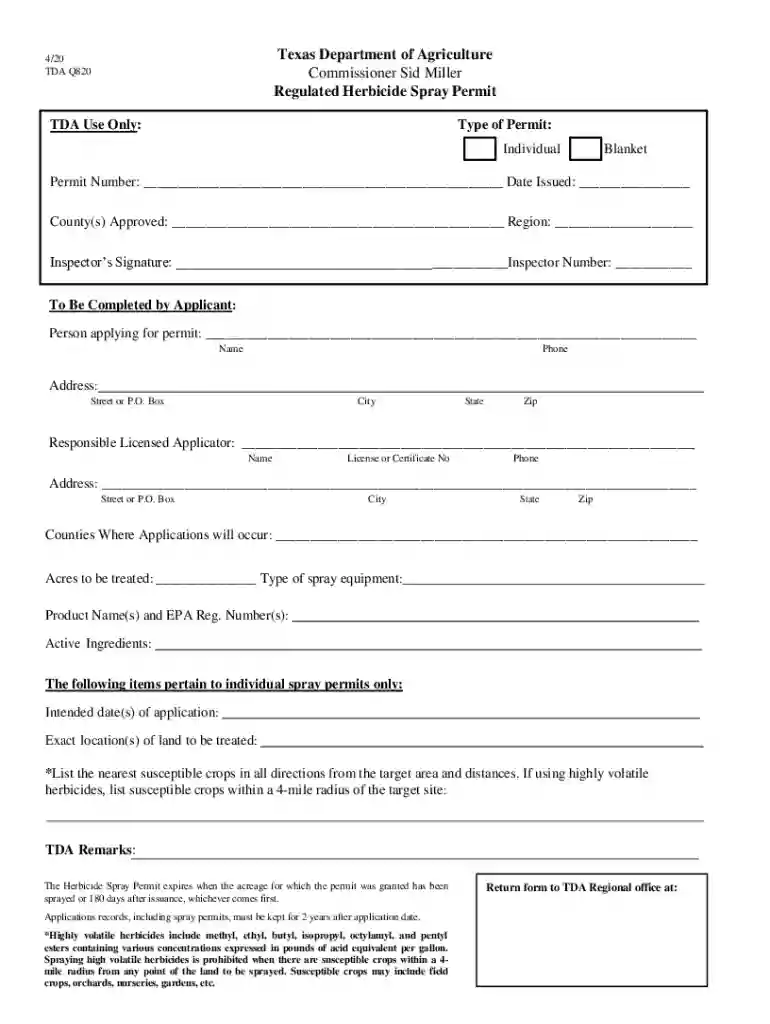
The Texas Department of Agriculture - Licensing form is a crucial document used to apply for a permit related to the use of regulated herbicides in Texas. This form requires comprehensive information about the applicant, such as personal details and licensed applicator information, ensuring only qualified individuals are authorized to handle certain chemicals. The significance of this form lies in maintaining safety standards and regulatory compliance for herbicide application, particularly near susceptible crops. Moreover, the form helps manage the lifespan of the permit, which remains valid until the specified acreage is treated or until 180 days post-issuance.
Utilizing the Texas Department of Agriculture - Licensing form requires a clear understanding of its components and how to accurately fill them out. The form usually consists of sections where you provide personal details, information about the licensed applicator, and specifics regarding the application of herbicides, including the location and type of equipment used. Each section needs to be completed with precise and truthful information to avoid processing delays and ensure compliance with regulatory requirements. Applicants need to follow exact instructions, as incorrect entries could lead to rejection or penalties. Thorough review and correct data entry are essential for successful form usage.
Securing the Texas Department of Agriculture - Licensing form involves a few straightforward steps. Initially, the form can be requested from the Texas Department of Agriculture's website or in-person at their office. Screening the requirements beforehand would be beneficial, as it allows you to gather necessary documents and information prior to receiving the form. Online accessibility often provides the advantage of form pre-filling which can streamline the process. Additionally, engaging with department officials or utilizing online resources like hotlines or FAQs can clarify any uncertainties about obtaining or completing the form.
The Texas Department of Agriculture - Licensing form plays a vital role in regulating the safe application of herbicides. It serves as a safeguard against overdosing and ensures the protection of neighboring susceptible crops from exposure to harmful chemicals. By ensuring that only qualified personnel apply these substances, the department minimizes potential health and environmental risks. Moreover, possessing a valid license adds a layer of legal protection for users, as it demonstrates compliance with state regulations, thus reducing the risk of facing legal actions or penalties.
The primary users of the Texas Department of Agriculture - Licensing form are those involved in agricultural operations requiring herbicide usage. This includes farmers, agricultural business owners, and licensed applicators in the state of Texas. Entities handling herbicides that could affect nearby farms or crops, potentially susceptible to volatile chemicals, are particularly mandated to complete this form. By utilizing it, users ensure they are legally cleared to perform their agricultural activities without infringing on state safety and regulatory guidelines.


Important components of the Texas Department of Agriculture - Licensing form include:
State regulations regarding the Texas Department of Agriculture - Licensing form vary by region, but they universally require adherence to rules and guidelines set out by the department. Users must be aware that each state may have unique specifications concerning the types of herbicides allowed, distances from susceptible environments, and qualifications of licensed applicators. Texas-specific rules include constraints on the types and conditions under which herbicides can be used to prevent drift and ensure crop safety. Understanding these nuances is necessary to stay compliant and avoid penalties or legal issues.
For practical instances, consider a farmer who intends to use a volatile herbicide near an organic farm. The necessary measure would involve filling out the licensing form to ensure compliance with provisions that safeguard the surrounding environment. Additionally, a landscaping business planning to apply herbicides in an urban setting might use the form to obtain permission and demonstrate engagement with regulatory expectations. By completing the licensing process, both scenarios underscore the importance of responsible chemical management for safety and legal conformity.
We've got more versions of the Texas Department of Agriculture - Licensing form. Select the right Texas Department of Agriculture - Licensing version from the list and start editing it straight away!
At DocHub, your data security is our priority. We follow HIPAA, SOC2, GDPR, and other standards, so you can work on your documents with confidence.
The Texas Department of Agriculture (TDA) licenses pesticide applicators that use restricted-use and state-limited-use pesticides and regulated herbicides.
The Texas Department of Agriculture (TDA) licenses pesticide applicators who use restricted-use pesticides, state-limited-use pesticides, or regulated
Texas Department of Agriculture Website. Center for Food Safety and Applied Nutrition. How gmos are regulated. U.S. Food


