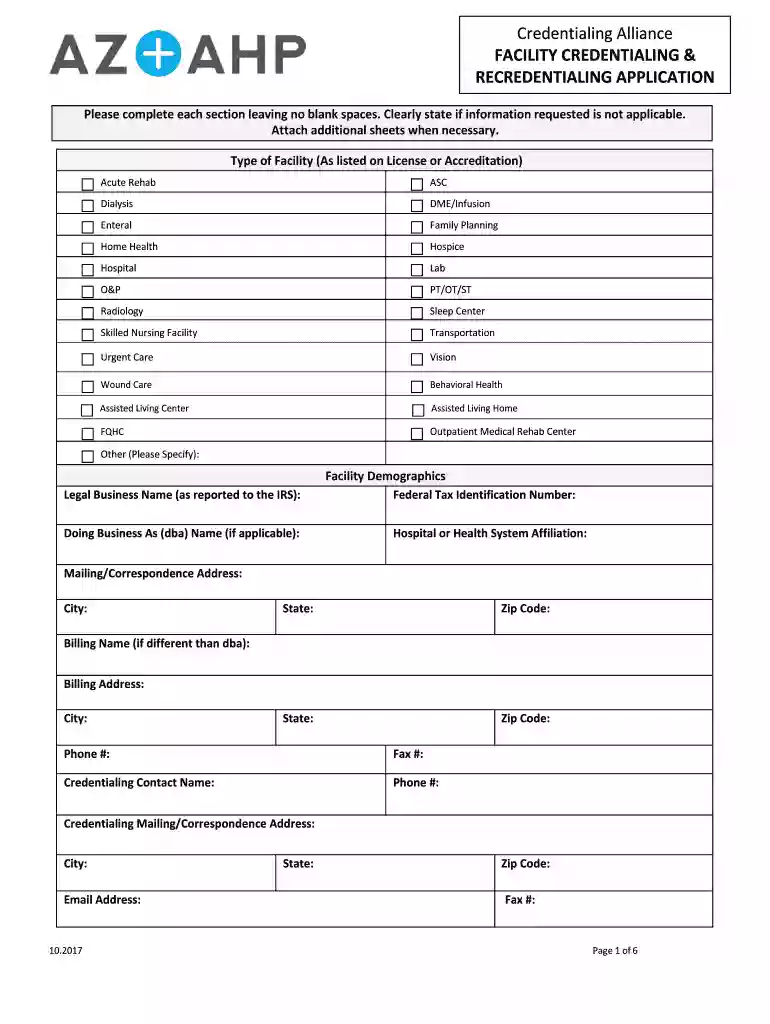
Credentialing Alliance Facility Credentialing and Recredentialing Application Facility Application 2026

Get Form
Credentialing Alliance Facility Credentialing and Recredentialing Application Facility Application Preview on Page 1

Here's how it works

01. Edit your form online
Type text, add images, blackout confidential details, add comments, highlights and more.

02. Sign it in a few clicks
Draw your signature, type it, upload its image, or use your mobile device as a signature pad.

03. Share your form with others
Send it via email, link, or fax. You can also download it, export it or print it out.

Definition and Purpose of the Credentialing Alliance Facility Application

The "Credentialing Alliance Facility Credentialing and Recredentialing Application Facility Application" is a comprehensive document utilized by healthcare facilities to apply for or renew their credentialing status. This process is crucial for ensuring that a healthcare facility meets specific standards and requirements to operate legally and efficiently. Credentialing involves verifying and assessing a facility's qualifications, including its adherence to industry standards and regulations. The application facilitates the collection of detailed information, ensuring that facilities are adequately evaluated for accreditation.

This application covers various aspects, including facility demographics, primary location, accreditation status, professional liability coverage, and any necessary disclosure questions. Facilities must complete this application thoroughly to avoid any delays in the credentialing process. By submitting the required documents, such as state licenses and insurance declarations, facilities demonstrate compliance with the relevant legal and regulatory frameworks, ultimately supporting their commitment to maintaining high standards of healthcare delivery.

How to Use the Credentialing Alliance Facility Application

The effective use of the Credentialing Alliance Facility Application involves several critical steps to ensure accurate and comprehensive submission. Facilities need to gather all essential information and documentation before beginning the application process. Preparing these materials in advance will streamline the completion process and reduce the likelihood of errors or omissions.

  1. Gather Required Information:

    • Collect demographic and primary location details of the facility.
    • Ensure accurate and up-to-date accreditation records, if applicable.
    • Compile evidence of professional liability coverage.
  2. Complete Each Section Accurately:

    • Carefully fill out each section of the application without leaving any blanks.
    • Verify that all information provided is current and correct.
  3. Attach Supporting Documents:

    • Attach copies of state licenses, accreditation credentials, and insurance declarations.
    • Provide detailed responses to any disclosure questions.
  4. Review and Verify:

    • Double-check entries for accuracy and completeness before submission.
    • Validate the attached documents to ensure they meet the specific requirements outlined in the application.
  5. Submit the Application:

    • Follow the prescribed submission method, whether online or via mail, to ensure timely processing.

By meticulously following these steps, facilities can navigate the credentialing process efficiently and maintain compliance with regulatory standards.

Key Elements of the Credentialing Alliance Facility Application

Several critical elements must be addressed within the Credentialing Alliance Facility Application to ensure it meets the necessary standards for processing. These elements form the foundation of the credentialing process, providing evaluators with a comprehensive view of the facility's qualifications and capabilities.

  • Facility Demographics: Includes basic identifying information such as the facility’s name, address, and contact information.
  • Primary Location Details: Involves the physical location where healthcare services are provided, which is crucial for site-specific evaluations.
  • Accreditation Status: Documentation of any accreditations held by the facility, indicating compliance with industry standards.
  • Professional Liability Coverage: Proof of insurance that protects against professional negligence or malpractice claims.
  • Disclosure Questions: Responses to specific questions regarding past violations, investigations, or legal proceedings.

These elements must be accurately completed, with all supporting documentation attached, to facilitate the review and decision-making process.

Steps to Complete the Credentialing Alliance Facility Application

Completing the Credentialing Alliance Facility Application requires a methodical approach to ensure all necessary sections are addressed comprehensively. The following step-by-step guide provides a roadmap for successfully completing the application.

  1. Initial Preparation:

    • Identify and organize all necessary documents and information required for the application.
    • Review the application instructions carefully to understand specific requirements.
  2. Fill Out Application Sections:

    • Complete each section of the application, ensuring all fields are populated with accurate information.
    • Pay close attention to sections that require detailed information, such as facility accreditation and liability coverage.
  3. Include Supporting Documents:

    • Attach required documents such as state licenses, accreditation certificates, and proof of insurance.
    • Ensure all attachments are clear, legible, and fully compliant with the application guidelines.
  4. Perform a Final Review:

    • Conduct a thorough review of the completed application to check for errors or missing information.
    • Cross-reference all information against original documents to confirm accuracy.
  5. Submit the Application:

    • Submit the completed application and all attachments using the prescribed method.
    • Keep copies of the application and attachments for your own records.
  6. Follow-Up:

    • Monitor the application status and be prepared to respond to any queries or requests for additional information from the credentialing body.

By adhering to this structured approach, facilities can enhance accuracy and speed in the credentialing process, facilitating their operational continuity and compliance.

Required Documents for the Credentialing Alliance Facility Application

The submission of a complete and thorough Credentialing Alliance Facility Application hinges on the inclusion of required supporting documents. These documents serve as evidence of a facility's qualifications and compliance with regulatory standards.

  • State Licenses: Proof of state licensure confirming the facility’s legal authorization to operate within a specific jurisdiction.
  • Accreditation Certificates: Validation of the facility's adherence to recognized industry standards through accreditation bodies.
  • Insurance Declarations: Documentation of professional liability coverage, ensuring protection against claims of negligence.
  • Additional Documentation: Any other relevant documents that may support the facility’s credentialing case, such as past compliance records or legal findings.

These documents must be current, verifiable, and match the information provided in the application. Ensuring their accuracy and completeness is paramount to enable a smooth credentialing process.

Form Submission Methods for the Credentialing Alliance Facility Application

The submission of the Credentialing Alliance Facility Application can be executed through multiple methods, providing flexibility to accommodate various logistical capabilities of facilities. Understanding the submission options is vital to ensuring compliance with application deadlines and processes.

  • Online Submission: Utilize electronic platforms or designated portals to upload the completed application and supporting documents. Online submission can offer faster processing times and is often preferred for its convenience and speed.
  • Mail Submission: Print the application and required documents and send them via postal service to the designated credentialing body address. Tracking the package and retaining proof of mailing are recommended to confirm submission.
  • In-Person Submission: Some credentialing bodies may allow or require in-person submission, especially for verification of original documents. This approach can facilitate immediate feedback or additional guidance.

By selecting the appropriate submission method, facilities ensure their applications are received and processed within the desired timeframe, aligning with the credentialing body’s specified procedure.

Legal Use and Compliance of the Credentialing Alliance Facility Application

Adhering to legal standards is critical when completing the Credentialing Alliance Facility Application. The application serves as a legal affirmation of the facility's qualifications and agreements to uphold particular standards of care and operation.

  • Accuracy of Information: The facility must provide truthful and precise information, as any discrepancies or falsifications can lead to penalties or denial of the application.
  • Regulatory Adherence: Compliance with federal and state regulations is mandatory, demonstrating the facility's commitment to upholding healthcare standards and legal requirements.
  • Confidentiality and Data Protection: Protect sensitive information contained in the application to avoid breaches of patient or facility confidentiality.

Facilities must ensure that all measures are taken to facilitate a legally sound application process, promoting transparency and trust with regulatory bodies.

See more Credentialing Alliance Facility Credentialing and Recredentialing Application Facility Application versions

We've got more versions of the Credentialing Alliance Facility Credentialing and Recredentialing Application Facility Application form. Select the right Credentialing Alliance Facility Credentialing and Recredentialing Application Facility Application version from the list and start editing it straight away!
Versions Form popularity Fillable & printable
2020 4.8 Satisfied (76 Votes)
2017 4.3 Satisfied (23 Votes)
be ready to get more

Complete this form in 5 minutes or less

Get form

Got questions?

We have answers to the most popular questions from our customers. If you can't find an answer to your question, please contact us.
Contact us
Its always a good idea to assume the process will take anywhere from 90 120 days for each plan application that you submit. It is important to note that you will not receive in-network reimbursement from an insurance company until you have completed credentialing and contracting.
The credentialing process for hospitals and health systems prioritizes in-depth research and meticulous accuracy, which means that it is not a speedy process, often taking from 90 to 120 days to complete. However, verifying a providers credentials is essential.
The general timeframe for healthcare providers to complete credentialing is between 90 to 120 days. However, this is an average estimate. Some payors may complete the process quicker, while others might take longer, especially for certain specialties.
~2 months for CA Providers.
What is an Example of Credentialing? Professional Credentialing. Facility Credentialing. Payer Enrollment Credentialing.

Security and compliance

At DocHub, your data security is our priority. We follow HIPAA, SOC2, GDPR, and other standards, so you can work on your documents with confidence.

Learn more
ccpa2
pci-dss
gdpr-compliance
hipaa
soc-compliance

People also ask

Credentialing is obtaining the necessary documents and certifications to become a DME provider. At the same time, re-credentialing is updating your credentials to meet the constantly changing regulatory requirements.
[2] Credentialing assesses if a provider meets institutional requirements for staff inclusion, such as training, board certification, and malpractice event history. In contrast, privileging evaluates a providers behavior, skills, and procedures within their practice scope at the institution.

Related links