Definition & Meaning
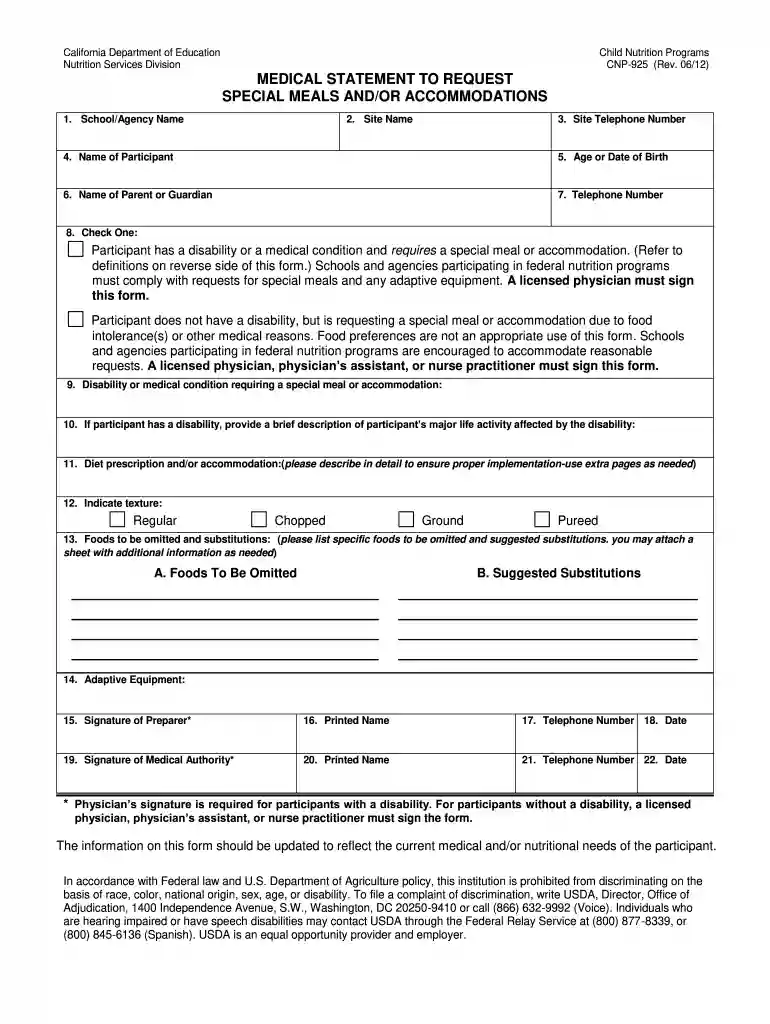
The "medical statement to request special meals andor accommodations cnp form" is a crucial document designed by the California Department of Education's Nutrition Services Division. This form is used to formally request special meals or accommodations for individuals with disabilities or specific medical needs. It holds significant importance because it ensures compliance with federal nutrition program regulations, thereby helping accommodate dietary needs appropriately.
- Purpose: To adjust meal plans or environments for individuals requiring specific dietary considerations due to medical reasons.
- Scope: Applicable primarily within educational settings or institutions where federal nutrition programs are in place.
- Compliance: Emphasizes adherence to non-discrimination policies, ensuring that individuals with dietary restrictions receive necessary accommodations.
Key Elements of the Form
The form contains several essential elements that ensure comprehensive coverage and clarity:
- Participant Details: Includes the personal information of the individual requiring accommodations.
- Medical Conditions: Specific information regarding the participant's medical condition that necessitates dietary modifications.
- Dietary Needs: Detailed description of the specific dietary needs or restrictions.
- Medical Authority Signature: Requires a signature from a qualified medical professional to validate the necessity for special accommodations.
- Legal and Compliance Statements: Statements that affirm compliance with relevant federal and state regulations.
How to Use the Form
Utilizing the form effectively involves several steps to ensure all necessary information is captured accurately:
- Acquire the Form: Obtain the form through the appropriate channels, such as the California Department of Education or through educational institutions.
- Fill in Participant Information: Provide detailed information about the participant requiring special meals or accommodations.
- Consult with a Medical Professional: Have a qualified medical professional evaluate the medical condition and necessity for special accommodations.
- Include Dietary Requirements: Clearly state the specific dietary needs as outlined by the medical professional.
- Authorization: Ensure the form is signed by the medical authority to legally authorize the request.
- Submission: Submit the completed form to the pertinent educational institution or agency responsible for meal programs.
Steps to Complete the Form
Completing the "medical statement to request special meals andor accommodations cnp form" involves a systematic process:
- Personal Information Section:
- Fill out the participant's personal information including name, age, and educational institution.
- Medical Details:
- Provide detailed medical information related to the participant’s condition.
- Dietary Accommodation Requests:
- Clearly outline the required meal modifications or accommodations.
- Verification and Signature:
- Obtain and include the medical professional’s signature to validate the request.
- Review:
- Double-check all entries for accuracy and completeness before submission.
Who Typically Uses the Form
The form is utilized by various individuals and entities to ensure proper dietary accommodations:

- Parents and Guardians: Primarily used by parents or guardians of children who require special dietary accommodations in schools.
- Educational Institutions: Schools and universities use the form to comply with federal nutrition programs.
- Healthcare Providers: Medical professionals who assess dietary needs and authorize the required accommodations.
- Administrators of Federal Nutrition Programs: Personnel responsible for overseeing compliance with these programs.
Legal Use of the Form
The legal significance of the form lies in its endorsement of federally-regulated dietary accommodations:
- Compliance: Ensures that accommodations meet the standards set by federal and state regulations, avoiding discrimination against individuals with special dietary needs.
- Documentation: Acts as formal documentation of the participant’s medical and dietary needs, providing evidence in case of inquiries or audits.
State-Specific Rules
While the form is primarily issued by California, understanding state-specific rules is essential:
- California Regulations: Aligns with California’s Department of Education policies on nutrition and non-discrimination.
- Differences in Application: While the structure of the form might be consistent, specific rules may vary slightly with different interpretations by other states.
Form Submission Methods
There are several methods available for form submission, ensuring flexibility and accessibility:
- Online Submission:
- Many institutions allow for digital submission through designated platforms like DocHub.
- Mail Submission:
- Completed forms can be mailed to the designated address provided by the educational institution.
- In-Person Submission:
- Direct submission at the institution’s administration office for immediate processing.
Required Documents
Certain documents are necessary to complete the submission effectively:
- Medical Records: Supporting documents from medical professionals outlining the participant’s condition.
- Identification Proof: Official identification to confirm the participant's identity.
- Previous Accommodation Requests: Any previously submitted requests for similar accommodations that may provide additional context.
Digital vs. Paper Version
Understanding the difference between digital and paper versions is crucial for efficient processing:
- Digital Version:
- Offers ease of access and submission, widely accepted by many institutions.
- Enables quick updates and revision tracking through platforms like DocHub.
- Paper Version:
- Traditional method, still common in areas with limited digital access.
- Requires physical handling and submission, which may take longer to process.
These sections provide an in-depth understanding of the function and use of the "medical statement to request special meals andor accommodations cnp form," ensuring clarity and compliance with relevant laws and nutritional guidelines.