




01. Edit your civil cover sheet online
Type text, add images, blackout confidential details, add comments, highlights and more.

Type text, add images, blackout confidential details, add comments, highlights and more.

Draw your signature, type it, upload its image, or use your mobile device as a signature pad.

Send it via email, link, or fax. You can also download it, export it or print it out.
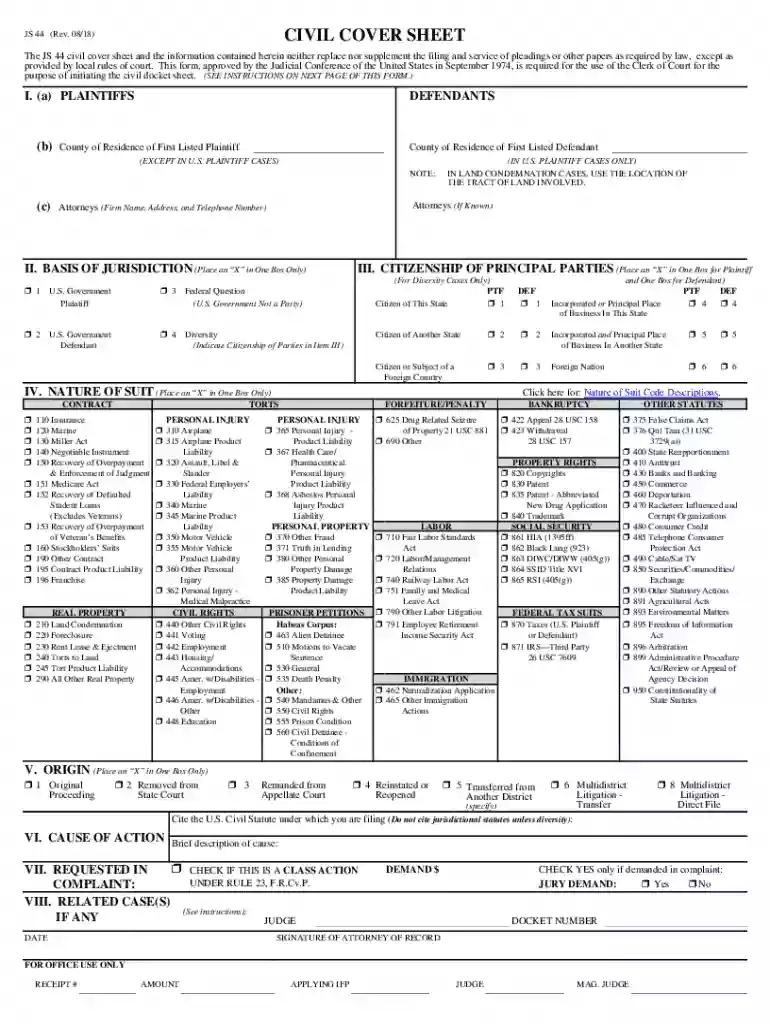
The 2018 JS 44, formally known as the Civil Cover Sheet (JS 44), is a document used in U.S. federal courts to initiate a civil docket sheet. This form serves as a crucial tool for providing the court with necessary information about a civil case. It outlines details such as the parties involved, the nature of the lawsuit, and the basis for jurisdiction, ensuring that cases are processed efficiently and accurately. By standardizing the information required for filing, the JS 44 facilitates a more organized and streamlined case management process within the judicial system.
To efficiently use the 2018 JS 44, familiarity with its sections is essential. Primarily, you will need to gather comprehensive details about the case, including:
These components ensure that the initial filing accurately reflects the case specifics, enabling the court to assign appropriate resources and judges.
Filling out the JS 44 requires attention to detail. Follow these steps for completion:
Each section must be fully completed to avoid processing delays or errors in case registration.
This form is predominantly used by attorneys when filing civil complaints in federal court. However, self-represented plaintiffs might also use it. Legal professionals rely on this document to communicate vital case information to the court, setting the groundwork for legal proceedings. By accurately detailing all necessary case elements, attorneys assist the court in managing and prioritizing cases efficiently.


Understanding the core elements of the 2018 JS 44 helps in its accurate completion:
These elements form the backbone of the civil cover sheet, each contributing to the form's purpose of case organization.
The legal application of the JS 44 lies in its vital role during the case filing process. It is a required document that accompanies the complaint or petition initiating a lawsuit. By providing a systematic approach to collecting case information, it ensures compliance with federal court requirements and aids in the preliminary case evaluation.
Consider a corporation filing a breach of contract lawsuit against another company in federal court. The attorney uses the JS 44 to detail each party's contact information, checks the appropriate jurisdiction box for diversity of citizenship, and selects the contract category under the nature of suit. Through this process, the JS 44 sets the stage for all subsequent legal actions and documentation.
Submitting the 2018 JS 44 can be accomplished through:
It is advisable to confirm specific court protocols, as procedures and requirements can vary between districts.
While the JS 44 is a standardized form, variations or updates, such as the 2018 version, might incorporate minor procedural adjustments reflecting legislative changes or administrative updates. Attorneys should ensure they use the latest version available to ensure compliance with current standards and to facilitate seamless processing within the judicial system.
We've got more versions of the civil cover sheet form. Select the right civil cover sheet version from the list and start editing it straight away!
At DocHub, your data security is our priority. We follow HIPAA, SOC2, GDPR, and other standards, so you can work on your documents with confidence.
Oct 18, 2018 The JS-44 civil cover sheet and the information contained herein neither replaces nor supplements the filings and services of pleadings or other
Defining the reasonableness standard of duty to search. Generally. Agencies have a duty to liberally construe FOIA requests to ensure responsive records are


