




01. Edit your form js 44 online
Type text, add images, blackout confidential details, add comments, highlights and more.

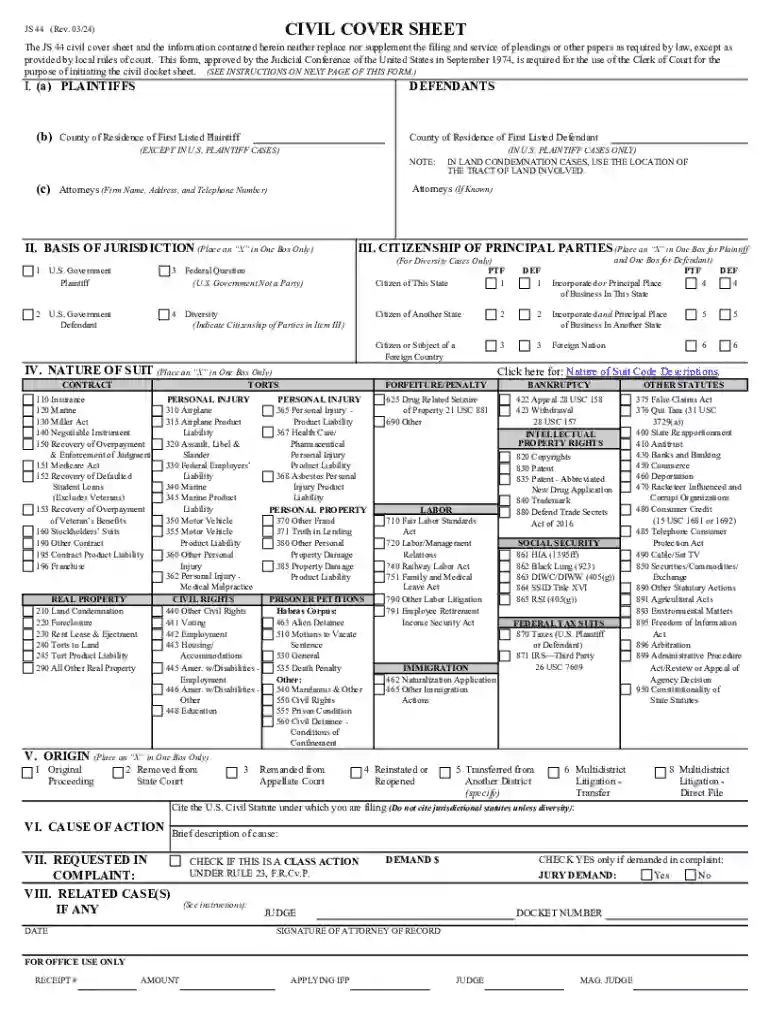
Type text, add images, blackout confidential details, add comments, highlights and more.

Draw your signature, type it, upload its image, or use your mobile device as a signature pad.

Send it via email, link, or fax. You can also download it, export it or print it out.
The JS-44 Civil Cover Sheet is a form used in U.S. federal courts to initiate a civil docket sheet. Its primary purpose is to provide basic information about a civil case, including the parties involved, the jurisdiction, and the nature of the suit. This sheet helps the court manage and track the case effectively. For attorneys, understanding its components is essential as it sets the groundwork for civil complaints, directly influencing how cases are processed and categorized by the court system.
To use the JS-44 Civil Cover Sheet properly, an attorney or plaintiff must fill it out accurately to ensure that all required information is provided to the court. This includes details about the plaintiffs and defendants, case jurisdiction, nature of the suit, and the cause of action. By following instructions precisely, legal professionals can avoid delays in case processing. It's important to review each section of the form care, check for completeness, and ensure that all data is current and accurate to prevent administrative setbacks.
Attention to each step ensures compliance with court filing requirements and assists in the correct categorization of the case.
Familiarity with these terms ensures effective communication and understanding of the form's requirements.
Several key elements define the JS-44:
Each element plays a crucial role in correctly framing the legal proceedings within the federal court system.
The legal use of the JS-44 Civil Cover Sheet is mandated in federal civil litigation to ensure transparent and organized case filing. This form aids in administrative and legal reporting requirements and facilitates efficient court system operations. It is not merely procedural—it is integral to standardizing civil case processing, ensuring legal parties have appropriate and uniform methods for initiating legal actions requiring federal court intervention.
Consider a scenario where a corporation sues another business over a breach of contract. Here, the JS-44 form would be used to file the case, indicating the federal district's jurisdictional basis, selecting "Contract" under the nature of suit, and detailing the legal cause of action. Another example includes individual plaintiffs filing a civil rights violation lawsuit, requiring this form to highlight the federal question under U.S. Civil Rights laws.
These varied practical applications highlight the form's versatility in handling diverse legal matters.
Filing the JS-44 Civil Cover Sheet can be done through several methods:
Selecting the right submission method depends on the court's capabilities and the filer's preference, impacting the filing process's speed and convenience.
The primary users of the JS-44 Civil Cover Sheet are attorneys representing clients in federal court cases, although pro se litigants—individuals representing themselves—may also use it. This document is critical for plaintiffs initiating new lawsuits, helping to outline case fundamentals and assist in situating the legal action within the federal system appropriately.
Understanding the user demographics aids in appreciating the JS-44's design as a tool tailored for legal professionals and self-represented parties.


We've got more versions of the form js 44 form. Select the right form js 44 version from the list and start editing it straight away!
At DocHub, your data security is our priority. We follow HIPAA, SOC2, GDPR, and other standards, so you can work on your documents with confidence.
The JS 44 civil cover. This form, approved by the Judicial Conference of the is required for the use of the Clerk of Court for the purpose of initiating the
by VICOF ACTION This section of the JS 44 is used to reference related pending cases if any. If there are related pending cases, insert the docket numbers and the correspondingRead more


