




01. Edit your form online
Type text, add images, blackout confidential details, add comments, highlights and more.

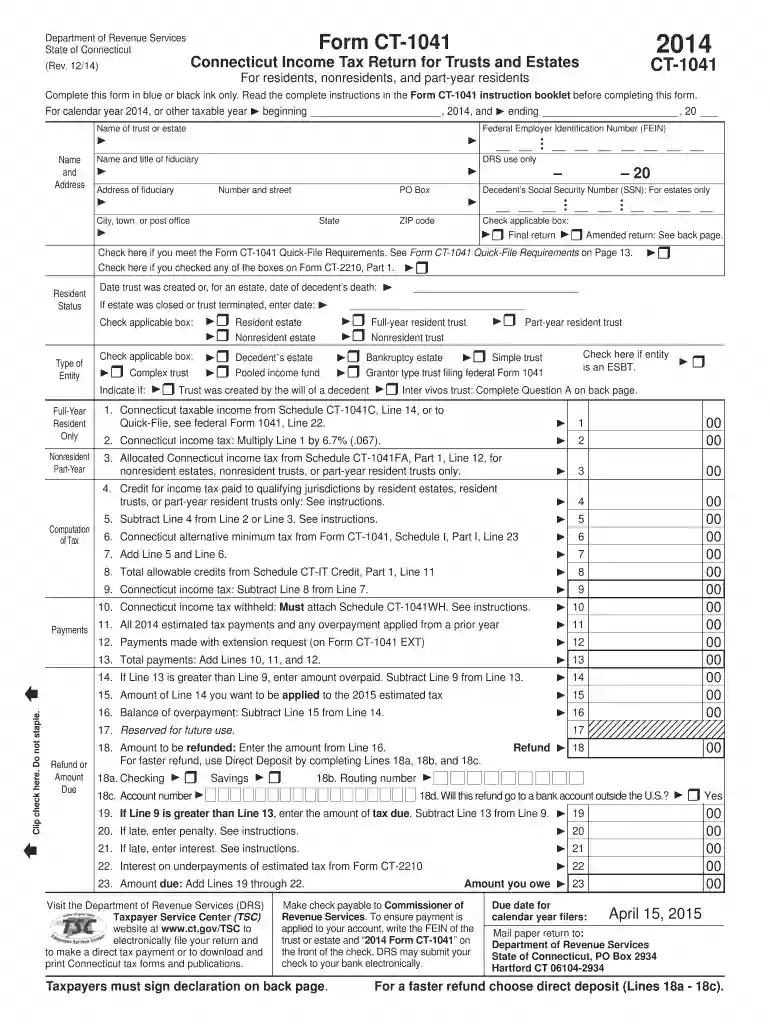
Type text, add images, blackout confidential details, add comments, highlights and more.

Draw your signature, type it, upload its image, or use your mobile device as a signature pad.

Send it via email, link, or fax. You can also download it, export it or print it out.
Form CT-1041ES, also known as the Connecticut Estimated Income Tax Payment Form for Fiduciaries, is used by trustees and executors to report and pay estimated income tax on behalf of estates and trusts in Connecticut. This form is essential for fiduciaries who manage income-generating assets, ensuring taxes are prepaid for anticipated earnings within the fiscal year.
Trusts and estates often have income sources such as dividends, interest, or capital gains, and these earnings must be declared for state tax purposes. By utilizing Form CT-1041ES, fiduciaries can effectively plan for and distribute tax liabilities, mitigating risks of underpayment and associated penalties.
Calculate Estimated Tax: Determine the anticipated income for the trust or estate within the tax year, including dividends, interest, and any other earnings subject to Connecticut state tax.
Complete the Form: Input the calculated estimated tax amount into the appropriate sections of Form CT-1041ES. Ensure all relevant information, such as fiduciary and beneficiary details, is accurately recorded.
Determine Payment Schedule: Payments are typically required in quarterly installments. Calculate when each payment is due based on Connecticut state tax guidelines.
Submit Payments on Time: Use the form to remit payments through the appropriate method, such as mail or electronic submission, to avoid late charges.
Online Access: Form CT-1041ES is downloadable via the Connecticut Department of Revenue Services (DRS) website. This digital availability ensures easy access and the ability to print or fill out electronically.
Mail Request: Fiduciaries may request a paper version by contacting the Connecticut DRS directly, though utilizing the online option can expedite the process.
Input General Information: Include the fiduciary's name, address, and identification number, plus details of the trust or estate.
Estimate Taxable Income: Assess all likely sources of income and correspond them with state tax rates.
Calculate Estimated Taxes Owed: Use current year's tax tables to determine exact amounts expected to be paid.
Input Payment Amounts: Clearly state the amount of each payment intended for quarterly submission on the form.
Review and Finalize: Double-check all entries for accuracy and accounting before submission.
Fiduciaries: Individuals acting as fiduciaries for trusts or estates, including executors and trustees, responsible for managing and reporting taxable income to ensure compliance with Connecticut tax codes.
Financial Advisors and Tax Preparers: Professionals assisting fiduciaries with estate management and tax responsibilities often prepare and submit Form CT-1041ES on their behalf.
Connecticut requires all agencies responsible for estate or trust assets to submit estimated tax payments when anticipated income exceeds state exemption levels. Texas law disallows using this form for state waivers or exemptions unrelated to income estimates.
Failure to file or pay on time can result in significant penalties, including interest fees based on unpaid amounts. Connecticut DRS imposes these to encourage timely compliance and accurate tax reporting.
Financial Statements: Documentation of all income received by the estate or trust.
Previous Tax Returns: If applicable, previous returns are necessary for continuity in reporting income trends.
Online Filing: Form CT-1041ES can be submitted electronically via state-approved platforms.
Postal Mail: Payments and forms can be mailed directly to the Connecticut DRS, though timely mailing is critical to ensure deadlines are met.
Fiduciaries may utilize specific software, such as TurboTax or QuickBooks, tailored for completing tax forms, streamlining calculations, and ensuring data accuracy. This software enhances efficiency by providing dedicated modules for state-specific forms, including Form CT-1041ES.
We've got more versions of the Form CT-1041ES 4 Form CT-1041ES form. Select the right Form CT-1041ES 4 Form CT-1041ES version from the list and start editing it straight away!
| Versions | Form popularity | Fillable & printable |
|---|---|---|
| 2025 | 4.9 Satisfied (60 Votes) | |
| 2024 | 4.5 Satisfied (57 Votes) | |
| 2023 | 4.2 Satisfied (54 Votes) | |
| 2022 | 4.7 Satisfied (46 Votes) | |
| 2021 | 4.9 Satisfied (24 Votes) | |
| 2020 | 4.4 Satisfied (115 Votes) | |
| 2019 | 4.3 Satisfied (104 Votes) | |
| 2018 | 4.3 Satisfied (81 Votes) | |
| 2017 | 4.4 Satisfied (113 Votes) | |
| 2016 | 4.3 Satisfied (363 Votes) | |
| 2015 | 4.4 Satisfied (40 Votes) | |
| 2014 | 4.1 Satisfied (59 Votes) | |
| 2013 | 4.3 Satisfied (27 Votes) | |
| 2011 | 4.3 Satisfied (35 Votes) |
At DocHub, your data security is our priority. We follow HIPAA, SOC2, GDPR, and other standards, so you can work on your documents with confidence.
State of Connecticut. PO Box 2934. Hartford CT 06104‑2934. Form CT‑1041ES ‑ Tax Payment Coupon Instructions. Complete this form in blue or black ink only. SeeRead more
Form 1041 must have an EIN. To apply for one, use Form SS-4. Form SS-4 has information on how to apply for an EIN by mail or by telephone. If the estate or


