




01. Edit your form online
Type text, add images, blackout confidential details, add comments, highlights and more.

Type text, add images, blackout confidential details, add comments, highlights and more.

Draw your signature, type it, upload its image, or use your mobile device as a signature pad.

Send it via email, link, or fax. You can also download it, export it or print it out.
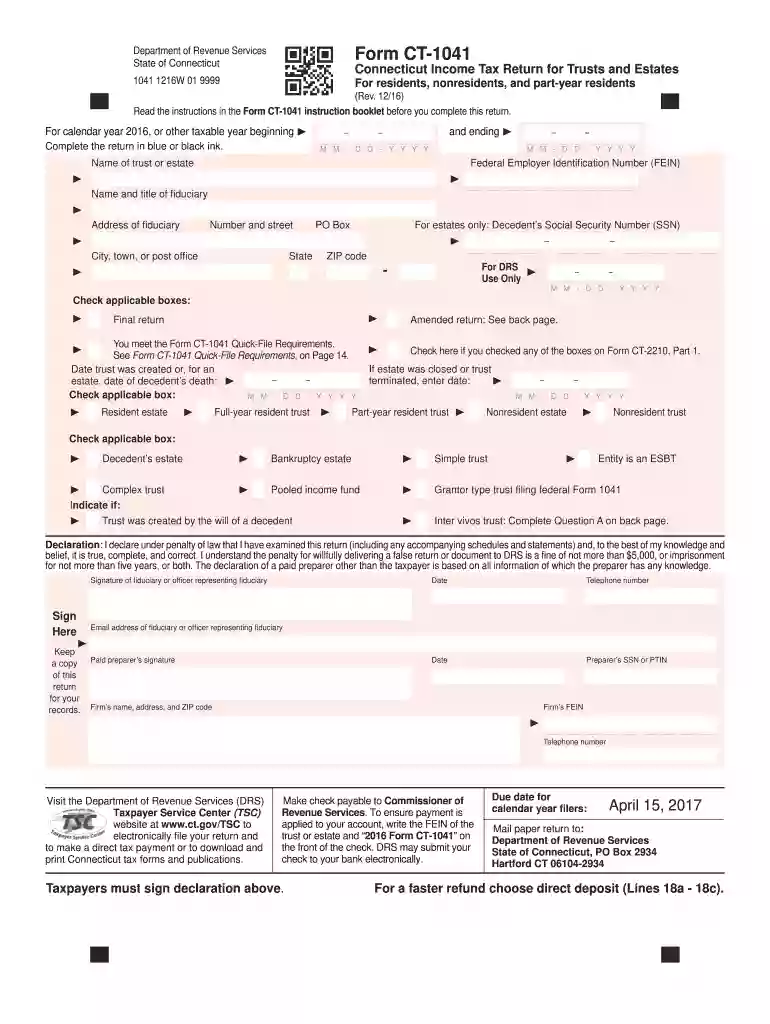
The Connecticut Income Tax Return Form CT-1041 for the year 2016 is a critical document used by fiduciaries, such as trustees or executors, to report income, deductions, and credits for trusts and estates. It applies to residents, nonresidents, and part-year residents. The form is designed to comply with state-specific tax regulations and requires comprehensive information about the trust or estate in question. By understanding the form's purpose, fiduciaries can ensure accurate reporting and compliance with Connecticut tax obligations.
Using the CT- form requires careful attention to detail. Fiduciaries must collect all relevant financial information pertaining to the trust or estate. This includes income from various sources such as dividends, interest, and capital gains. Additionally, any deductions, credits, and specific exemptions should be identified and appropriately documented. The form requires calculations for determining the taxable income and the resultant tax obligation, ensuring that all fiduciary responsibilities are met according to state laws.
Fiduciaries can obtain the CT- form through various channels. Most commonly, the form is available online through the Connecticut Department of Revenue Services website. Additionally, printed copies can be requested via mail or picked up at local tax offices. Ensuring the form is sourced from official avenues maintains the validity and reliability needed for compliant tax filing.
Completing the form involves a series of structured steps that guide fiduciaries in reporting necessary financial information. Starting with a review of all income documents, fiduciaries must transcribe this data into relevant sections of the form. Additional steps involve detailing any adjustments or credits claimed, followed by a series of calculations to establish the final tax obligation. Ensuring each step is followed meticulously aids in the accurate completion of the document.
Understanding key terms related to the CT-1041 form enhances accuracy and compliance:
Timely completion and filing of the CT- form are critical to avoid penalties. For the 2016 tax year, the standard deadline is April 15, 2017. Extensions can be requested but must be submitted before the original deadline. Failure to comply with these timelines results in interest charges or additional fees, emphasizing the importance of adhering to all specified due dates.
Non-compliance with filing the CT- form can result in significant penalties. These may include late filing and late payment penalties, along with accruing interest on unpaid taxes. To mitigate these risks, fiduciaries must ensure timely and accurate submissions. Understanding the consequences of non-compliance encourages proactive management and filing.
For convenience, the CT- form can be filed in both digital and paper formats. The digital version allows for online submission, which is often quicker and reduces the risk of errors due to the system's checks and balances. The paper version remains available for those who prefer traditional filing methods or lack access to digital resources. Each method ensures the same legal compliance and reporting requirements are met.
Understanding the key elements of the CT-1041 form fosters efficient and accurate filing:
By adhering to the above guidelines, users can ensure comprehensive compliance with Connecticut tax laws. Each aspect of the form requires detailed attention to promote accuracy in reporting and fulfill all fiduciary duties effectively.
We've got more versions of the ct 1041 2016 form form. Select the right ct 1041 2016 form version from the list and start editing it straight away!
| Versions | Form popularity | Fillable & printable |
|---|---|---|
| 2025 | 4.9 Satisfied (60 Votes) | |
| 2024 | 4.5 Satisfied (57 Votes) | |
| 2023 | 4.2 Satisfied (54 Votes) | |
| 2022 | 4.7 Satisfied (46 Votes) | |
| 2021 | 4.9 Satisfied (24 Votes) | |
| 2020 | 4.4 Satisfied (115 Votes) | |
| 2019 | 4.3 Satisfied (104 Votes) | |
| 2018 | 4.3 Satisfied (81 Votes) | |
| 2017 | 4.4 Satisfied (113 Votes) | |
| 2016 | 4.3 Satisfied (363 Votes) | |
| 2015 | 4.4 Satisfied (40 Votes) | |
| 2014 | 4.1 Satisfied (59 Votes) | |
| 2013 | 4.3 Satisfied (27 Votes) | |
| 2011 | 4.3 Satisfied (35 Votes) |
At DocHub, your data security is our priority. We follow HIPAA, SOC2, GDPR, and other standards, so you can work on your documents with confidence.
Jul 1, 2020 candidate summary form as provided by the Employer. This candidate summary form shall be filed by a tenured 2016 June 30, 2021.Read more
N/A. CT-1041. Income Tax Return for Trusts and Estates - RETURN. 12/2016. N/A. CT-1041V. 2016 Connecticut Electronic Filing Payment Voucher. 12/2016.Read more


