




01. Edit your form online
Type text, add images, blackout confidential details, add comments, highlights and more.

Type text, add images, blackout confidential details, add comments, highlights and more.

Draw your signature, type it, upload its image, or use your mobile device as a signature pad.

Send it via email, link, or fax. You can also download it, export it or print it out.
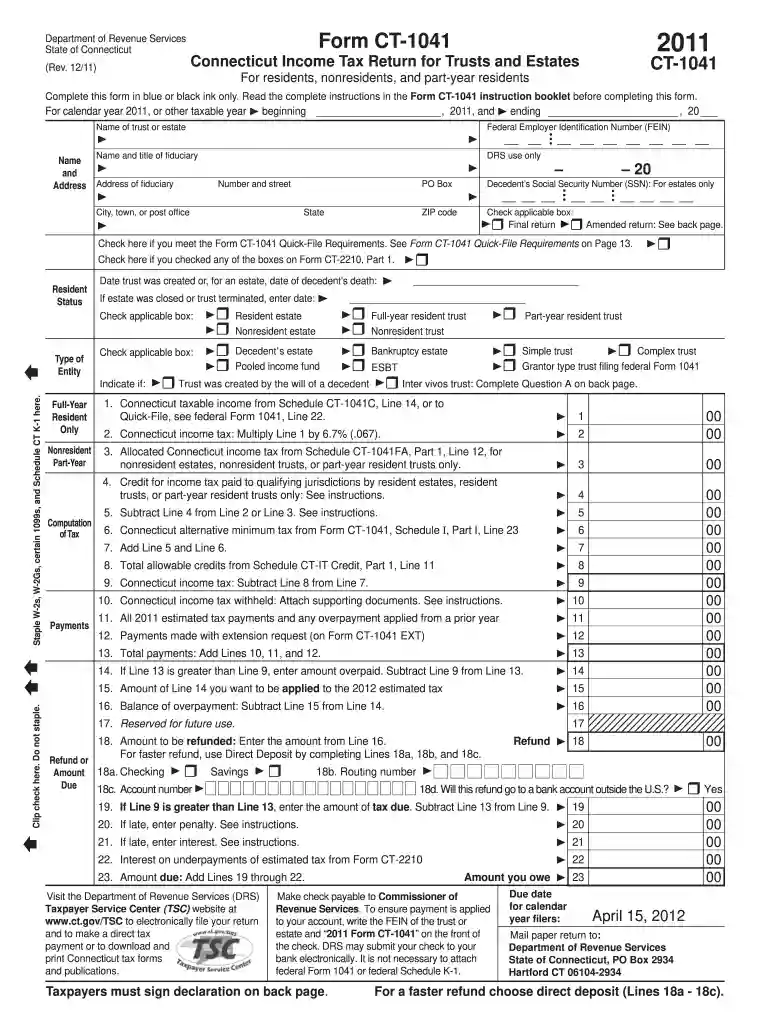
Trust and estate forms from CT.gov, such as the Connecticut Income Tax Return for Trusts and Estates (Form CT-1041), are essential documents used to report income tax for trusts and estates in Connecticut. These forms include sections for taxpayer information, income computation, tax calculations, payments, refunds, and required attachments. The purpose is to ensure accurate tax reporting and compliance with Connecticut tax laws for entities managing a deceased person's estate or functioning for the benefit of beneficiaries. Trust and estate forms are typically submitted by fiduciaries, including executors or administrators handling estate affairs.
Obtain the correct form: Start by downloading the Connecticut Trust and Estate forms, such as Form CT-1041, from the official CT.gov website. Ensure it is the latest version for the relevant tax year.
Fill in taxpayer details: Enter the trust or estate’s name, federal employer identification number (FEIN), and any other relevant contact information on the designated sections.
Compute income: Calculate all taxable income the trust or estate earned during the year. This could include dividends, interest, or other income types specified in the form instructions.
Determine deductions: Review applicable deductions and credits, and fill in these sections to reduce taxable income. Common deductions may include administrative expenses or fees related to managing the estate.
Calculate taxes due: Use the form instructions to compute the estate or trust's tax liability based on taxable income and deductions.
Attach necessary documentation: Include relevant documentation such as attachment schedules or supporting evidence required to substantiate claims on income or deductions.
Sign and submit: Ensure the form is signed by the fiduciary and submit it by the April 15 deadline, mid-April. Forms can be mailed or submitted electronically, depending on CT.gov's available submission methods.
Forms like the CT-1041 can be accessed directly from the Connecticut Department of Revenue Services' website. You can download the forms as fillable PDFs or request a paper form by mail if preferred. Ensure you're using the version applicable to the specific tax year you're reporting for, as requirements may change annually.
Connecticut's tax laws and regulations may differ from other states. Fiduciaries must ensure familiarity with specific state requirements that govern how trust and estate income is reported:
Connecticut's rules stipulate April 15 as the deadline for filing returns like the CT-1041. If this date falls on a weekend or public holiday, the due date may be extended to the next business day. Extensions may also be requested if additional time is needed to file returns, though any taxes owed must still be paid by the original deadline to avoid penalties.
Failure to comply with filing requirements or deadlines can result in significant penalties:
Understanding these implications underscores the importance of timely and accurate form submissions.
We've got more versions of the Trust and Estate forms - CT.gov form. Select the right Trust and Estate forms - CT.gov version from the list and start editing it straight away!
| Versions | Form popularity | Fillable & printable |
|---|---|---|
| 2025 | 4.9 Satisfied (60 Votes) | |
| 2024 | 4.5 Satisfied (57 Votes) | |
| 2023 | 4.2 Satisfied (54 Votes) | |
| 2022 | 4.7 Satisfied (46 Votes) | |
| 2021 | 4.9 Satisfied (24 Votes) | |
| 2020 | 4.4 Satisfied (115 Votes) | |
| 2019 | 4.3 Satisfied (104 Votes) | |
| 2018 | 4.3 Satisfied (81 Votes) | |
| 2017 | 4.4 Satisfied (113 Votes) | |
| 2016 | 4.3 Satisfied (363 Votes) | |
| 2015 | 4.4 Satisfied (40 Votes) | |
| 2014 | 4.1 Satisfied (59 Votes) | |
| 2013 | 4.3 Satisfied (27 Votes) | |
| 2011 | 4.3 Satisfied (35 Votes) |
At DocHub, your data security is our priority. We follow HIPAA, SOC2, GDPR, and other standards, so you can work on your documents with confidence.
The fate of nitrate is complex and includes several physical and biological processes of which denitrification plays a major role. There are four major forms ofRead more
Name, Description, Revised Date. CT-1041, 2025 Connecticut Income Tax Return for Trusts and Estates -INSTRUCTIONS, 12/2025. CT-1041, 2025 Income Tax ReturnRead more
Income) and your total net assets are less than $75,000 (see Section IV. Assets). Otherwise, use the long version, form JD-FM-6-LONG. Docket number.Read more


