




01. Edit your form online
Type text, add images, blackout confidential details, add comments, highlights and more.

Type text, add images, blackout confidential details, add comments, highlights and more.

Draw your signature, type it, upload its image, or use your mobile device as a signature pad.

Send it via email, link, or fax. You can also download it, export it or print it out.
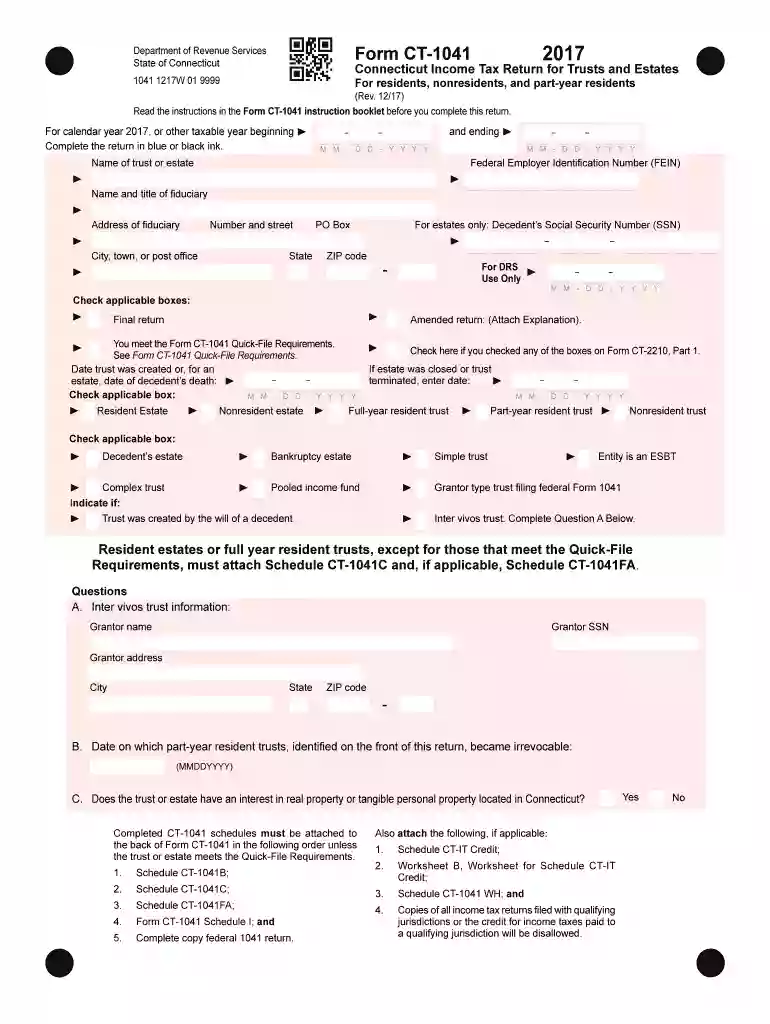
The Form CT-1041, also referred to in full as the Connecticut Income Tax Return for Trusts and Estates, is a tax document utilized specifically for reporting income earned by these entities within the state. This form is essential for ensuring that trusts and estates comply with state tax obligations, calculating the fiduciary income tax, and declaring any credits or deductions. It is applicable to both resident and nonresident trusts and estates with income sourced from Connecticut.
To effectively use Form CT-1041 for the 2017 tax year, begin by gathering all pertinent financial documents related to the trust or estate, including income statements and records of deductions. The form consists of several sections that require input of detailed information concerning the trust's or estate's income, deductions, credits, and fiduciary declarations. Ensure accuracy in each entry to avoid potential auditing. Use the instruction manual provided with the form for guidance on specific entries.
The 2015 Form CT-1041 for filing in the 2017 tax year can be acquired through several channels. You can download it directly from the Connecticut Department of Revenue Services' official website. Alternatively, physical copies are often available at libraries or government offices. Additionally, tax preparation software may offer downloadable versions of the form compatible with digital filing.
The form is composed of several elements:
Form CT-1041 is typically used by fiduciaries of trusts or estates, including executors or administrators. These individuals are responsible for filing taxes on behalf of the trust or estate. It is particularly relevant for entities receiving income within Connecticut and those subject to its taxation regulations. Both resident and nonresident trusts and estates must comply, depending on income source.


When filing the 2015 Form CT-1041, gather:
Ensuring these documents are in hand will streamline the filing process and aid in accurate form completion.
The deadline for filing Form CT-1041 typically coincides with the federal tax deadline, around April 15. However, it is crucial to verify specific Connecticut state deadlines for that tax year, as form instructions may outline extensions or specific conditions under which deadlines may vary. Late submissions can result in penalties.
We've got more versions of the 2015 form ct 1041 2017 form. Select the right 2015 form ct 1041 2017 version from the list and start editing it straight away!
| Versions | Form popularity | Fillable & printable |
|---|---|---|
| 2025 | 4.9 Satisfied (60 Votes) | |
| 2024 | 4.5 Satisfied (57 Votes) | |
| 2023 | 4.2 Satisfied (54 Votes) | |
| 2022 | 4.7 Satisfied (46 Votes) | |
| 2021 | 4.9 Satisfied (24 Votes) | |
| 2020 | 4.4 Satisfied (115 Votes) | |
| 2019 | 4.3 Satisfied (104 Votes) | |
| 2018 | 4.3 Satisfied (81 Votes) | |
| 2017 | 4.4 Satisfied (113 Votes) | |
| 2016 | 4.3 Satisfied (363 Votes) | |
| 2015 | 4.4 Satisfied (40 Votes) | |
| 2014 | 4.1 Satisfied (59 Votes) | |
| 2013 | 4.3 Satisfied (27 Votes) | |
| 2011 | 4.3 Satisfied (35 Votes) |
At DocHub, your data security is our priority. We follow HIPAA, SOC2, GDPR, and other standards, so you can work on your documents with confidence.
Your 2015 Federal Return of Organization Exempt from Income Tax will be electronically filed with the Internal Revenue Service upon receipt of a signed FormRead more
The 2017 Form CT-1041 may be used for a taxable year beginning in 2018 if: 1. The trust or estate has a taxable year of less than 12 months that begins and endsRead more
May 5, 2017 Respondents should be aware that notwithstanding any other provision of law, no person shall be subject to any penalty for failing to complyRead more


