




01. Edit your how to fill out declaration of gross vehicle weight online
Type text, add images, blackout confidential details, add comments, highlights and more.

Type text, add images, blackout confidential details, add comments, highlights and more.

Draw your signature, type it, upload its image, or use your mobile device as a signature pad.

Send ca dmv weight declaration form via email, link, or fax. You can also download it, export it or print it out.
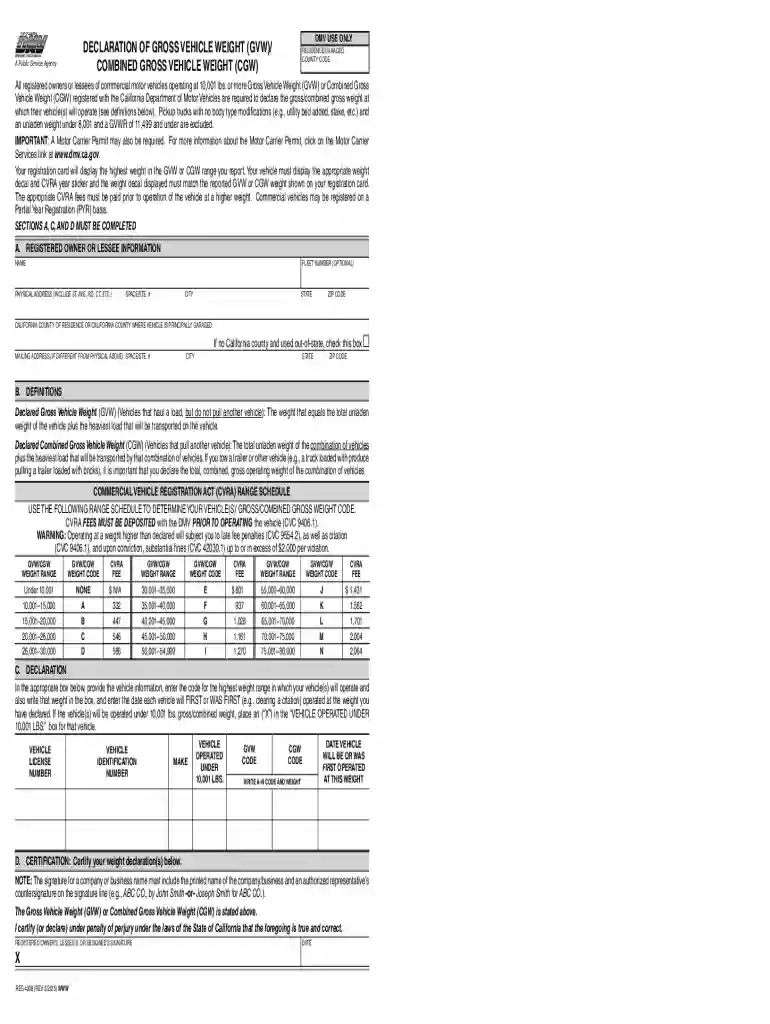
The Declaration of Gross Vehicle Weight form is a document issued by the California Department of Motor Vehicles (DMV) designed for registered owners or lessees of commercial motor vehicles. This form is necessary for vehicles, including trucks, buses, and trailers, operating at a Gross Vehicle Weight (GVW) or Combined Gross Vehicle Weight (CGW) of 10,001 lbs. or more. It serves a dual purpose: to officially declare the weight of the vehicle and to determine the appropriate registration fees based on the weight class. Filling out this form correctly is crucial for compliance with state regulations and for maintaining the legality of vehicle operations.
To successfully use the declaration of gross vehicle weight form, the vehicle owner must accurately assess their vehicle's weight and ensure all required sections are completed. Start by gathering accurate information about the vehicle's GVW or CGW by referring to manufacturing specifications or conducting weigh-ins. Make sure to fill in the owner information, vehicle details, and any other required sections meticulously. This ensures accurate data submission, which is essential for compliance and fair registration fee calculation.
Gathering the required documents before starting the form will streamline the process and reduce errors. Required documents typically include the vehicle's registration, weight certification (such as scale tickets if applicable), insurance documents, and any previous Gross Vehicle Weight declarations if available. These documents serve as proof and help verify accurate entries on the form.
Download or Obtain the Form: Access the form online through the DMV website or pick one up at a local DMV office.
Fill Out Owner Information: Begin by completing the section for owner or lessee details with accurate personal and contact information.
Enter Vehicle Specifications: Provide detailed information about the vehicle, including its make, model, year, and VIN.
Declare Vehicle Weight: Carefully enter the GVW or CGW, ensuring it corresponds with official weight measurements.
Attach Supporting Documents: Collect and attach all necessary documents, such as previous declarations or weight certificates.
Submit the Form: Choose a submission method—online, mail, or in-person—to send your completed form to the DMV. Ensure you adhere to any deadlines or provide additional documents if requested.
Understanding key terms related to vehicle weight can aid in accurately completing the form:
The declaration form holds legal significance as it influences the registration fees and ensures compliance with state weight limits. Misrepresentation, either intentional or accidental, can result in penalties, fines, or revocation of registration. Thus, the accuracy of the provided information is legally binding and essential.
Failure to accurately complete and submit the vehicle weight declaration can incur substantial penalties, including fines, increased registration fees, or suspension of the vehicle's registration. It is essential to adhere to all instructions and verify all entries to avoid these consequences.
The DMV provides several methods for submission, including online portals, mail, or in-person delivery at specific DMV offices. Each submission method may have particular requirements or deadlines. Keep track of submission confirmation and potential deadlines to ensure timely compliance and avoid late fees.
We've got more versions of the how to fill out declaration of gross vehicle weight form. Select the right how to fill out declaration of gross vehicle weight version from the list and start editing it straight away!
At DocHub, your data security is our priority. We follow HIPAA, SOC2, GDPR, and other standards, so you can work on your documents with confidence.
(Please see note below.) This diesel powered vehicle has a manufacturers gross vehicle weight rating (GVWR) of more than 8,500 pounds. LICENSE PLATE NUMBER.
Declared GVWThe weight that equals the total unladen weight of the vehicle plus the weight of the heaviest load that will be transported on the vehicle. (
Aug 6, 2012 Figure and pay the tax due on highway motor vehicles used during the period with a taxable gross weight of 55,000 pounds or more. Figure and pay


