







Definition & Meaning
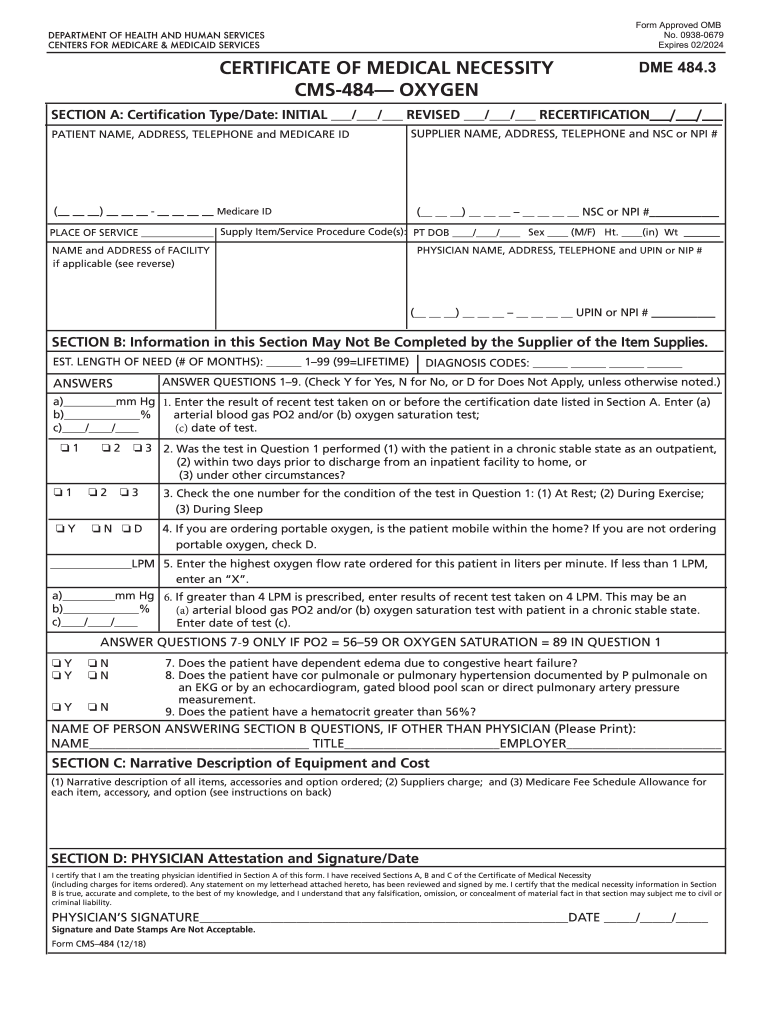
The Certificate of Medical Necessity (CMS-484) is pivotal for patients needing oxygen therapy. Issued by the Centers for Medicare & Medicaid Services, it's a formal document specifying the medical requirements justifying such therapy. Hospitals and healthcare providers use it to determine eligibility and ensure compliance with Medicare's protocols. Understanding this form's purpose is vital for healthcare providers and patients in need of oxygen for medical treatments.
Medical Necessity Criteria
- Patient Diagnosis: The document outlines the medical diagnosis necessitating oxygen therapy.
- Physician's Certification: A licensed physician must attest to the necessity of the prescribed oxygen therapy.
- Supply Details: Information about the type and amount of oxygen supply.
Impact on Patient Care
- Facilitates accurate prescription for medical oxygen.
- Ensures Medicare adherence and reimbursement.
How to Use the Form Medical Necessity Oxygen
To use the Certificate of Medical Necessity for oxygen, healthcare providers fill it to substantiate a patient's need for oxygen therapy. This begins by gathering pertinent patient details and medical records that support the need for such therapy.
Steps for Healthcare Providers
- Patient Evaluation: Conduct a comprehensive assessment to determine oxygen therapy's necessity.
- Document Preparation: Complete the form with patient data, including diagnosis and medical history.
- Physician Involvement: Ensure the attending physician reviews and signs the form.
Practical Tips
- Maintain clear and concise record entries.
- Keep a copy of the completed form for future reference.
Key Elements of the Form Medical Necessity Oxygen
The CMS-484 form includes several critical components, each requiring meticulous attention to detail. Understanding these elements ensures accuracy in completion and compliance with regulatory standards.
Sections and Their Importance
- Patient Information: Full name, Medicare number, and contact details.
- Supplier Information: Details about the oxygen provider.
- Medical Justification: Explanation of the patient's condition and the necessity of oxygen.
- Physician Attestation: Certification section where the physician signs off on the need for therapy.
Critical Data Points
- Include the specific oxygen concentration required.
- Record any associated medical conditions.
Steps to Complete the Form Medical Necessity Oxygen
Completing the CMS-484 form requires attention to the provided instructions to ensure all sections are filled correctly. Accurate completion is critical as errors could delay therapy initiation or reimbursement.
- Collect Necessary Documentation: Gather patient records and diagnostic tests.
- Fill Patient Information: Ensure accuracy in the basic details section.
- Detail Supplier Information: Provide accurate supplier contact and location.
- Describe Medical Necessity: Use precise medical terminology.
- Obtain Physician's Signature: Ensure the attending physician reviews the form and provides a signature.
Tips for Accuracy
- Double-check all entered data against patient records.
- Seek a second review by another healthcare professional.
Who Typically Uses the Form Medical Necessity Oxygen
The primary users include healthcare professionals such as physicians and respiratory therapists who need to document the medical necessity for their patients' oxygen use. Insurance companies and Medicare use this information to process claims appropriately.


Common User Groups
- Doctors: Especially pulmonologists or general practitioners treating respiratory conditions.
- Respiratory Therapists: Specialists involved in developing a patient's oxygen therapy plan.
- Insurance Providers: Entities verifying the justification for residential oxygen supply.
Scenarios
- Elderly patients with Chronic Obstructive Pulmonary Disease (COPD).
- Individuals recovering from hospitalization due to pneumonia.
Legal Use of the Form Medical Necessity Oxygen
Understanding the legal implications of using the CMS-484 form is crucial for healthcare providers. Falsifying information or improper use can lead to significant penalties.
Legal Considerations
- Compliant Documentation: Ensure correct completion of the form to adhere to Medicare regulations.
- Physician Accountability: Physicians are legally responsible for verifying the information.
Compliance Risks
- Potential audits for inconsistencies.
- Medical fraud charges for false information.
Examples of Using the Form Medical Necessity Oxygen
Healthcare providers routinely utilize the CMS-484 in various real-world scenarios to substantiate the need for oxygen therapy.
Case Studies
- COPD Patient: Use of the form to document chronic respiratory failure requiring long-term oxygen.
- Post-Surgical Recovery: Needing supplemental oxygen after major chest surgery for insured care duration.
Additional Use Cases
- Home Health Care: For patients transitioning from hospital to home care.
- Palliative Care: Managing comfort for terminally ill patients with breathing issues.
Eligibility Criteria
To qualify for oxygen therapy under Medicare, certain health conditions and documentation standards must be met, typically verified through the CMS-484 form.

Required Conditions
- Documented hypoxemia substantiated by arterial blood gas levels or pulse oximetry.
- Demonstrated improvement upon oxygen therapy.
Required Documentation
- Recent physician examination notes.
- Diagnostic test results validating low oxygen levels.
Software Compatibility
For effective digital handling, the CMS-484 should be streamlined with compatible software solutions. This eases completion, tracking, and filing.
Recommended Solutions
- DocHub: High compatibility for filling out PDF forms online securely.
- EHR Systems: Electronic Health Record systems that integrate with PDF handling capabilities.
Benefits of Digital Use
- Ensures quick access and sharing.
- Enhances accuracy and minimizes manual entry errors.




