
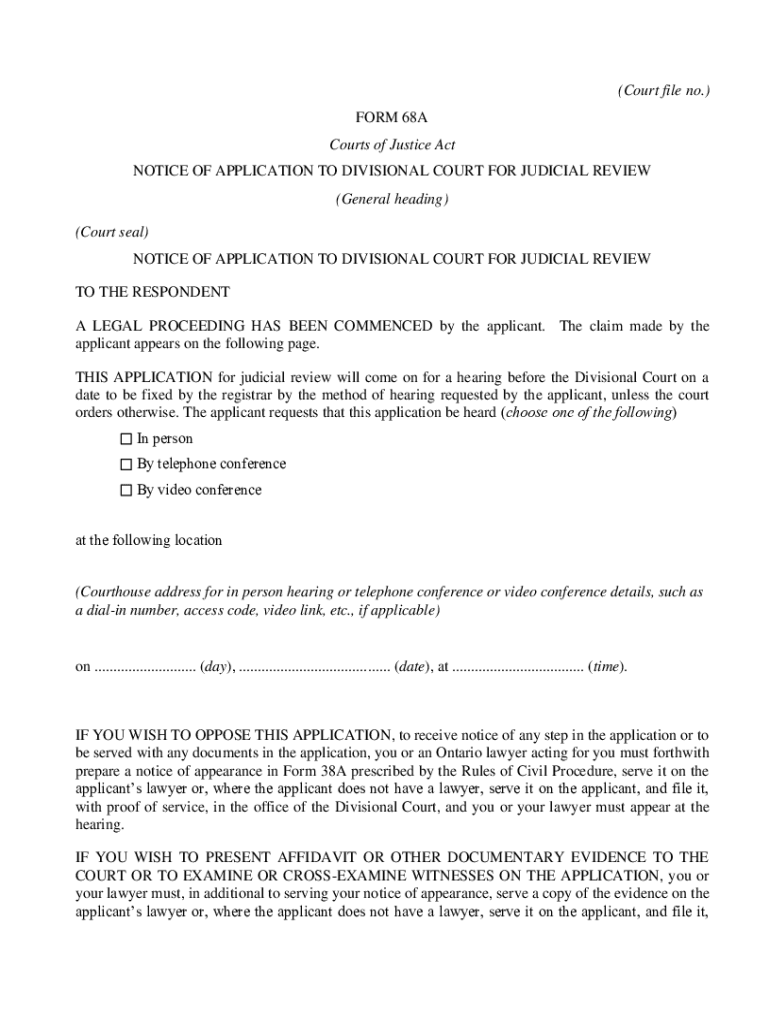







Definition & Meaning
The "FormsUnited States CourtsAn Applicant's Guide to Judicial ReviewHuman Rights Court Forms - MichiganC" is a legal document used primarily within the Michigan jurisdiction for individuals seeking a judicial review. This form is pivotal for applicants who assert that there has been a breach of their judicial rights and wish to challenge a decision made by a lower court. Judicial review allows the upper courts—such as appellate courts—to assess the validity and legality of a court decision, and to determine whether the law has been applied correctly.
Key Functions of the Form
- Initiating a Judicial Review: The form is essential for starting the process of judicial review, providing a measurable way for applicants to challenge prior legal decisions.
- Outlining Arguments: It allows applicants to specify their grievances and the legal grounds on which they believe the decision was flawed or unjust.
How to Use the Form
To effectively use the "FormsUnited States CourtsAn Applicant's Guide to Judicial ReviewHuman Rights Court Forms - MichiganC," applicants must follow a structured approach in filling and submitting it. The process involves several crucial steps to ensure that the form is completed accurately.
-
Complete the Applicant’s Details: Applicants need to fill in personal information accurately, including full names, contact information, and any relevant identifying details.
-
Detail the Court Case: This section requires a clear account of the original court case, including the case number and the exact decision being contested.
-
Specify Grounds for Review: Applicants must articulate the legal reasons for seeking a review, citing specific statutes or precedents that support their position.
Tips for Accurate Completion
- Consult Legal Expertise: Given the complexity of judicial matters, consulting with an attorney can provide valuable guidance in completing the form efficiently.
- Review and Proofread: Double-check all details for accuracy to prevent any delays caused by incomplete or incorrect information.
Steps to Complete the Form
Filling out the form requires meticulous attention to detail and a comprehensive understanding of the legal grounds for judicial review. The form must be completed in alignment with legal standards to stand up to scrutiny in court.
-
Gather All Required Documents: Assemble documentation from the original case, including court opinions, transcripts, and any relevant evidence.
-
Outline the Desired Outcome: Clearly specify what outcome you are seeking from the judicial review—a reversal, a re-trial, or a different ruling.
-
Submit Detailed Legal Arguments: Compose a section highlighting detailed legal arguments that justify the need for review, supported by citations from legal precedents or statutory laws.
Required Documentation
- Court opinion from the lower court
- Evidence presented in the original hearing
- Any new evidence that may have surfaced
Important Terms Related to the Form
Understanding legal terminology is crucial when interacting with this form. Familiarity with specific terms ensures clarity and precision in the application process.
- Appellant: The individual or party who initiates the judicial review.
- Respondent: The opposing party whose decision is being challenged.
- Precedent: A legal decision that serves as an authoritative rule in future similar cases.
Legal Use of the Form
This form plays a specific legal role within the Michigan judicial system, acting as the formal method by which decisions of lower courts can be questioned.
- Court of Competence: Designed for use in state-level courts that have the jurisdiction to conduct judicial reviews.
- Regulatory Compliance: Ensures applicants comply with state legal procedures when contesting a court's decision.
Key Elements of the Form
The form comprises several critical sections that must be addressed accurately by the applicant:
- Section for Applicant’s Information: Collects all personal and pertinent details about the applicant.
- Statement of Facts: A narrative section where the applicant describes the facts of the case.
- Legal Grounds for Review: Applicants detail the specific legal basis for challenging the decision.
State-Specific Rules
Given its design for Michigan use, the form adheres to state-specific guidelines, which must be carefully considered:
- Filing Regulations: Understand Michigan's specific timeline and requirements for filing.
- Jurisdictional Requirements: Ensure that your case qualifies for review under Michigan's legal framework.
Examples of Using the Form
Real-world scenarios illustrate the utility and application of the form in various judicial review contexts:
- Example 1: An individual believes a trial court ruling contradicts Michigan constitutional law and uses the form to request a review by the appellate court.
- Example 2: A business entity challenges a regulatory decision impacting their operation, arguing improper application of law or overlooked evidence.
In each scenario, applicants use the form to initiate a judicial review and potentially alter a previous legal decision, highlighting its versatility in addressing various legal grievances.




