JUD-100 JUDGMENT 2026

Get Form
california stipulated judgment form Preview on Page 1

Here's how it works

01. Edit your california stipulated judgment form online
Type text, add images, blackout confidential details, add comments, highlights and more.

02. Sign it in a few clicks
Draw your signature, type it, upload its image, or use your mobile device as a signature pad.

03. Share your form with others
Send stipulated judgment sample via email, link, or fax. You can also download it, export it or print it out.

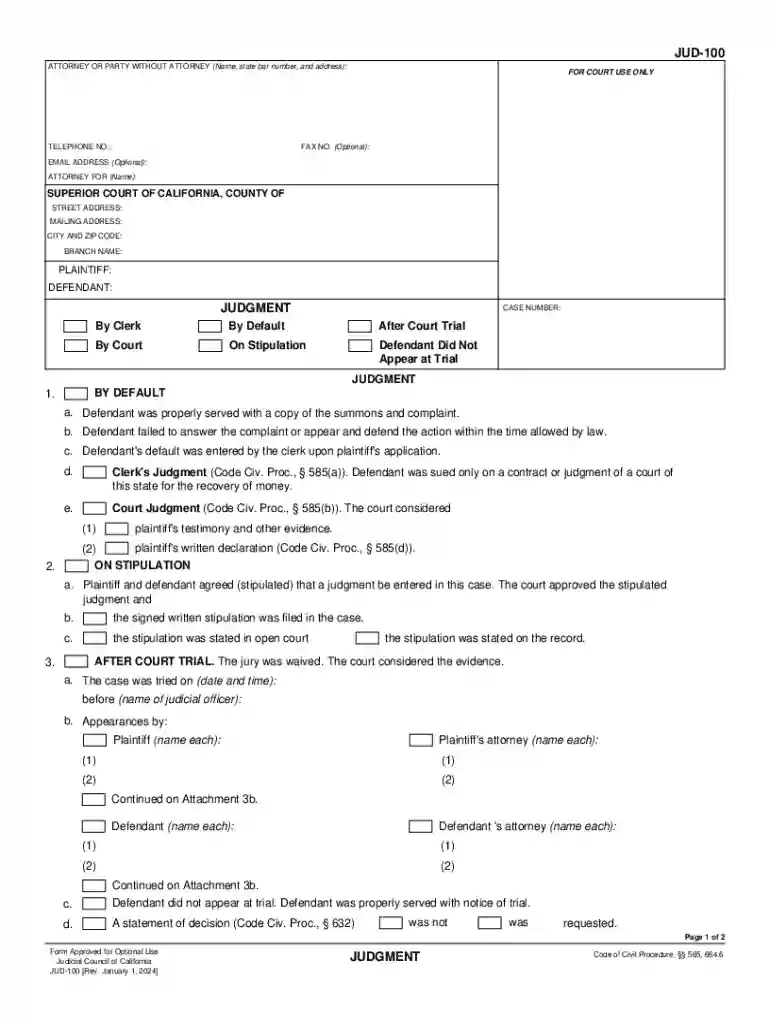
Definition and Purpose of the JUD-100 Judgment

The JUD-100 Judgment form is a legal document utilized within the Superior Court of California to officially record judgments in civil court cases. It is an essential element of the court proceedings, ensuring that a formal, written record of the court's decision is maintained. The form serves to document scenarios under which a judgment is entered, such as by default, upon stipulation by the parties involved, or following a court trial. Being an official court document, it outlines key details related to the judgment including parties involved, the specific nature of the judgment, and any monetary awards such as damages, attorney fees, and court costs.

Important Elements of the JUD-100 Judgment

Understanding the various sections and components of the JUD-100 is crucial for accurate completion and submission:

  • Parties Involved: The form requires detailed information about the plaintiff and defendant, ensuring clarity regarding the individuals or entities subject to the court's decision.
  • Nature of Judgment: This section specifies whether the judgment is a result of a trial, stipulation, or default, providing context for the decision.
  • Monetary Awards: Details regarding damages, attorney fees, and costs awarded are included, offering a comprehensive financial summary of the court's judgment.
  • Court Information: This includes the court's name, case number, and other relevant identifiers necessary for case tracking and record-keeping.

Step-by-Step Process to Complete the JUD-100 Judgment

Completing the JUD-100 Judgment form involves several careful steps:

  1. Gather Required Information: Collect all necessary details about the case, including party names, case number, and judgment specifics.
  2. Fill Out Party Details: Input complete and accurate information about all parties involved.
  3. Specify Judgment Type: Clearly identify whether the judgment is by default, stipulation, or after a court trial.
  4. Document Monetary Awards: Precisely record any monetary awards granted, ensuring accuracy in amounts and categories.
  5. Review and Verify: Double-check all entries for accuracy to prevent any potential delays or errors in the court's processing.

Legal Use and Implications of the JUD-100 Judgment

The form's legal function extends beyond mere documentation — it serves as an enforceable piece of legal authority that reflects the court's decision. It can be used to initiate further legal actions, such as enforcement of monetary awards or addressing compliance with the judgment terms. Because of its legal impact, it's critical that all information entered is accurate and complete, as any discrepancies can lead to legal complications or disputes.

Common Users and Scenarios for the JUD-100 Judgment

Typically, the form is used by attorneys, legal representatives, and court officials managing civil cases. It is pertinent in various scenarios involving:


  • Civil Litigation: When parties are involved in civil lawsuits, and a formal judgment is necessary.
  • Debt Recovery: Cases where monetary judgments are issued to recover debts owed.
  • Property Disputes: Situations involving disputes over property ownership or damages.
decoration image ratings of Dochub

State-Specific Requirements for the JUD-100 Judgment

While the JUD-100 is standard across California, it's essential to consider specific county or court rules that may affect how the form is filled and filed. Differences may arise in submission procedures or additional documentation that may be required to accompany the form.

Examples of JUD-100 Judgments in Practice

Practical application of the JUD-100 can be seen in various cases such as:

  • Lease Agreements: Individual landlords filing against tenants for unpaid rent may use this form to secure a judgment in small claims court.
  • Contract Disputes: Businesses resolving disputes over breached contracts, with the court issuing a judgment for damages or specific performance.
  • Personal Injury Claims: Plaintiffs in personal injury cases obtaining a judgment for compensation from the responsible party.

Obtaining and Accessing the JUD-100 Judgment Form

The JUD-100 form is accessible through the California Courts' official portal and can also be requested at court clerk offices. It may be filled out manually or electronically, depending on the court's capabilities and resources.

Submission Methods and Considerations

Upon completion, the form can typically be submitted in-person at a court clerk’s office, by mail, or via online court filing systems. Selection of the submission method may depend on court location, specific court rules, and user preference for convenience or confirmation of receipt.

Digital vs. Paper Submission of the JUD-100

Both digital and paper submissions are accepted depending on the court's regulations. Electronic filing offers benefits such as faster processing times and immediate confirmation of receipt, while paper submissions might be preferred in situations where digital literacy is a concern or for records not supported by the court’s electronic systems.

By adhering to these guidelines, individuals and legal professionals can ensure accurate and effective completion and use of the JUD-100 Judgment form, facilitating the smooth progression of civil court proceedings.

See more JUD-100 JUDGMENT versions

We've got more versions of the JUD-100 JUDGMENT form. Select the right JUD-100 JUDGMENT version from the list and start editing it straight away!
Versions Form popularity Fillable & printable
2024 4.2 Satisfied (55 Votes)
2002 4.8 Satisfied (123 Votes)
be ready to get more

Complete this form in 5 minutes or less

Get form

Got questions?

We have answers to the most popular questions from our customers. If you can't find an answer to your question, please contact us.
Contact us
In general, you can only ask for a clerk judgment if the case was about a contract or an open book account. In those cases, if the contract makes clear what youre owed, the clerk may be able to process the judgment. In other cases, youll need a court judgment so a judge can review what youve asked for.
Request for Entry of Default (Application to Enter Default) (CIV-100) Asks the court to enter a default against the defendant or cross-defendant because they failed to file an Answer or other responsive document in the case. Can be used to ask for a default alone, or also a default judgment. Get form CIV-100.
States the final decision of the court in a limited or unlimited civil case. Get form JUD-100. Effective: January 1, 2025. View JUD-100 Judgment form.
CH-100 Request for Civil Harassment Restraining Orders (Civil Harassment Prevention)
When focusing on the main objectives, Judgment is about 27 Hours in length. If youre a gamer that strives to see all aspects of the game, you are likely to spend around 98 Hours to obtain 100% completion.

Security and compliance

At DocHub, your data security is our priority. We follow HIPAA, SOC2, GDPR, and other standards, so you can work on your documents with confidence.

Learn more
ccpa2
pci-dss
gdpr-compliance
hipaa
soc-compliance
be ready to get more

Complete this form in 5 minutes or less

Get form

People also ask

If the court has your address, the clerk mails you a Notice of Entry of Default. If they sent this, you must file and serve the request to set aside within 180 days from the date you were served that notice.
If the defendant fails to reply within 14 days of service, the claimant can apply for a judgment in default, either by simply requesting the courts administrative staff enter judgment filing a request for judgment (which is sufficient for routine cases), or by making a formal application to the procedural judge.

stipulated judgment form