




01. Edit your cbp form 4457 online
Type text, add images, blackout confidential details, add comments, highlights and more.

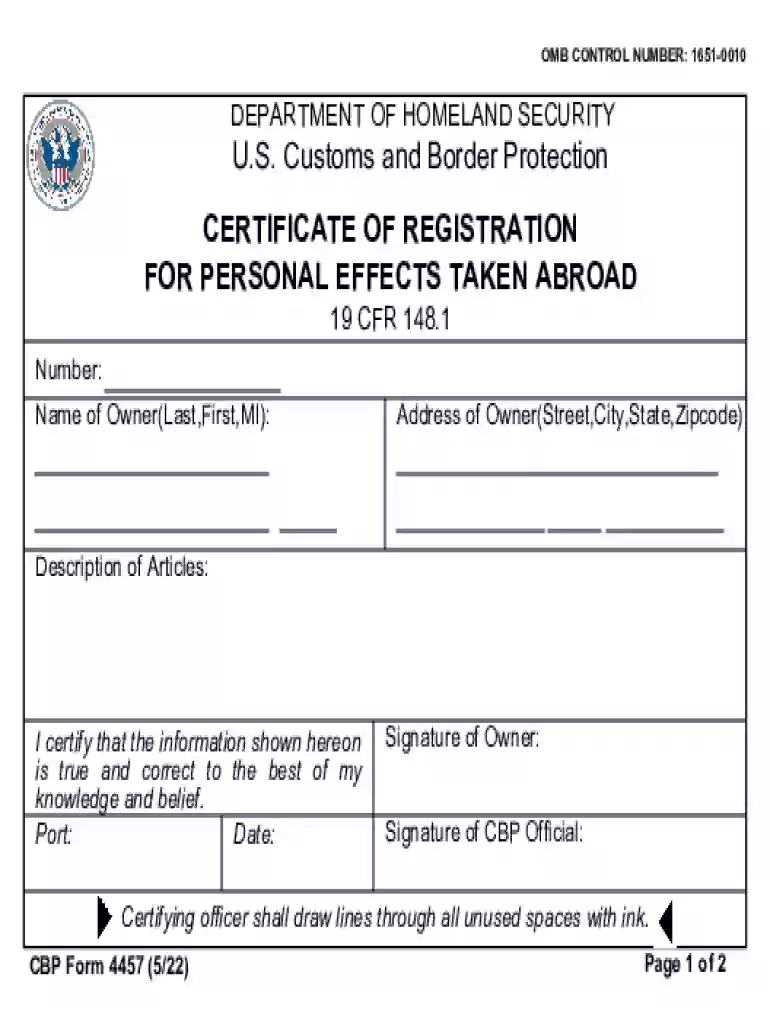
Type text, add images, blackout confidential details, add comments, highlights and more.

Draw your signature, type it, upload its image, or use your mobile device as a signature pad.

Send form 4457 via email, link, or fax. You can also download it, export it or print it out.
CBP Form 4457, officially known as the Certificate of Registration for Personal Effects Taken Abroad, is a document issued by U.S. Customs and Border Protection (CBP). Its primary purpose is to allow U.S. residents to register their personal items before traveling internationally. By doing so, individuals have documented proof of ownership that aids in mitigating potential issues upon reentry into the United States. The form is especially pertinent for valuable personal effects such as jewelry, cameras, and electronics, which may be subject to customs assessment.
The need for this certificate arises when travelers are concerned about potential duties or taxes on the items they bring back into the U.S. Each form is uniquely numbered and is effective for various personal effects, making it easier for customs officials to identify previously registered items. However, it's crucial to note that this registration is voluntary, and the form is non-transferable; it must be completed and signed by the owner in the presence of a CBP officer.
Completing CBP Form 4457 is a systematic process that involves a few straightforward steps:
Making sure the form is fully and accurately completed can save time and potential complications when returning to the U.S.
CBP Form 4457 consists of several critical components that users should understand:
Each of these components plays a vital role in ensuring that the registration is legally recognized and can facilitate smoother customs procedures upon reentry.
Using CBP Form 4457 comes with several important benefits for travelers:
For anyone planning international travel with valuable possessions, understanding and utilizing this certificate can provide peace of mind.
Individuals eligible to use CBP Form 4457 include U.S. citizens and residents who plan to take personal effects abroad, including but not limited to:
It's essential for travelers to ensure their items fit the criteria laid out by CBP and to understand that the form does not cover items intended for sale or commercial use.


We've got more versions of the cbp form 4457 form. Select the right cbp form 4457 version from the list and start editing it straight away!
At DocHub, your data security is our priority. We follow HIPAA, SOC2, GDPR, and other standards, so you can work on your documents with confidence.
Registrar (AE) Registration Department R.Baskaran. Special Officer Revenue Complex, 4132248759 5359 Puducherry 605 013 5360 43 Sainik Welfare director
The exporter is required to submit a properly completed Department of Homeland Security, CBP Form 4457, (Certificate of Registration for Personal Effects TakenRead more
Jun 27, 2025 CBP Form 4457 - Certificate of Registration for Personal Effects Taken Abroad 4457 PDF 1.01 MB 06/10/2024. Customs and Border Protection: U.S


