Florida supreme judgment 2026

Get Form
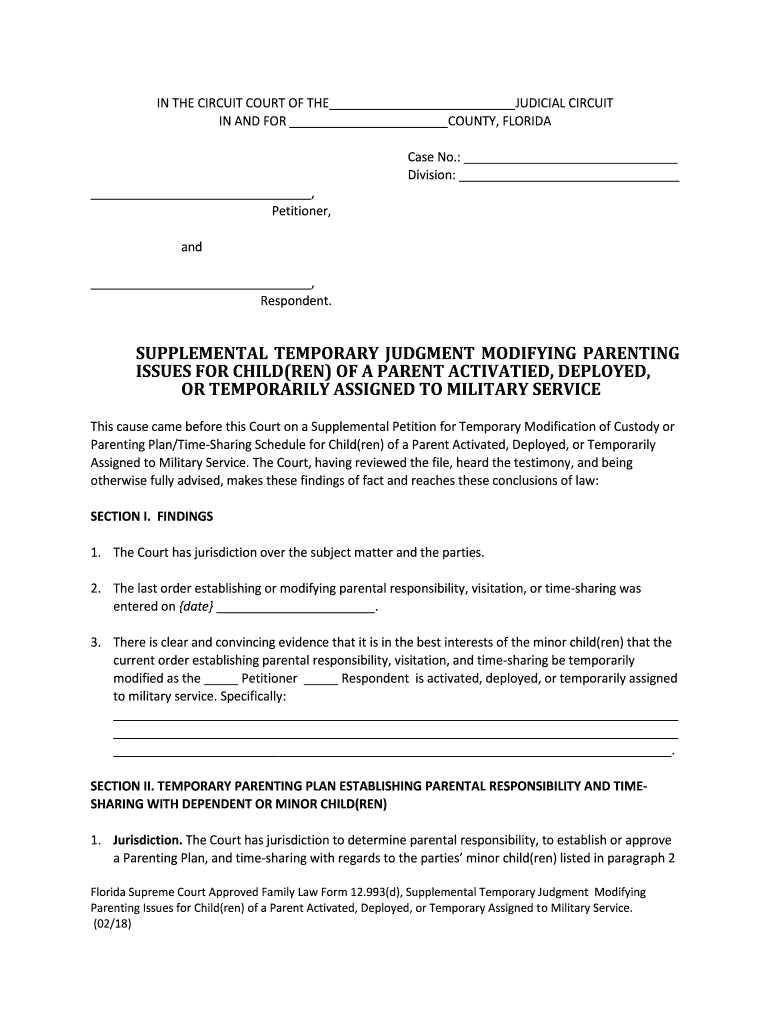
temporary judgment Preview on Page 1

Here's how it works

01. Edit your temporary judgment online
Type text, add images, blackout confidential details, add comments, highlights and more.
02. Sign it in a few clicks
Draw your signature, type it, upload its image, or use your mobile device as a signature pad.
03. Share your form with others
Send supplemental modifying form via email, link, or fax. You can also download it, export it or print it out.

How to use or fill out Florida Supreme Judgment with our platform

Form edit decoration
9.5
Ease of Setup
DocHub User Ratings on G2
9.0
Ease of Use
DocHub User Ratings on G2
  1. Click ‘Get Form’ to open the Florida Supreme Judgment in the editor.
  2. Begin by filling in the case details, including the Circuit Court name, County, Case Number, and Division at the top of the form.
  3. In Section I, provide findings such as jurisdiction and previous orders. Ensure you accurately state the date of the last order.
  4. Move to Section II to list the names and birth dates of all minor children involved. This is crucial for establishing parental responsibility.
  5. In Section III, choose options regarding child support modifications. Fill in specific amounts and payment schedules as required.
  6. Complete Section IV by detailing the method of payment for child support obligations, ensuring clarity on where payments will be directed.
  7. Finally, review all sections for accuracy before saving or sharing your completed document through our platform.

Start using our platform today to streamline your document editing and signing process for free!

See more florida supreme judgment versions

We've got more versions of the florida supreme judgment form. Select the right florida supreme judgment version from the list and start editing it straight away!
Versions Form popularity Fillable & printable
2018 4.8 Satisfied (61 Votes)
2015 4.4 Satisfied (96 Votes)
be ready to get more

Complete this form in 5 minutes or less

Get form

Got questions?

We have answers to the most popular questions from our customers. If you can't find an answer to your question, please contact us.
Contact us
The Court hears cases in all areas of the law, including constitutional law, administrative law, criminal law and private law.
The Supreme Court has the constitutional authority to issue the extraordinary writs of prohibition, mandamus, quo warranto, and habeas corpus and to issue all other writs necessary to the complete exercise of its jurisdiction.
A judgment can be enforced against real property or personal property for up to 20 years under Florida law. That means that a creditor can pursue payment from you for up to 20 years from the date of the judgment if the creditor extends or renews it.
The 2021 Rule required that the Motion for Summary Judgment (MSJ) be served at least 40 days before the hearing, with responses due 20 days before the hearing. No specific deadline for replies was set. Under the 2025 amendment, the Rule eliminates any reference to a hearing.
Once signed by the judge, the final judgment becomes enforceable under Florida law. Both parties are legally bound to follow its terms unless and until they are modified by the court.

Security and compliance

At DocHub, your data security is our priority. We follow HIPAA, SOC2, GDPR, and other standards, so you can work on your documents with confidence.

Learn more
ccpa2
pci-dss
gdpr-compliance
hipaa
soc-compliance

People also ask

Jurisdiction final orders imposing death sentences, district court decisions declaring a State statute or provision of the State Constitution invalid, bond validations, certain orders of the Public Service Commission on utility rates and services.
The Supreme Court has appellate jurisdiction over the following types of cases: Appeals from Federal Circuit Courts or United States Court of Appeals for the Armed Forces. Appeals from state courts of last resort on issues of federal constitutional or statutory law.
any decision of a district court of appeal that expressly declares valid a state statute, construes a provision of the state or federal constitution, affects a class of constitutional or state officers, directly conflicts with a decision of another district court or of the Supreme Court on the same question of law,

temporary modifying form