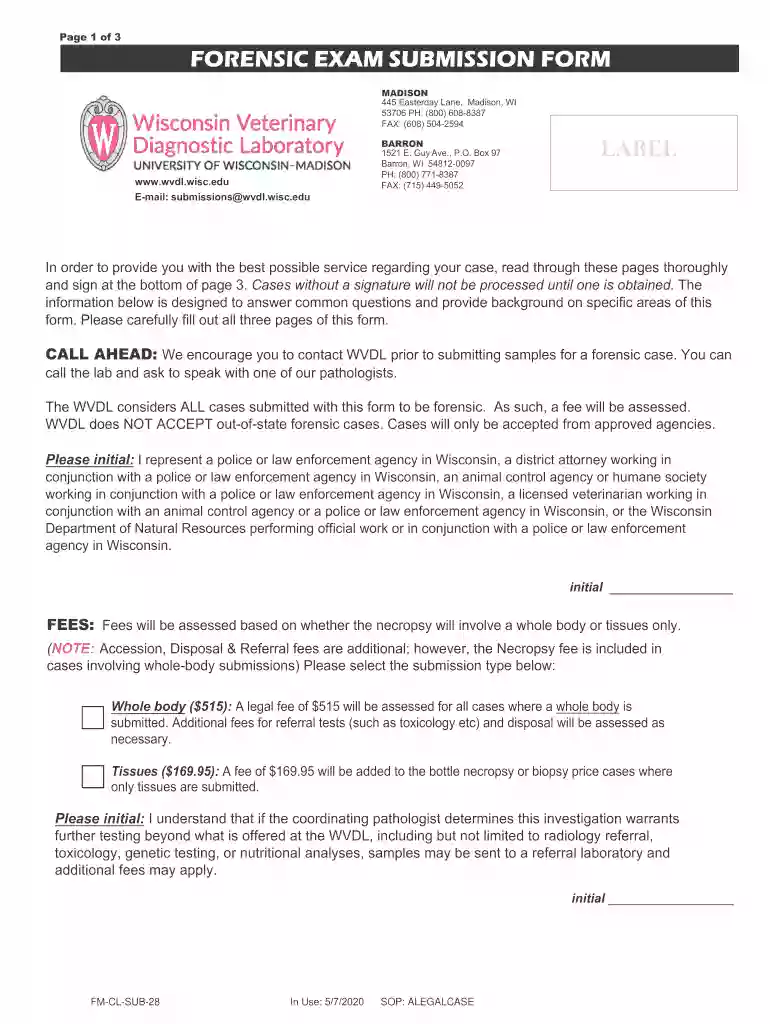
Wisconsin Veterinary Diagnostic Laboratory Submission Forms 2026

Get Form
Wisconsin Veterinary Diagnostic Laboratory Submission Forms Preview on Page 1

Here's how it works

01. Edit your form online
Type text, add images, blackout confidential details, add comments, highlights and more.

02. Sign it in a few clicks
Draw your signature, type it, upload its image, or use your mobile device as a signature pad.

03. Share your form with others
Send it via email, link, or fax. You can also download it, export it or print it out.

How to use or fill out Wisconsin Veterinary Diagnostic Laboratory Submission Forms

Form edit decoration
9.5
Ease of Setup
DocHub User Ratings on G2
9.0
Ease of Use
DocHub User Ratings on G2
  1. Click ‘Get Form’ to open it in the editor.
  2. Begin by filling out the 'Owner' and 'Submitter' sections. Ensure all required fields marked with an asterisk (*) are completed accurately.
  3. In the 'Specimens Submitted' section, indicate how the tissues were preserved by selecting from options such as Fresh, Fixed, Frozen, or Whole Body.
  4. Complete the 'Specimen Information' section by providing details about the animal/specimen ID, species, breed, sex, age, and any tests requested.
  5. Fill out the 'Chain of Custody' section to document evidence transfer. This includes signatures and dates from both the releasing and receiving parties.
  6. In the 'Cause of Death' section, specify whether the animal died naturally or was euthanized. Provide relevant dates and methods as necessary.
  7. Choose a disposal option in the 'Disposition of Body' section and initial to confirm your choice. Remember that bodies cannot be returned to owners.
  8. Finally, review all entries for accuracy before signing at the bottom of page 3 to ensure your submission is processed without delays.

Start using our platform today for free to streamline your form completion process!

See more Wisconsin Veterinary Diagnostic Laboratory Submission Forms versions

We've got more versions of the Wisconsin Veterinary Diagnostic Laboratory Submission Forms form. Select the right Wisconsin Veterinary Diagnostic Laboratory Submission Forms version from the list and start editing it straight away!
Versions Form popularity Fillable & printable
2020 4.8 Satisfied (60 Votes)
2019 3.8 Satisfied (35 Votes)
be ready to get more

Complete this form in 5 minutes or less

Get form

Got questions?

We have answers to the most popular questions from our customers. If you can't find an answer to your question, please contact us.
Contact us
Traditional diagnosis analyzes blood, tissue, or stool to detect proteins, antibodies, disease presence or general indicators of overall health. Lab-based testing ensures accurate, quality results while point-of-care diagnostics enable real-time decisions that can ease concerned animal owners.
The public and private laboratories offer not only diagnostic services but also the expertise of veterinary specialists who can consult on cases by helping select tests, interpret results, and talk through treatments.
Laboratory Diagnosis refers to the use of laboratory testing to assist physicians in diagnosing conditions, such as the probability of HIT, which is challenging to judge based solely on clinical grounds.
The Veterinary Diagnostic Laboratory offers diagnostic services to veterinarians and owners of livestock, zoo animals, and companion animals in the form of postmortem examinations, clinical pathology, surgical biopsy interpretations, bacteriology, endocrinology, nutrition, parasitology, immunodiagnostics, toxicology,
However, the school does offer a number of courses that are available to undergraduates, and it offers residency, masters, Ph. D., and doctor of veterinary medicine (DVM) degrees. Scores from the Graduate Record Exam (GRE) must be submitted at the time of application.

Security and compliance

At DocHub, your data security is our priority. We follow HIPAA, SOC2, GDPR, and other standards, so you can work on your documents with confidence.

Learn more
ccpa2
pci-dss
gdpr-compliance
hipaa
soc-compliance
be ready to get more

Complete this form in 5 minutes or less

Get form

People also ask

Blood Tests Along with helping to diagnose specific conditions, blood work is also a part of routine diagnostics to monitor your pets overall health. They are used to evaluate a variety of health issues including organ function, electrolyte levels, blood cell counts, and more.

Related links