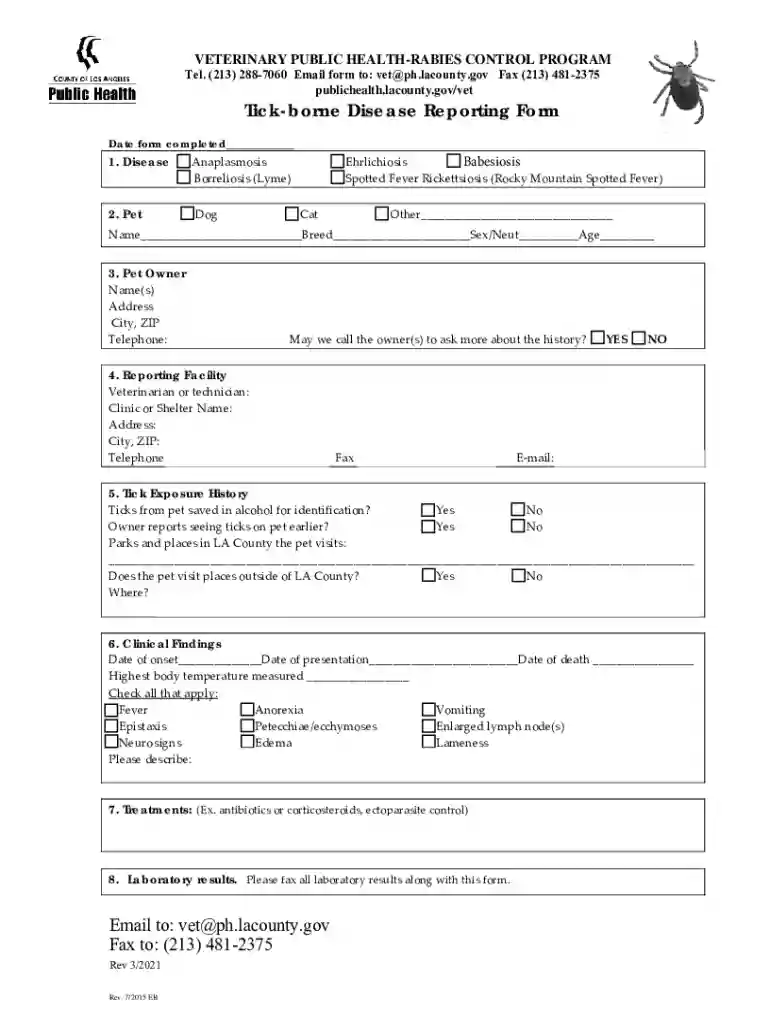
Tick-borne Disease Reporting Form for Animals in Los Angeles County 2026

Get Form
Tick-borne Disease Reporting Form for Animals in Los Angeles County Preview on Page 1

Here's how it works

01. Edit your form online
Type text, add images, blackout confidential details, add comments, highlights and more.

02. Sign it in a few clicks
Draw your signature, type it, upload its image, or use your mobile device as a signature pad.

03. Share your form with others
Send it via email, link, or fax. You can also download it, export it or print it out.

How to use or fill out Tick-borne Disease Reporting Form for Animals in Los Angeles County with DocHub

Form edit decoration
9.5
Ease of Setup
DocHub User Ratings on G2
9.0
Ease of Use
DocHub User Ratings on G2
  1. Click ‘Get Form’ to open the Tick-borne Disease Reporting Form in our editor.
  2. Begin by filling out the date the form is completed at the top of the document.
  3. In section 1, select the disease affecting your pet by checking the appropriate box for Anaplasmosis, Borreliosis (Lyme), Babesiosis, Ehrlichiosis, or Spotted Fever Rickettsiosis.
  4. Section 2 requires you to provide details about your pet. Fill in their name, breed, sex/neutering status, and age.
  5. In section 3, enter your name as the pet owner along with your address, city, ZIP code, and telephone number. Indicate if we may call you for more information.
  6. For section 4, provide details about the reporting facility including veterinarian or technician's name and clinic/shelter information.
  7. In section 5, answer questions regarding tick exposure history and list parks or places in LA County that your pet visits.
  8. Section 6 asks for clinical findings; fill in dates of onset and presentation along with any observed symptoms by checking applicable boxes.
  9. Document any treatments administered in section 7 and ensure to fax all laboratory results along with this form as indicated at the bottom.

Start using our platform today to easily complete and submit your Tick-borne Disease Reporting Form for free!

See more Tick-borne Disease Reporting Form for Animals in Los Angeles County versions

We've got more versions of the Tick-borne Disease Reporting Form for Animals in Los Angeles County form. Select the right Tick-borne Disease Reporting Form for Animals in Los Angeles County version from the list and start editing it straight away!
Versions Form popularity Fillable & printable
2021 4.8 Satisfied (60 Votes)
2015 4.8 Satisfied (123 Votes)
be ready to get more

Complete this form in 5 minutes or less

Get form

Got questions?

We have answers to the most popular questions from our customers. If you can't find an answer to your question, please contact us.
Contact us
Emergency Conditions Anthrax (Bacillus anthracis) Crimean Congo hemorrhagic fever (CCHFV) Foot-and-mouth disease (FMDV) Heartwater (Ehrlichia ruminantium) Japanese encephalitis (JEV) Melioidosis (Burkholderia pseudomallei) Rabies. Rift Valley fever (RVFV)
Tick-borne disease occurs when ticks infected with a pathogen bite a dog and transmit the pathogen into the dogs body. Many of these pathogens are zoonotic, meaning they can also infect humans.
A Veterinarian-On-Call is available Monday - Friday, 8am-5pm to answer questions about rabies, rabies-related incidents, animal diseases and reporting. Call 213-288-7060 or email vet@ph.lacounty.gov.
Ticks that are located in the brush and on tall grasses come into contact with humans as we pass through these environments. The ticks can then crawl up sleeves and bite the skin, typically around warm areas under the hair. Lyme disease, Anaplasmosis, and Babesiosis are spread by the Deer Tick (Ixodes scapularis).
Ticks wait for host animals on the tips of grasses and shrubs. When a moving animal or person brushes the plant, the tick quickly lets go of the vegetation and climbs onto the host. This process is known as questing. Ticks can only crawl; they cannot jump or fly.

Security and compliance

At DocHub, your data security is our priority. We follow HIPAA, SOC2, GDPR, and other standards, so you can work on your documents with confidence.

Learn more
ccpa2
pci-dss
gdpr-compliance
hipaa
soc-compliance
be ready to get more

Complete this form in 5 minutes or less

Get form

People also ask

These small ticks are known parasites of over 15 different animals including cattle, horses, pigs, deer, dogs, cats, opossums, rodents and humans, to name a few. They can lead to reduced production and even death by anemia due to their ability to reproduce parthenogenically (without a male).

Related links