




01. Edit your form online
Type text, add images, blackout confidential details, add comments, highlights and more.

Type text, add images, blackout confidential details, add comments, highlights and more.

Draw your signature, type it, upload its image, or use your mobile device as a signature pad.

Send it via email, link, or fax. You can also download it, export it or print it out.
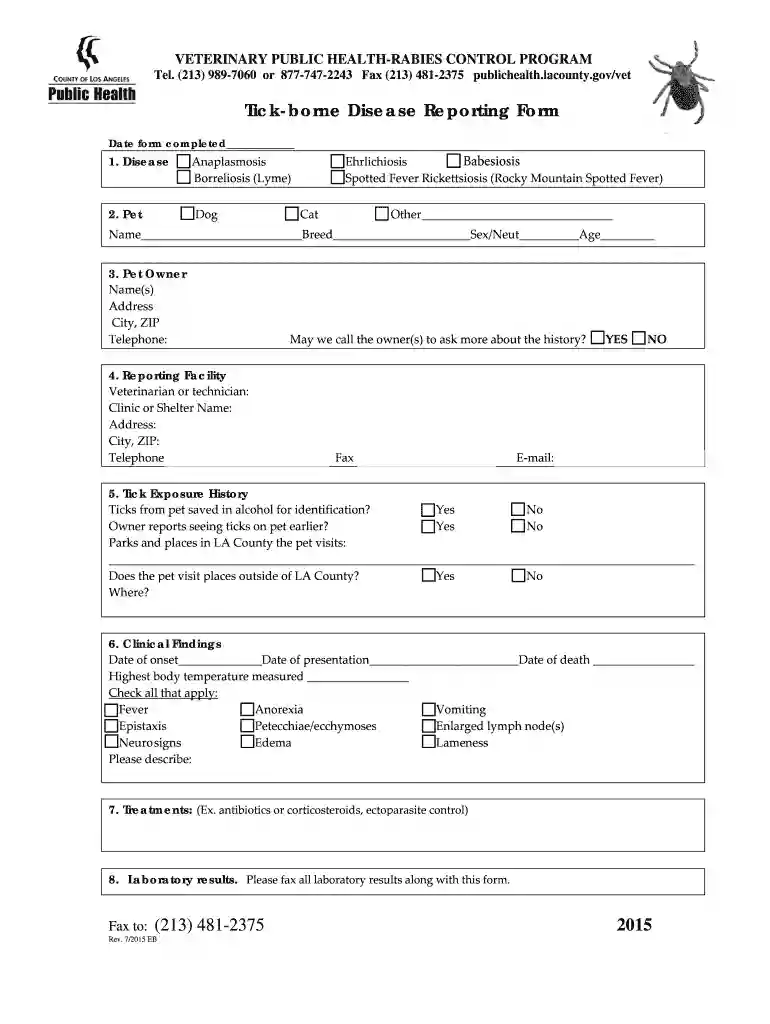
The "Tick-borne Disease Reporting Form for Animals in Los Angeles County" is a specialized document used for reporting cases of tick-borne diseases in animals. It is crucial for maintaining public health and managing veterinary concerns related to these diseases, which can affect both pets and wildlife. This form gathers essential data on disease prevalence and transmission patterns in the Los Angeles County area to facilitate timely intervention and control measures.
To acquire the Tick-borne Disease Reporting Form for Animals in Los Angeles County, individuals may contact the local public health department or visit its official website. The form might also be available at veterinary clinics or animal shelters within the county. Ensuring access to this form is vital for veterinarians and pet owners who suspect tick-borne diseases in animals and need to report such findings promptly.
Pet and Owner Information: Begin by filling in the owner's contact information and pet details, including the animal's name, species, breed, age, and microchip number if available.
Tick Exposure History: Document the animal's exposure history, noting any recent outdoor activities, locations visited, and known tick encounters.
Clinical Findings: Record observed symptoms and clinical signs such as lethargy, fever, or abnormal behavior that may suggest a tick-borne disease.
Treatments and Interventions: List any treatments administered, including medications, dosages, and treatment dates aimed at managing or mitigating symptoms.
Laboratory Results: Include any diagnostic test results, either pending or completed, that provide evidence of tick-borne disease, such as Lyme disease or ehrlichiosis.
Signature and Date: Complete the form by signing and dating it to verify the accuracy of the information provided.
Veterinarians, veterinary technicians, and public health officials predominantly use the Tick-borne Disease Reporting Form. Pet owners may also be involved in filling out sections of the form to provide comprehensive exposure history. These users rely on accurate reporting to guide public health responses and medical care for affected animals.


Submission of the Tick-borne Disease Reporting Form is often a legal requirement within public health frameworks to report suspected or confirmed instances of tick-borne diseases in animals. It assists in the monitoring efforts by local health authorities to prevent broader outbreaks and manage public health risks associated with tick-borne diseases.
While the form is designed for use within Los Angeles County, users should recognize any additional state-specific requirements governing the reporting of tick-borne diseases. These may involve specific timelines for reporting, additional documentation, or mandatory testing intervals defined by state public health laws.
Consider a veterinarian who discovers tick presence and symptoms like fever and joint pain in a dog brought to their clinic. They would complete the tick exposure and clinical findings sections of the form and submit laboratory results after testing for diseases like Lyme.
In another scenario, a pet owner traveling through tick-prevalent areas reports tick encounters and subsequent symptoms in their pet to local authorities using this form, enabling timely public health interventions.
We've got more versions of the Tick-borne Disease Reporting Form for Animals in Los Angeles County Tick-borne Disease Reporting For form. Select the right Tick-borne Disease Reporting Form for Animals in Los Angeles County Tick-borne Disease Reporting For version from the list and start editing it straight away!
At DocHub, your data security is our priority. We follow HIPAA, SOC2, GDPR, and other standards, so you can work on your documents with confidence.
Tick paralysis, a potentially fatal disease of many animals including man, is associated Los Angeles County. J.E. Keirans (personal communication) states that
Instructions: Use this form to report suspected and confirmed cases of tick-borne disease to the Veterinary Public Health Program at the Los Angeles County.
May 9, 2008 Preventing and controlling stroke risk factors (e.g., high blood pressure, heart disease, atrial fibrillation, high blood cholesterol levels,


