Lifting inspection checklist 2026

Get Form
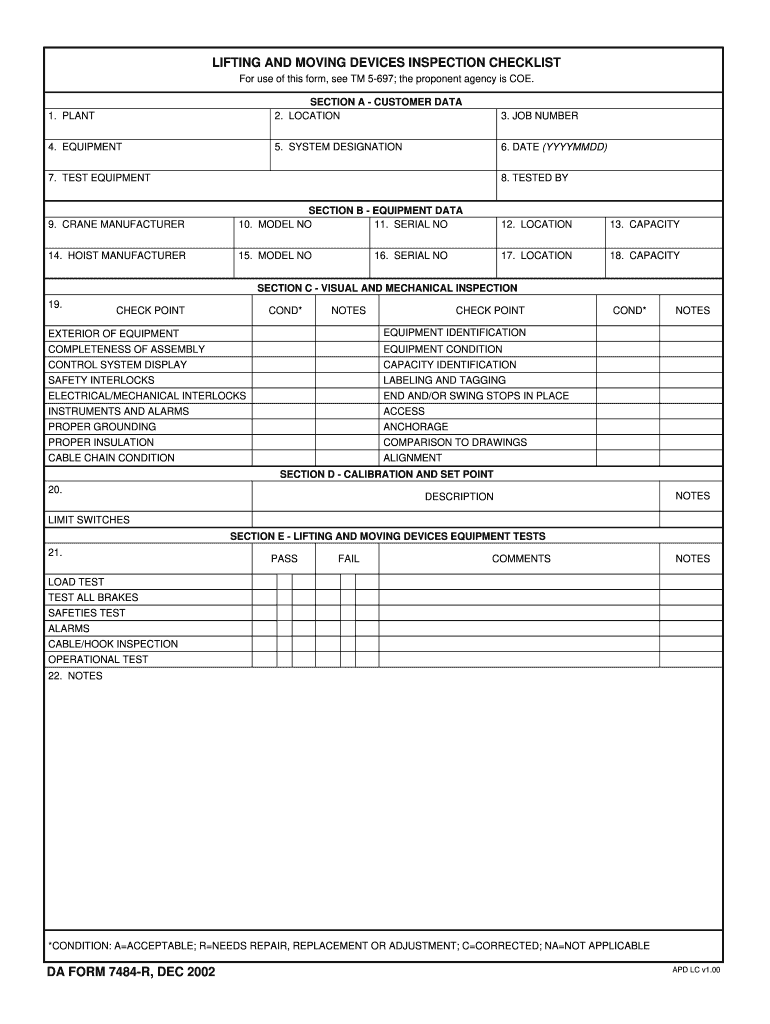
lifting inspection checklist Preview on Page 1

Here's how it works

01. Edit your lifting inspection checklist online
Type text, add images, blackout confidential details, add comments, highlights and more.
02. Sign it in a few clicks
Draw your signature, type it, upload its image, or use your mobile device as a signature pad.
03. Share your form with others
Send passenger lift inspection checklist pdf via email, link, or fax. You can also download it, export it or print it out.

How to use or fill out lifting inspection checklist with our platform

Form edit decoration
9.5
Ease of Setup
DocHub User Ratings on G2
9.0
Ease of Use
DocHub User Ratings on G2
  1. Click ‘Get Form’ to open the lifting inspection checklist in the editor.
  2. Begin by filling out SECTION A - CUSTOMER DATA. Enter the location, job number, equipment details, system designation, date, test equipment used, who tested it, and the crane manufacturer.
  3. Proceed to SECTION B - EQUIPMENT DATA. Here, input the model number and serial number of both the main equipment and hoist. Also include their respective locations and capacities.
  4. In SECTION C - VISUAL AND MECHANICAL INSPECTION, review each checkpoint listed. Mark the condition of each item (acceptable, needs repair, etc.) and add any relevant notes for clarity.
  5. Move on to SECTION D - CALIBRATION AND SET POINT. Document any observations regarding limit switches and provide notes as necessary.
  6. Finally, complete SECTION E - LIFTING AND MOVING DEVICES EQUIPMENT TESTS by indicating pass or fail for each test conducted. Add comments and additional notes where applicable.

Start using our platform today to streamline your lifting inspection checklist process for free!

See more lifting inspection checklist versions

We've got more versions of the lifting inspection checklist form. Select the right lifting inspection checklist version from the list and start editing it straight away!
Versions Form popularity Fillable & printable
2002 4.8 Satisfied (160 Votes)
be ready to get more

Complete this form in 5 minutes or less

Get form

Got questions?

We have answers to the most popular questions from our customers. If you can't find an answer to your question, please contact us.
Contact us
A full initial inspection is often required when an elevator is first installed. After the initial inspection, a regular biannual or annual inspection is essential to your elevator maintenance and operation.
Factors to include may be any or all of the following: working under suspended loads. visibility. attaching / detaching and securing loads. environment. location. overturning. proximity hazards. derating.
Aerial Lift Pre-Use Inspection Lower-level controls. Battery and charger. Wheels and tires. Steering and breaks. Horn, lights and backup alarms. Proper fluid levels (oil, hydraulic, fuel and coolant)
Key areas to check include the capacity, quality of the pole surfaces, handle and handle locking system, tags with capacity and safety information, and the lifting eye. Regular inspections ensure the magnets operate safely and efficiently, maintaining their reliability in lifting operations.
Here are six ways to keep you safer when using lifting equipment. Always check equipment before use. Keep up to date with safety training. Ensure lifting loads are within limit. Prevent access to dangerous areas. Never stand under a load. Perform regular inspections and maintenance.

Security and compliance

At DocHub, your data security is our priority. We follow HIPAA, SOC2, GDPR, and other standards, so you can work on your documents with confidence.

Learn more
ccpa2
pci-dss
gdpr-compliance
hipaa
soc-compliance
be ready to get more

Complete this form in 5 minutes or less

Get form

People also ask

Check for any visible signs of damage, such as s, dents, bends, or corrosion. Inspect for loose or missing bolts, nuts, pins, or other fasteners. Look for signs of wear on load-bearing components, such as hooks, shackles, slings, and chains.
An inspection checklist (sometimes called an inspection sheet) is a structured list of tasks that must be completed during an inspection. It helps ensure compliance with safety regulations, industry standards, or maintenance requirements.
1 Perform a visual inspection of all aerial lift components, missing parts, torn or loose hoses, hydraulic fluid leaks, and replace as necessary. 2 Check to see if all oil, hydraulic, fuel and coolant are all at proper fluid levels. 3 Check the wheels tires for damage. Check the wheel lugs for tightness.

passenger lift checklist