Summary of high-quality cpr 2026

Get Form
summary of high-quality cpr Preview on Page 1

Here's how it works

01. Edit your form online
Type text, add images, blackout confidential details, add comments, highlights and more.

02. Sign it in a few clicks
Draw your signature, type it, upload its image, or use your mobile device as a signature pad.

03. Share your form with others
Send it via email, link, or fax. You can also download it, export it or print it out.

How to use or fill out summary of high-quality CPR

Form edit decoration
9.5
Ease of Setup
DocHub User Ratings on G2
9.0
Ease of Use
DocHub User Ratings on G2
  1. Click ‘Get Form’ to open it in the editor.
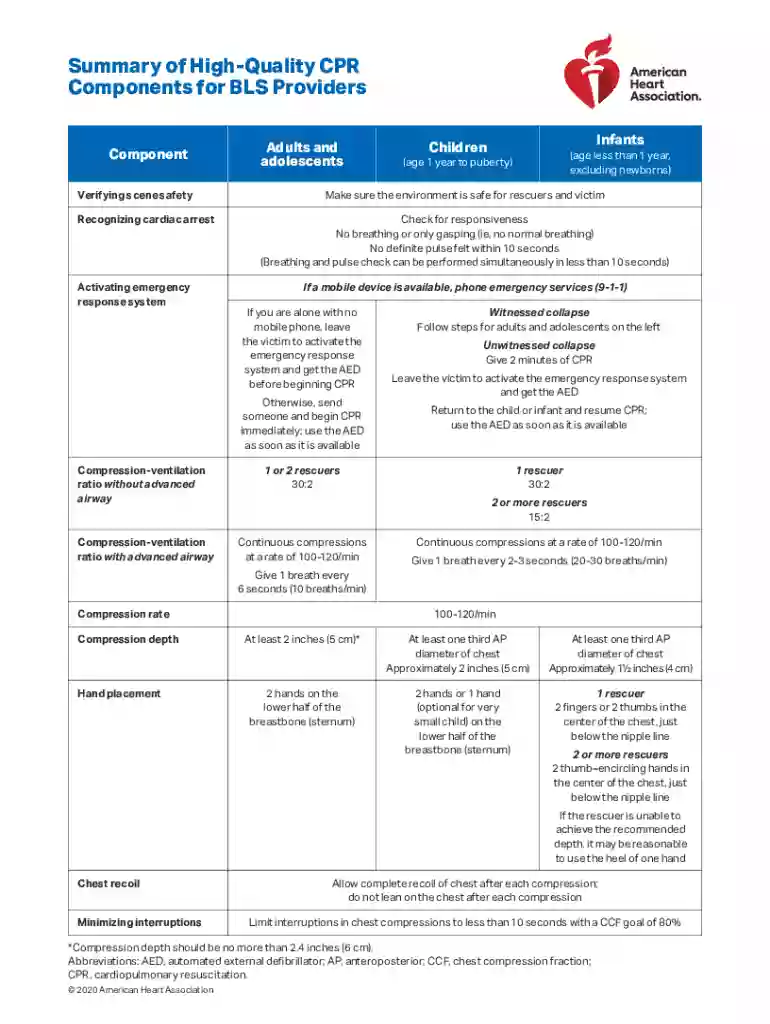
  2. Begin by verifying scene safety. Ensure that the environment is safe for both the rescuer and the victim before proceeding.
  3. Recognize cardiac arrest by checking for responsiveness, normal breathing, and pulse within 10 seconds. Document your findings in the designated fields.
  4. Activate the emergency response system. If alone, leave to call emergency services (9-1-1) and retrieve an AED before starting CPR.
  5. Fill in the compression-ventilation ratio based on whether you are a single rescuer or with multiple rescuers. For adults, use 30:2; for infants, adjust as necessary.
  6. Record the compression rate and depth according to age group guidelines provided in the form. Ensure you note any interruptions during compressions.

Start using our platform today to efficiently complete your summary of high-quality CPR!

See more summary of high-quality cpr versions

We've got more versions of the summary of high-quality cpr form. Select the right summary of high-quality cpr version from the list and start editing it straight away!
Versions Form popularity Fillable & printable
2020 4.7 Satisfied (36 Votes)
2015 4.6 Satisfied (62 Votes)
be ready to get more

Complete this form in 5 minutes or less

Get form

Got questions?

We have answers to the most popular questions from our customers. If you can't find an answer to your question, please contact us.
Contact us
The six foundational concepts of high-quality CPR are adequate rate and depth of compressions, complete chest recoil, minimizing interruptions, avoiding excessive ventilation, ensuring proper hand placement, and using correct compression technique.
High-quality CPR performance metrics include: Chest compression fraction 80% Compression rate of 100-120/min. Compression depth of at least 50 mm (2 inches) in adults and at least 1/3 the AP dimension of the chest in infants and children.
Position the victim. Prepare for chest compressions. Provide 30 chest compressions. Give 2 rescue breaths. With two rescuers, switch compression roles every two minutes. Continue CPR until it is appropriate to stop.
Five main components of high-performance CPR have been identified: chest compression fraction (CCF), chest compression rate, chest compression depth, chest recoil (residual leaning), and ventilation. These CPR components were identified due to their contribution to blood flow and outcome.
There are five critical components: Minimize interruptions in chest compressions. Provide compressions of adequate rate and depth. Avoid leaning on the victim between compressions. Ensure proper hand placement. Avoid excessive ventilation.

Security and compliance

At DocHub, your data security is our priority. We follow HIPAA, SOC2, GDPR, and other standards, so you can work on your documents with confidence.

Learn more
ccpa2
pci-dss
gdpr-compliance
hipaa
soc-compliance
be ready to get more

Complete this form in 5 minutes or less

Get form

People also ask

About High-Quality CPR Provide compressions of adequate rate and depth. Avoid leaning on the victim between compressions. Ensure proper hand placement. Avoid excessive ventilation.
This includes providing compressions at the proper rate and depth, making sure not to lean on the chest, avoiding excessive ventilation, and keeping interruptions to an absolute minimum.

Related links