Emergency Department Hip Fracture Adult Order Set 2025

Get Form
gcd order Preview on Page 1

Here's how it works

01. Edit your gcd order online
Type text, add images, blackout confidential details, add comments, highlights and more.
02. Sign it in a few clicks
Draw your signature, type it, upload its image, or use your mobile device as a signature pad.
03. Share your form with others
Send it via email, link, or fax. You can also download it, export it or print it out.

How to use or fill out Emergency Department Hip Fracture Adult Order Set

Form edit decoration
9.5
Ease of Setup
DocHub User Ratings on G2
9.0
Ease of Use
DocHub User Ratings on G2
  1. Click ‘Get Form’ to open the Emergency Department Hip Fracture Adult Order Set in our editor.
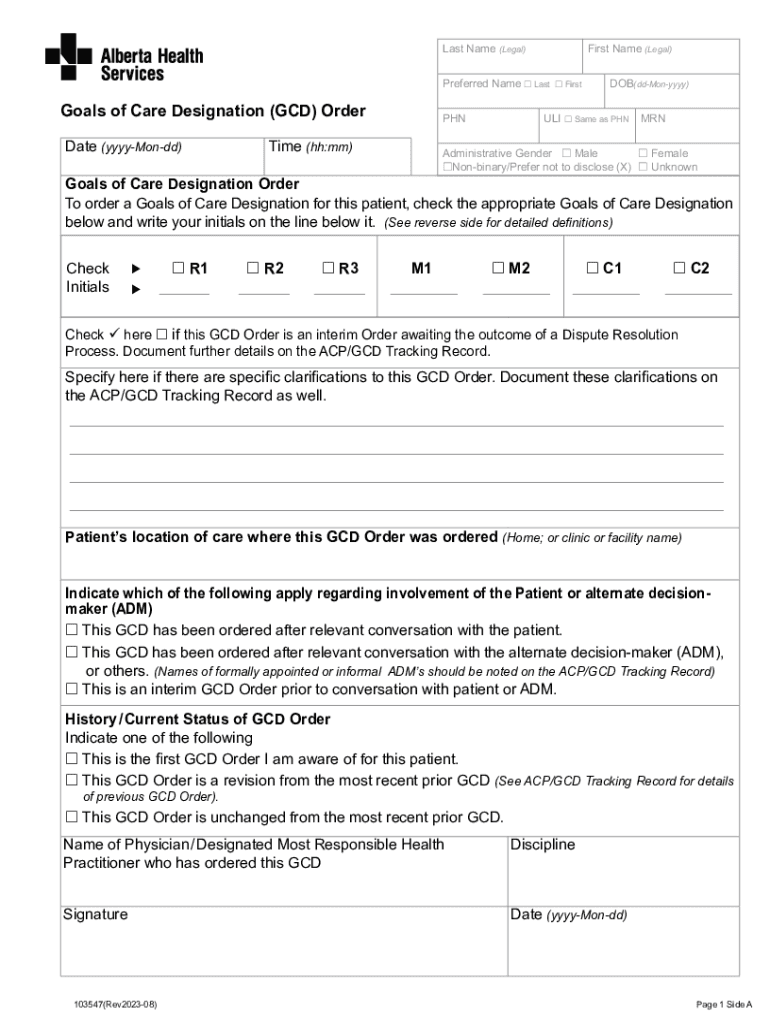
  2. Begin by entering the patient's legal last name and first name in the designated fields. Ensure accuracy for proper identification.
  3. Fill in the preferred name, Goals of Care Designation (GCD) Order date, time, PHN, DOB, ULI, and MRN as required. This information is crucial for patient records.
  4. Select the appropriate Goals of Care Designation by checking the relevant box and initialing next to it. Refer to the definitions provided on the reverse side for clarity.
  5. Indicate if this GCD Order is interim and document any specific clarifications needed on the ACP/GCD Tracking Record.
  6. Specify the patient's location of care and indicate involvement with a patient or alternate decision-maker by checking applicable boxes.
  7. Complete the history/current status section by selecting one of the options regarding previous GCD Orders.
  8. Finally, enter your name, discipline, signature, and date at the bottom of the form to finalize it.

Start using our platform today to streamline your document editing and ensure efficient workflows!

See more Emergency Department Hip Fracture Adult Order Set versions

We've got more versions of the Emergency Department Hip Fracture Adult Order Set form. Select the right Emergency Department Hip Fracture Adult Order Set version from the list and start editing it straight away!
Versions Form popularity Fillable & printable
2023 4.4 Satisfied (39 Votes)
2014 4.8 Satisfied (138 Votes)
be ready to get more

Complete this form in 5 minutes or less

Get form

Got questions?

We have answers to the most popular questions from our customers. If you can't find an answer to your question, please contact us.
Contact us
Most hip fractures are treated in one of the following ways: with metal pins, with a metal plate and screws, metal rod and screws, or replacing the broken femoral head with an artificial implant consisting of metal and plastic.
If fracture or deformity of the femur is obvious, apply a traction splint and place an intravenous (IV) line for hydration. If the patient is hypotensive or tachycardic, initiate crystalloid fluid bolus and administer supplemental oxygen.
When responding to patients with a suspected broken hip, remember these tips: Plan then move. The patient is often already in a relative position of comfort. Anticipate hypothermia. Geriatric patients have decreased thermoregulatory responses. Pain management. Splint the long bone above and below. Team lifting.
Operative management of a hip fracture should occur within 24 to 48 hours of injury unless a delay is needed to stabilize comorbidities. Early operative management improves pain control, decreases length of hospitalization, and reduces complications.
Most people will need surgery to treat a broken hip. Depending on things like your age and the type of break, you may have surgery to: fix the broken bones back into place using screws, nails, rods or plates. replace some of the damaged hip joint with an artificial part (hemiarthroplasty)

People also ask

To perform a reduction of a fracture, EMS providers start by checking for distal circulation, sensation, and motor function. Next, stabilize above and below the injury, followed by applying gentle traction to the distal extremity in the direction it is facing.

Related links