42020 Mental Health Questionnairev4 2026

Get Form
42020 Mental Health Questionnairev4 Preview on Page 1

Here's how it works

01. Edit your form online
Type text, add images, blackout confidential details, add comments, highlights and more.
02. Sign it in a few clicks
Draw your signature, type it, upload its image, or use your mobile device as a signature pad.
03. Share your form with others
Send it via email, link, or fax. You can also download it, export it or print it out.

How to use or fill out 42020 Mental Health Questionnairev4 with our platform

Form edit decoration
9.5
Ease of Setup
DocHub User Ratings on G2
9.0
Ease of Use
DocHub User Ratings on G2
  1. Click ‘Get Form’ to open the 42020 Mental Health Questionnairev4 in the editor.
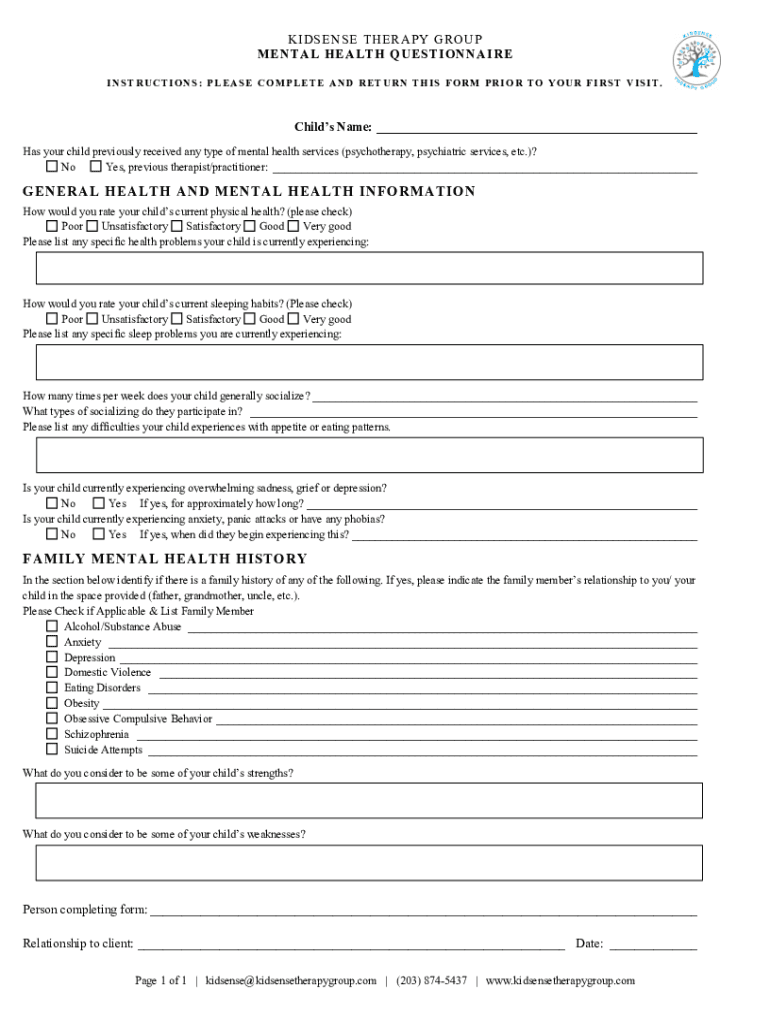
  2. Begin by entering your child’s name at the top of the form. This personalizes the document and ensures clarity.
  3. Indicate whether your child has previously received mental health services by selecting 'Yes' or 'No'. If 'Yes', provide details about the previous therapist or practitioner.
  4. In the General Health and Mental Health Information section, rate your child's physical health and sleeping habits by checking the appropriate boxes. Additionally, list any specific health or sleep problems.
  5. Answer questions regarding your child's socialization frequency and types of activities they engage in. Provide details on any appetite or eating difficulties.
  6. Respond to questions about overwhelming sadness, anxiety, or phobias, including duration and onset if applicable.
  7. Complete the Family Mental Health History section by checking applicable conditions and listing family members related to those issues.
  8. Reflect on your child's strengths and weaknesses in the designated areas before signing off with your name, relationship to the client, and date.

Start filling out your 42020 Mental Health Questionnairev4 for free today using our platform!

See more 42020 Mental Health Questionnairev4 versions

We've got more versions of the 42020 Mental Health Questionnairev4 form. Select the right 42020 Mental Health Questionnairev4 version from the list and start editing it straight away!
Versions Form popularity Fillable & printable
2021 4.9 Satisfied (50 Votes)
2020 4.8 Satisfied (25 Votes)
2019 4.4 Satisfied (46 Votes)
be ready to get more

Complete this form in 5 minutes or less

Get form

Got questions?

We have answers to the most popular questions from our customers. If you can't find an answer to your question, please contact us.
Contact us
The PHQ-9 also has been used in many studies in primary care settings, as well as with older individuals and with those who have physically disabling conditions. It is free to users and available in English and over 30 other languages.
Source. The PHQ-4 is available from .phqscreeners.com free of charge, and permission for use is not required.
The total PHQ4 score complements the subscale scores as an overall measure of symptom burden, as well as functional impairment and disability. An elevated PHQ4 score is not diagnostic, but is, instead, an indicator for further inquiry to establish the presence or absence of a clinical disorder warranting treatment.
Total score is determined by adding together the scores of each of the 4 items. Scores are rated as normal (0-2), mild (3-5), moderate (6-8), and severe (9-12). Total score 3 for first 2 questions suggests anxiety.
The PHQ-2 and PHQ-8 are self-report measures used to assess depression symptoms. The PHQ-4 is also a self-report measure for depression, but it assesses both depression and anxiety.

Security and compliance

At DocHub, your data security is our priority. We follow HIPAA, SOC2, GDPR, and other standards, so you can work on your documents with confidence.

Learn more
ccpa2
pci-dss
gdpr-compliance
hipaa
soc-compliance
be ready to get more

Complete this form in 5 minutes or less

Get form

People also ask

The Patient Health Questionnaire-4 (PHQ-4) is an ultra-brief instrument that measures depressive and anxiety symptoms. Although it has been frequently used in the last 15 years, no research has systematically reviewed its psychometric properties.

Related links