San Francisco General Hospital & Trauma Center - SFGH-POCT 2026

Get Form
San Francisco General Hospital & Trauma Center - SFGH-POCT Preview on Page 1

Here's how it works

01. Edit your form online
Type text, add images, blackout confidential details, add comments, highlights and more.

02. Sign it in a few clicks
Draw your signature, type it, upload its image, or use your mobile device as a signature pad.

03. Share your form with others
Send it via email, link, or fax. You can also download it, export it or print it out.

Definition & Purpose of San Francisco General Hospital & Trauma Center - SFGH-POCT

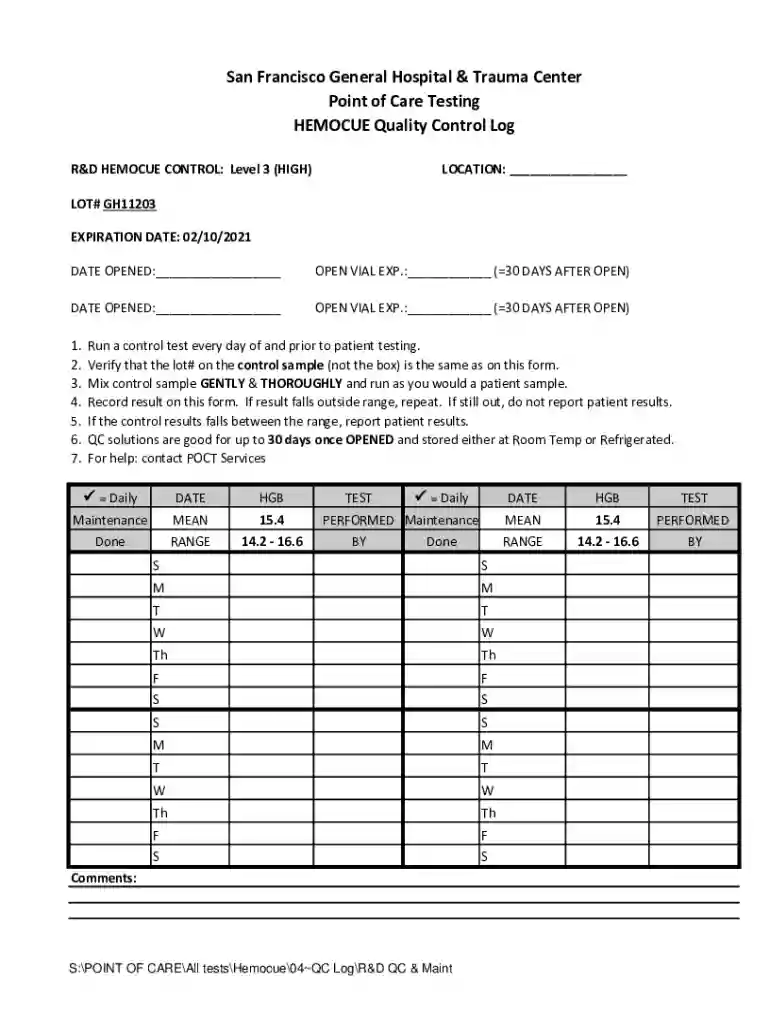
The San Francisco General Hospital & Trauma Center - SFGH-POCT form is a critical component in the management of point-of-care testing. This document serves as a guide for conducting quality control procedures essential for blood testing using HEMOCUE devices. The form outlines the necessary steps for daily control tests, emphasizes the verification of lot numbers, and provides comprehensive guidelines for recording and reporting patient results. By maintaining the integrity and accuracy of test outcomes, the document ensures that diagnostic procedures meet high standards of clinical reliability.

Key Elements of the SFGH-POCT Form

The SFGH-POCT form comprises several crucial elements that are indispensable for its proper utilization. The document details the steps required for daily quality control tests, such as:

  • Verification of lot numbers: Ensures that the correct batch of testing materials is used.
  • Maintaining QC solutions: Specifies that solutions must be used within 30 days of opening to guarantee test accuracy.
  • Data recording: Provides fields for noting results and observations, which are vital for tracking and audit purposes.

These elements are specifically designed to maintain consistency and accuracy in point-of-care testing practices.

Steps to Complete the SFGH-POCT

Completion of the SFGH-POCT form involves a series of precise steps designed to ensure comprehensive data entry and adherence to protocol:

  1. Prepare Testing Materials: Verify that all equipment is functioning and the necessary reagents are within their use dates.
  2. Conduct Daily Control Tests: Follow the outlined procedures to test control samples, ensuring the equipment is working correctly.
  3. Verify Lot Numbers: Confirm that the lot numbers of reagents match the documentation for accurate traceability.
  4. Record Results: Immediately enter test outcomes and any observations into the designated areas on the form.
  5. Review and Submit: Finalize the form by double-checking entries for completeness and accuracy before submission.

This step-by-step process is intended to guide users through the form completion systematically, minimizing errors and ensuring data integrity.

Who Typically Uses the SFGH-POCT Form

The SFGH-POCT form is primarily utilized by healthcare professionals involved in laboratory and diagnostic processes at San Francisco General Hospital & Trauma Center. This includes:

  • Laboratory Technicians: Responsible for implementing testing protocols and ensuring the correct usage of diagnostic equipment.
  • Clinical Staff: Engaged in patient care, who require accurate test results for informed decision-making.
  • Quality Assurance Personnel: Oversee the compliance with testing standards and regulatory requirements.

Each role plays a crucial part in maintaining the high-quality standards expected from health-related diagnostic tests.


decoration image ratings of Dochub

Importance of the SFGH-POCT Form

Using the SFGH-POCT form is vital for several reasons:

  • Accuracy in Testing: Provides structured guidelines to maintain diagnostic accuracy, avoiding detrimental errors in patient care.
  • Regulatory Compliance: Ensures that testing procedures adhere to mandated healthcare regulations and standards.
  • Data Integrity: Facilitates organized record-keeping, crucial for patient documentation and future reference.

These aspects highlight the form's significance in promoting effective healthcare practices and ensuring patient safety.

Legal Use and Compliance

The legal use of the SFGH-POCT form mandates strict adherence to healthcare regulations set forth by bodies such as the Clinical Laboratory Improvement Amendments (CLIA). Users must comply with these guidelines when conducting and documenting point-of-care tests. Non-compliance can result in severe penalties, including fines and loss of accreditation. Understanding these legal requirements is essential for professionals to protect themselves and their institutions from legal repercussions.

Core Procedures and Protocols

The SFGH-POCT form lays out core procedures essential for routine testing:

  • Daily Controls: Conducting checks with control samples daily ensures operational accuracy.
  • Equipment Calibration: Regular checks and calibrations of devices minimize errors.
  • Recording Anomalies: All deviations from standard procedures or unexpected results must be documented and addressed immediately.

Following these protocols is crucial for maintaining the efficacy and reliability of point-of-care testing.

Required Documentation and Supporting Material

To execute the SFGH-POCT effectively, certain documents and materials are required:

  • Quality Control Logs: Track test results and any corrective actions taken.
  • Device Manuals: Provide reference for proper handling and maintenance procedures.
  • Training Records: Verify that personnel performing tests are adequately trained and certified.

These documents serve as essential resources that support the accurate completion and interpretation of test results, ensuring comprehensive coverage of the testing process.

Practical Examples and Use Cases

Practical application of the SFGH-POCT form is widespread within the hospital setting, addressing various diagnostic needs:

  • Patient Admission: Quick bedside diagnostics streamline patient assessment and treatment initiation.
  • Emergency Situations: Rapid testing aids in the timely management of trauma cases.
  • Chronic Disease Management: Regular monitoring through point-of-care tests helps in adjusting treatment plans.

These scenarios demonstrate the form's utility and adaptability in real-world healthcare situations, contributing significantly to patient care outcomes.

See more San Francisco General Hospital & Trauma Center - SFGH-POCT versions

We've got more versions of the San Francisco General Hospital & Trauma Center - SFGH-POCT form. Select the right San Francisco General Hospital & Trauma Center - SFGH-POCT version from the list and start editing it straight away!
Versions Form popularity Fillable & printable
2022 4.3 Satisfied (53 Votes)
2020 4.1 Satisfied (42 Votes)
2015 4 Satisfied (30 Votes)
be ready to get more

Complete this form in 5 minutes or less

Get form

Got questions?

We have answers to the most popular questions from our customers. If you can't find an answer to your question, please contact us.
Contact us
Zuckerberg San Francisco General Hospital and Trauma Center in San Francisco, CA is rated high performing in 8 adult procedures and conditions. It is a general medical and surgical facility.
The Level I Trauma Center was established at The Priscilla Chan and Mark Zuckerberg San Francisco General Hospital (ZSFG) in 1968. lt is the only Trauma Center in the City and County of San Francisco with nearly 4,000 trauma activations per year.
Level I Adult and Pediatric Trauma Care ZSFG and UCSF Fresnos CRMC are Level I Trauma Centers. Level I is the highest designation awarded by the American College of Surgeons (ACS).
Level II (Potentially Life Threatening): A Level of Trauma evaluation for a patient who meets mechanism of injury criteria with stable vital signs pre-hospital and upon arrival.
Number of trauma centers by level LevelNumber of trauma centersExplore dataset Level I 254 Explore Level II 343 Explore Level III 471 Explore Level IV 930 Explore6 more rows Dec 17, 2024

Security and compliance

At DocHub, your data security is our priority. We follow HIPAA, SOC2, GDPR, and other standards, so you can work on your documents with confidence.

Learn more
ccpa2
pci-dss
gdpr-compliance
hipaa
soc-compliance
be ready to get more

Complete this form in 5 minutes or less

Get form

People also ask

Diverse patients, level 1 trauma center ZSFG is the countys only trauma center, and UCSF provides the full resources of one of the nations leading tertiary care referral centers.
Through an affiliation agreement with the city and county of San Francisco, UCSF leases or otherwise occupies space in exchange for services. UCSF faculty physicians provide all the medical care at ZSFG.

Related links