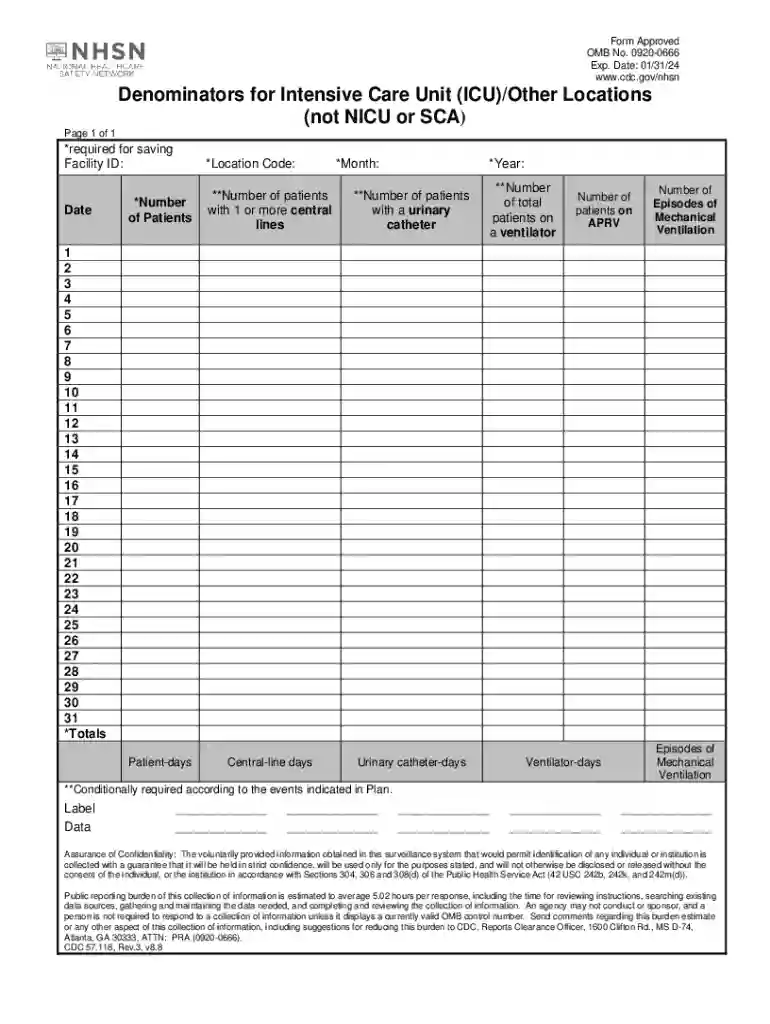
Denominators for intensive care unit form: Fill out & sign 2026

Get Form
Denominators for intensive care unit form: Fill out & sign Preview on Page 1

Here's how it works

01. Edit your form online
Type text, add images, blackout confidential details, add comments, highlights and more.

02. Sign it in a few clicks
Draw your signature, type it, upload its image, or use your mobile device as a signature pad.

03. Share your form with others
Send it via email, link, or fax. You can also download it, export it or print it out.

Definition & Meaning

The denominators for intensive care unit form are essential tools used by healthcare facilities to collect data about patient metrics within ICUs. This form tracks critical figures such as the number of patients with central lines, urinary catheters, and those on mechanical ventilation. By standardizing data collection across ICUs, the form helps maintain consistent surveillance and supports public health initiatives driven by organizations such as the CDC. Accurate data reported through these forms are crucial for monitoring trends and making informed decisions about patient care and facility operations.

How to Use the Denominators for Intensive Care Unit Form: Fill Out & Sign

Utilizing the ICU form involves multiple steps to ensure comprehensive data collection and compliance. Begin by downloading the form from the relevant healthcare platform or authority issuing the form. Once accessed, the necessary patient metrics should be gathered accurately, filling out all required fields to reflect true patient counts and conditions. The form must then be signed by an authorized personnel to authenticate the data. The secure and efficient processing of this information often calls for digital solutions like DocHub, which streamline signing and submission processes.

Steps to Complete the Denominators for Intensive Care Unit Form: Fill Out & Sign

  1. Access the Form: Obtain the form from the issuing body, ensuring it is the latest version available.
  2. Data Collection: Gather necessary patient data, focusing on the main metrics required, such as central lines, urinary catheters, and mechanical ventilation usage.
  3. Fill Out the Form: Enter the collected data accurately into the designated fields.
  4. Review Entries: Double-check all inputs for accuracy to prevent discrepancies.
  5. Sign the Form: Utilize a digital tool like DocHub for an efficient signing process, ensuring signatories authenticate the content.
  6. Submit the Form: Depending on the institution's preference, submit via digital platforms or traditional methods.

Key Elements of the Denominators for Intensive Care Unit Form: Fill Out & Sign

  • Central Line Counts: Tracks patients with central lines for infection control and resource allocation.
  • Urinary Catheter Data: Records urinary catheter use to monitor potential infection risks.
  • Mechanical Ventilation Numbers: Essential for assessing ventilation resource needs and patient care strategies.
  • Confidentiality Assurance: A critical component to ensure data privacy and compliance with legal standards.
  • Authorized Signatures: Required for data authentication and verification purposes.

Important Terms Related to Denominators for Intensive Care Unit Form: Fill Out & Sign

  • CDC Surveillance Systems: Refers to the systematic collection of ICU data for national public health monitoring.
  • Patient Metrics: The specific figures, such as those with central lines or on mechanical ventilation, that the form tracks.
  • Data Authentication: The process of verifying that all collected data are accurate and truthful, often through authorized signatures.

Who Typically Uses the Denominators for Intensive Care Unit Form: Fill Out & Sign

Healthcare administrators, ICU managers, and designated hospital staff are generally responsible for filling out and signing this form. These individuals ensure that the data reported pertain to the ICU's current operations, supporting both internal hospital quality control measures and broader public health reporting initiatives.


decoration image ratings of Dochub

Examples of Using the Denominators for Intensive Care Unit Form: Fill Out & Sign

A hospital may use the form to track and report ICU metrics across different healthcare settings. For instance, in a scenario where there is a sudden rise in ICU admissions, swift utilization of this form enables the facility to communicate resources and needs effectively to public health bodies, aiding in potential intervention measures. Furthermore, during routine patient care assessments, the data collected help inform best practices for infection control within the ICU environment.

Legal Use of the Denominators for Intensive Care Unit Form: Fill Out & Sign

This form is utilized within the framework of legal obligations for data reporting in healthcare settings. Bodies like the CDC mandate its use to maintain a standardized approach to patient data collection, which is critical for legal accountability in public health management. Failure to properly complete and submit this form can result in regulatory challenges and penalties, emphasizing the importance of understanding and adhering to compliance requirements in its usage.

See more Denominators for intensive care unit form: Fill out & sign versions

We've got more versions of the Denominators for intensive care unit form: Fill out & sign form. Select the right Denominators for intensive care unit form: Fill out & sign version from the list and start editing it straight away!
Versions Form popularity Fillable & printable
2020 4.7 Satisfied (29 Votes)
2018 4.5 Satisfied (58 Votes)
be ready to get more

Complete this form in 5 minutes or less

Get form

Got questions?

We have answers to the most popular questions from our customers. If you can't find an answer to your question, please contact us.
Contact us
An intensive care unit (ICU) is a specialised section in a hospital dedicated to providing critical care and life support to critically ill or severely injured patients.
Intensive care is needed if someone is seriously ill and requires intensive treatment and close monitoring, or if theyre having surgery and intensive care can help them recover. Most people in an ICU have problems with 1 or more organs. For example, they may be unable to breathe on their own.
Device Days. A count of the number of patients with a specific device on the inpatient location. For each day of the month, at the same time each day, record the number of patients who have the specific device (e.g., central line, ventilator, or indwelling urinary catheter). At the end of the month, the sum is recorded
Intensive Care Units (ICUs) are a highly specialised area providing advanced care such as close monitoring, advanced medical treatment, and organ support for critically ill and injured patients and their families.
Critical care is for hospital patients with serious health problems who need intensive medical care and monitoring. Patients in intensive care units, also called ICUs, are cared for by a team of providers that may include: Specially trained nurses.

Security and compliance

At DocHub, your data security is our priority. We follow HIPAA, SOC2, GDPR, and other standards, so you can work on your documents with confidence.

Learn more
ccpa2
pci-dss
gdpr-compliance
hipaa
soc-compliance

People also ask

Admission to the Intensive Care Unit (ICU)/High Dependency Unit (HDU) A patient whose condition is extremely serious, possibly life-threatening, is often taken to an Intensive Care Unit (ICU) which provides constant observation and treatment from specially trained staff qualified to use specialised equipment.

Related links