
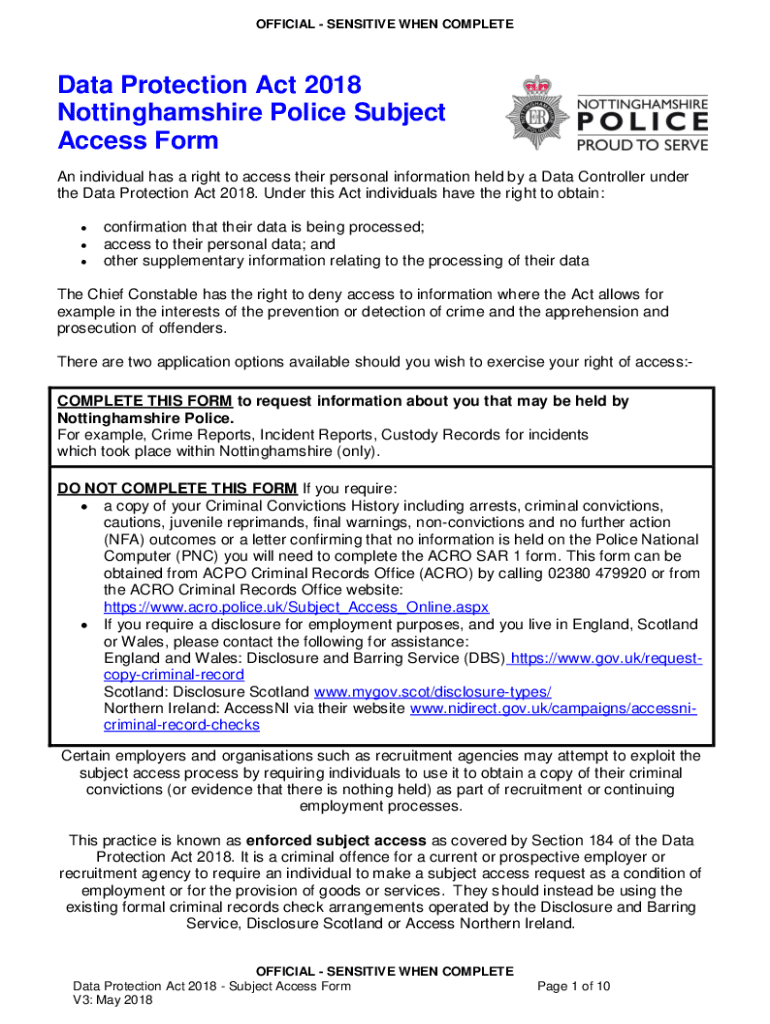



What is the Data Protection Act?Nottinghamshire Police 2026

Get Form
What is the Data Protection Act?Nottinghamshire Police Preview on Page 1

Here's how it works

01. Edit your form online
Type text, add images, blackout confidential details, add comments, highlights and more.

02. Sign it in a few clicks
Draw your signature, type it, upload its image, or use your mobile device as a signature pad.

03. Share your form with others
Send it via email, link, or fax. You can also download it, export it or print it out.

How to use or fill out What is the Data Protection Act? Nottinghamshire Police with our platform

Form edit decoration
9.5
Ease of Setup
DocHub User Ratings on G2
9.0
Ease of Use
DocHub User Ratings on G2
  1. Click ‘Get Form’ to open it in the editor.
  2. Begin by completing Section 1, which requires your personal details such as title, surname, first name, date of birth, and current postal address. Ensure that the address matches your identity documents.
  3. In Section 2, select your preferred method for receiving the disclosure: email, post, or collection from a police station. If you choose email, provide a valid email address.
  4. Fill out Section 3 with specific details about the information you are requesting. Be as detailed as possible to assist in locating your records.
  5. Complete Section 4 by signing and dating the form to confirm that all information provided is accurate.
  6. Attach two forms of identification as specified in the guidance notes and submit the completed form to Nottinghamshire Police.

Start using our platform today to easily fill out your Data Protection Act request form for free!

See more What is the Data Protection Act?Nottinghamshire Police versions

We've got more versions of the What is the Data Protection Act?Nottinghamshire Police form. Select the right What is the Data Protection Act?Nottinghamshire Police version from the list and start editing it straight away!
Versions Form popularity Fillable & printable
2018 4.2 Satisfied (57 Votes)
2015 4 Satisfied (56 Votes)
be ready to get more

Complete this form in 5 minutes or less

Get form

Got questions?

We have answers to the most popular questions from our customers. If you can't find an answer to your question, please contact us.
Contact us
it provides individuals with rights, including the right to know what information is held about them and the right to access that information. it states that anyone who processes personal information must comply with the principles in the Act.
The Act works in two ways: it provides individuals with rights, including the right to know what information is held about them and the right to access that information. it states that anyone who processes personal information must comply with the principles in the Act.
Anyone responsible for using personal data must make sure the information is: used fairly, lawfully and transparently.
If your company handles personal data, its important to understand and comply with the 7 principles of the GDPR. The principles are: Lawfulness, Fairness, and Transparency; Purpose Limitation; Data Minimisation; Accuracy; Storage Limitations; Integrity and Confidentiality; and Accountability.
The EUs Data Protection Reform package, which contained the General Data Protection Regulation, also contained a Directive on the processing of personal data for authorities responsible for preventing, investigating, detecting and prosecuting crimes.

Security and compliance

At DocHub, your data security is our priority. We follow HIPAA, SOC2, GDPR, and other standards, so you can work on your documents with confidence.

Learn more
ccpa2
pci-dss
gdpr-compliance
hipaa
soc-compliance
be ready to get more

Complete this form in 5 minutes or less

Get form

People also ask

Lawfulness, fairness, and transparency; ▪ Purpose limitation; ▪ Data minimisation; ▪ Accuracy; ▪ Storage limitation; ▪ Integrity and confidentiality; and ▪ Accountability. These principles are found right at the outset of the GDPR, and inform and permeate all other provisions of that legislation.
The Data (Use and Access) Act 2025 ( DUAA , the Act) received Royal Assent on 19 June 2025. This is a wide-ranging Act which includes provisions to enable the growth of digital verification services, new Smart Data schemes like Open Banking and a new National Underground Asset Register.

Related links

