
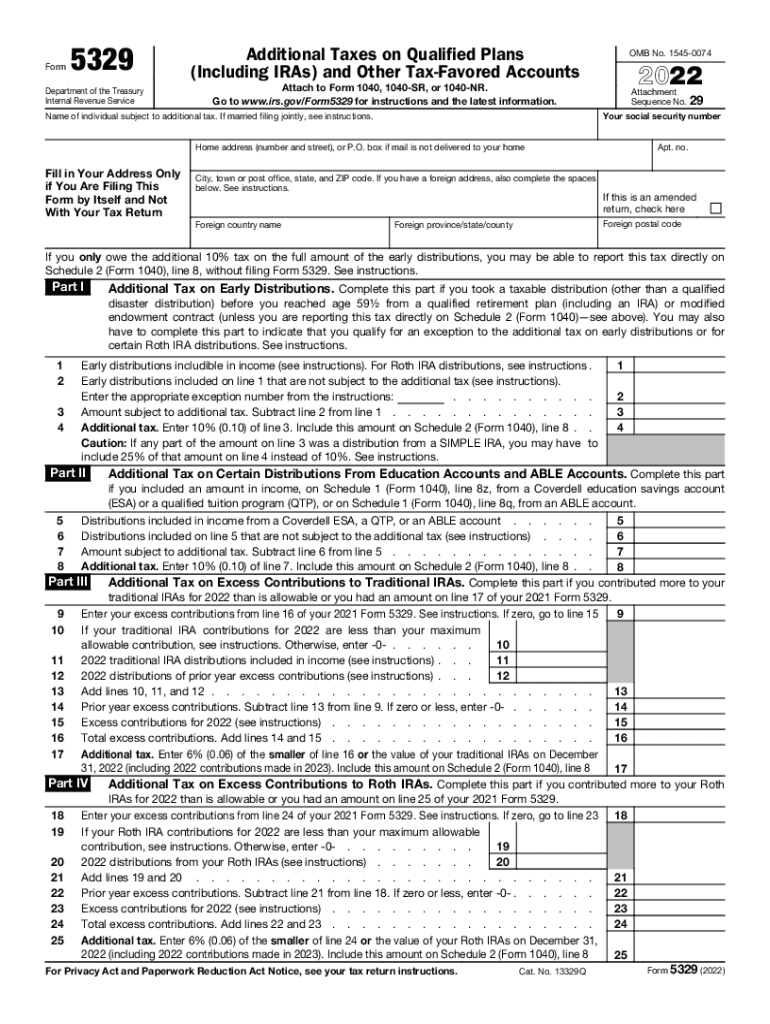







Definition and Purpose of Form 5329
Form 5329, known as "Additional Taxes on Qualified Plans (including IRAs)," is a vital document for individuals reporting additional taxes related to their retirement accounts. This form is primarily used to detail taxes on early distributions, excess contributions, and failure to meet minimum distribution requirements. Each of these areas carries specific tax implications, which Form 5329 helps to quantify and report to the IRS. By accurately completing this form, individuals ensure compliance with tax regulations and avoid potential penalties.
Importance of Form 5329
Form 5329 plays a crucial role in the accurate reporting of additional taxes associated with retirement accounts such as IRAs and other qualified plans. The form serves as a mechanism to report penalties and taxes incurred from non-compliance with the IRS guidelines on retirement accounts. These could include early withdrawals before the age of 59½, excess contributions, or unsuccessful adherence to required minimum distributions (RMDs). Utilizing this form helps both individuals and tax professionals manage tax obligations effectively and avoid unnecessary penalties.
Steps to Complete Form 5329
-
Understand Eligibility: Before tackling the form, determine if you need to report additional taxes due to early distributions, excess contributions, or failure to meet RMDs.
-
Gather Necessary Financial Information: Collect data related to your withdrawals, contributions, and the status of your retirement accounts.
-
Section-by-Section Completion:
- Part I: Report taxes on early distributions from IRAs and qualified retirement plans.
- Part II: Account for taxes related to distributions exceeding the lifetime amount.
- Part III and Beyond: Detail additional sections that relate to specific scenarios, such as taxes on education savings accounts.
-
Attach to Tax Return: Once completed, Form 5329 must be attached to your federal tax return, usually Form 1040, 1040-SR, or 1040-NR.
-
Review for Accuracy: Double-check all entries to ensure accuracy and compliance with IRS guidelines.
Who Needs to Use Form 5329
Form 5329 is typically used by individuals who have incurred penalties due to premature distributions from retirement accounts or have excess contributions that were not corrected. It is also used by those who did not meet their RMDs. Generally, taxpayers who manage their own retirement accounts and advisors handling multiple clients’ accounts will find this form essential. Understanding the necessity of this form is crucial for retirees, individuals planning early withdrawals for specific reasons, and those contributing to several retirement accounts.
Key Elements of Form 5329
Form 5329 consists of several parts addressing different types of additional taxes:
- Early Withdrawal Penalties: Calculate the tax for distributions taken before age 59½.
- Excess Contribution Penalties: Identify and quantify penalties for contributing above the allowable limits.
- RMD Penalties: Address penalties for not taking the required minimum distributions.
Each section provides a structured method to report specific tax obligations, ensuring compliance with IRS rules and regulations.
Important Terms Related to Form 5329
Familiarity with certain terms is crucial when dealing with Form 5329:
- Qualified Plan: Retirement plans qualifying for tax benefits under IRS rules, such as 401(k)s and IRAs.
- Early Distribution: Withdrawals taken prior to the eligible age for retirement accounts that often lead to penalties.
- Excess Contribution: Contributions exceeding IRS limits that may incur taxes.
- Minimum Distribution: Required distributions from retirement accounts after reaching a certain age.
Understanding these terms ensures accurate completion of Form 5329 and compliance with tax laws.
IRS Guidelines for Form 5329
The IRS provides comprehensive guidelines for completing Form 5329. These guidelines help individuals identify taxable distributions, understand their obligations regarding excess contributions, and manage penalties associated with not meeting RMDs. The IRS specifies deadlines for filing and submitting this form as part of your tax return and offers resources for taxpayers needing further clarification on their reporting responsibilities.
Penalties for Non-Compliance
Failure to correctly complete Form 5329 or to include it in your tax filing when required can lead to significant penalties. The IRS imposes penalties on early withdrawals, uncorrected excess contributions, and missed RMDs if they are not reported correctly on Form 5329. Understanding these penalties and accurately reporting them helps avoid additional interest and penalties from the IRS, safeguarding your financial well-being.




