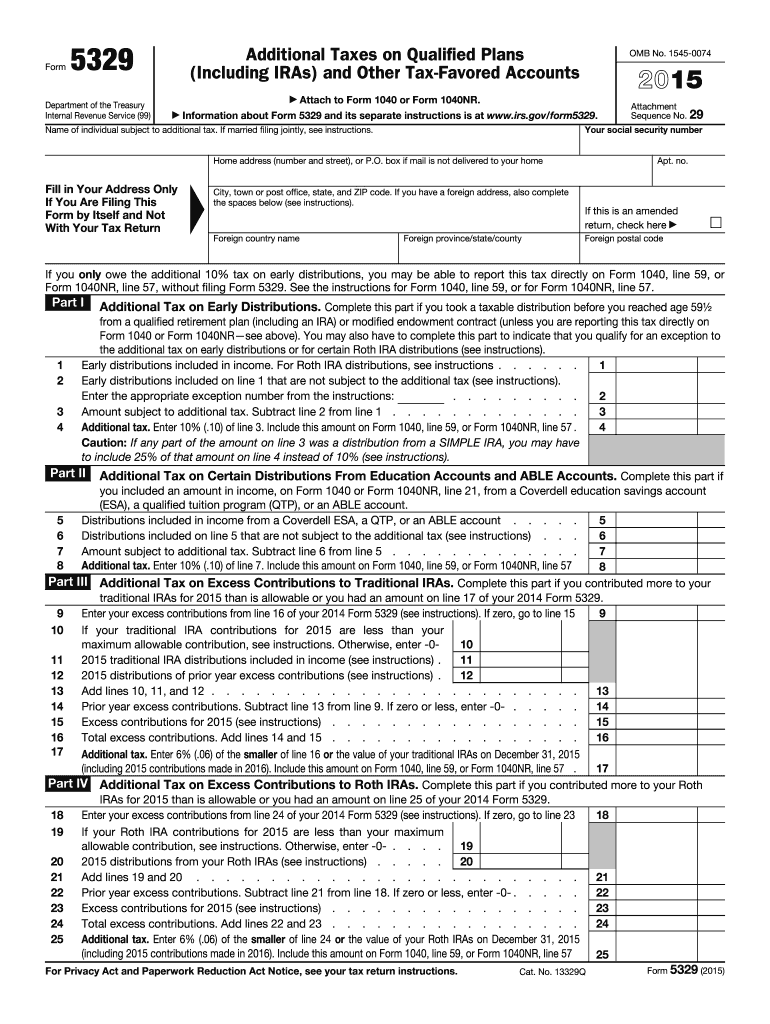







Definition and Meaning of 2015 Form 5329
Form 5329 for the year 2015 is utilized by individuals to report additional taxes on IRAs and other tax-favored accounts, primarily focusing on calculating taxes associated with early distributions, excess contributions, and failure to meet required minimum distributions. The form plays a critical role in highlighting penalties related to the improper handling of retirement accounts. It is typically attached to an individual’s tax return, such as Form 1040 or Form 1040NR, ensuring that all additional taxes are properly documented and declared.
Form 5329 encompasses specific sections, each designed to address different aspects of retirement account taxation. The penalties that it helps calculate primarily include the early distribution penalty for withdrawals taken before reaching the age of 59½ and the penalty for excess contributions that remain in accounts beyond the allowed limits. Understanding the intricacies of this form is crucial for taxpayers aiming to avoid errors that could lead to fines or penalties.
Important Terms Related to 2015 Form 5329
To navigate Form 5329 effectively, it's important to become familiar with its key terminology:
- Qualified Plans: These include retirement savings plans such as IRAs and other tax-beneficial accounts.
- Early Distribution: Withdrawals taken from a retirement account before the account holder reaches the age of 59½, typically subject to additional taxes.
- Excess Contributions: Contributions made beyond the legal limits into a retirement account, potentially subject to penalties if not corrected.
- Required Minimum Distribution (RMD): The minimum amount that must be withdrawn from certain retirement accounts annually after reaching a specific age, previously 70½ in 2015.
- Additional Taxes: Taxes imposed on early distributions and excess contributions that are calculated using Form 5329.
A thorough understanding of these terms is essential for correctly completing the form and ensuring taxes are accurately reflected.
Steps to Complete the 2015 Form 5329
Completing Form 5329 requires careful attention to detail and a systematic approach:
-
Gather Required Information: Before starting, collect information about your IRAs and other tax-favored accounts, including records of contributions, distributions, and the age of the account holder.
-
Determine Section Relevance: Identify which sections of the form are applicable based on your specific tax situation. This may include sections on early distributions or excess contributions.
-
Fill Out the Applicable Sections: Enter the necessary information for each applicable section, using IRS instructions for precise guidelines.
-
Calculate Penalties and Taxes: Utilize the form to calculate any penalties or additional taxes owed, ensuring each calculation is accurate and clearly documented.
-
Attach to Main Tax Return: Once completed, attach Form 5329 to your Form 1040 or 1040NR, ensuring all calculations are incorporated into your overall tax filing.
-
Review and File: Double-check all entries for accuracy, ensuring consistency across all documents before final submission.
Completing these steps with careful attention helps prevent mistakes that might incur further penalties from the IRS.
Who Typically Uses the 2015 Form 5329
Form 5329 is primarily used by individuals who have engaged in activities associated with retirement accounts that may trigger additional tax considerations:
-
Individuals Under 59½: Those who have taken early distributions from their retirement accounts and need to report associated penalties.
-
Account Holders with Excess Contributions: Those who have exceeded contribution limits in their retirement accounts and are reporting penalties.
-
Retirees: Individuals over the age of 70½ are dealing with required minimum distributions and need to account for any deficiencies.
Each type of taxpayer uses the form to ensure that their additional tax liabilities are comprehensively reported and rectified within their annual tax filing.

IRS Guidelines for the 2015 Form 5329
The IRS provides specific guidelines on how to fill out Form 5329. Following these guidelines is crucial for ensuring compliance:
-
Correct Use of Sections: Determine which sections apply to the taxpayer's circumstances. Only specific sections of the form may be required depending on individual tax situations.
-
Accurate Calculation of Penalties: The form contains instructions on how to calculate penalties accurately to avoid misreporting taxes.
-
Timely Filing: The form should be completed and filed along with the taxpayer's yearly tax return, ensuring that all additional taxes and penalties are correctly integrated into the overall tax liability.
Following IRS guidelines meticulously ensures that there are no errors in reporting, which can otherwise lead to further audits or penalties.
Penalties for Non-Compliance
Failing to accurately file or include Form 5329 with a tax return can result in several adverse consequences:
-
Increased Penalties: Additional penalties may be incurred for incorrect reporting of early distributions or excess contributions.
-
IRS Audits: Inaccuracies or omissions could trigger an IRS audit, leading to further scrutiny and potential penalties.
-
Interest Accrual: Any unpaid penalties or taxes may accrue interest, increasing the taxpayer's overall liability over time.
To avoid these outcomes, taxpayers must ensure accurate and complete filing of the form as an integral part of their compliance strategy.
Obtaining the 2015 Form 5329
There are various avenues to acquire Form 5329 for the year 2015, whether through physical or digital means:
-
Online from IRS Website: The form can be downloaded directly from the IRS website, where users can access both the form and accompanying instructions.
-
Tax Preparation Software: Software tools often include the form as part of their tax filing offerings, facilitating digital completion and submission.
-
Tax Professionals: Engaging a tax advisor or accountant can provide access to the form as part of a professional tax preparation service.
Using these methods, taxpayers can access Form 5329 efficiently and ensure it is included in their tax returns.
Examples of Using the 2015 Form 5329
Several scenarios illustrate when and how Form 5329 is appropriately used:
-
Early IRA Withdrawal: A taxpayer takes a $10,000 distribution at age 50 to fund a new business venture. They must report and calculate the 10% penalty using Form 5329.
-
Excess Roth IRA Contributions: An individual contributes $2,000 over the allowable Roth IRA limit and must use the form to report and plan the removal of the excess amount.
-
RMD Shortfall: Upon reaching 70½, a retiree fails to withdraw the full RMD amount from their traditional IRA, necessitating the use of Form 5329 to report and address the shortfall.
These examples highlight the form's role in ensuring compliance and avoiding unnecessary penalties.