




Understanding Form 5329: Definition & Purpose
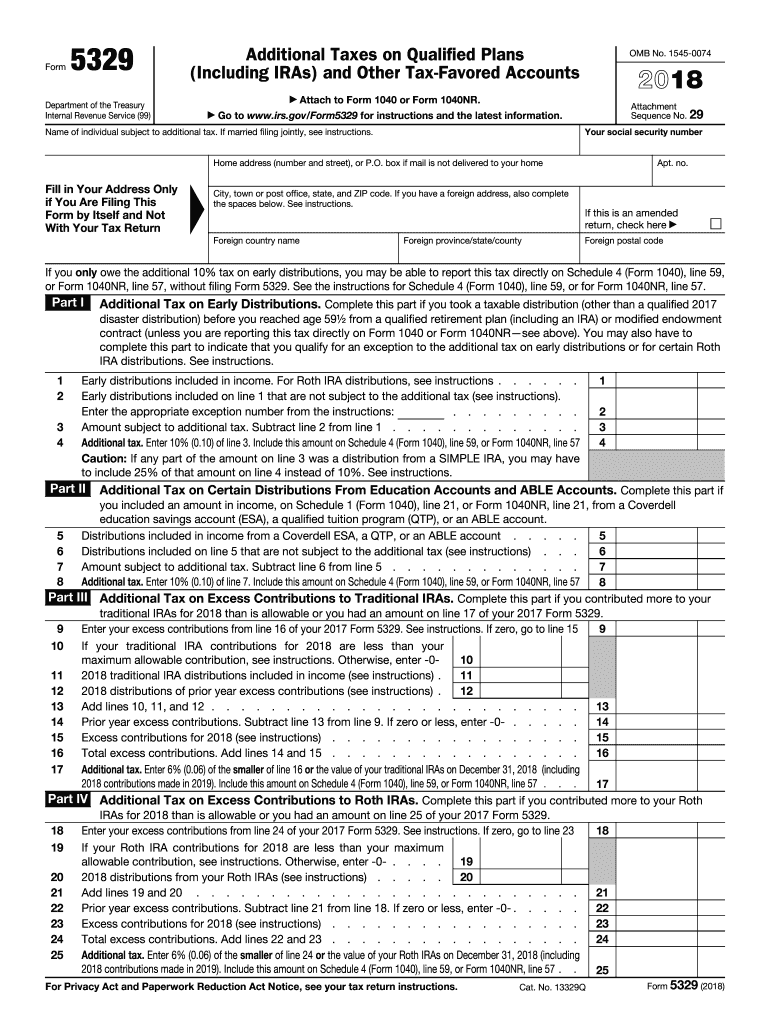
Form 5329, officially titled "Additional Taxes on Qualified Plans (Including IRAs) and Other Tax-Favored Accounts," is utilized by taxpayers in the United States to report various taxes related to retirement plans. It serves a crucial role in reporting penalties or additional taxes that may apply to individual retirement accounts (IRAs) and other tax-advantaged accounts such as 401(k)s. The form is primarily used to acknowledge early distributions, excess contributions, and missed required minimum distributions (RMDs). Understanding when and why this form is necessary ensures compliance with the Internal Revenue Service (IRS) regulations.
How to Obtain Form 5329
Taxpayers can obtain Form 5329 from the official Internal Revenue Service (IRS) website, where the form is available for download as a PDF file. This provides the option to fill it out either electronically or in print form. It's also commonly available through tax preparation software, such as TurboTax or H&R Block, often used alongside Form 1040 during tax season. Access to the form can also be requested through tax professionals who assist with tax filings.
Steps to Complete Form 5329
Completing Form 5329 involves several critical steps:
-
Personal Information: Begin by entering your personal details, including name and Social Security number.
-
Calculate Penalties: Determine applicable penalties for early withdrawals or other tax-related issues associated with retirement accounts.
-
Report Additional Taxes: Use the form to report any additional taxes related to qualified retirement accounts, taking note of specific instructions for different sections such as early distributions or excess contributions.
-
Attach to Tax Return: Ensure Form 5329 accompanies your Form 1040 or 1040NR when filing.
-
Review and Submit: Double-check all entries for accuracy and completeness before submitting.
Reasons to Use Form 5329
Form 5329 is essential for several reasons:
- Early Distributions: It reports penalties applied to distributions taken before the age of 59½.
- Excess Contributions: It assists in addressing excess contributions made to retirement accounts beyond the annual limit.
- Missed RMDs: It helps in reporting and potentially waiving penalties for failing to meet RMDs from retirement accounts.
Understanding these reasons ensures taxpayers are not caught off-guard by unexpected tax liabilities.
Who Typically Uses Form 5329
Individuals who engage in transactions that deviate from standard IRS rules for retirement accounts typically utilize Form 5329. This includes:
- People under 59½: Those who withdraw from IRAs or 401(k)s early.
- High-Income Earners: Individuals exceeding contribution limits on retirement accounts.
- Retirees: Who might miss required minimum distributions.
Knowing the typical users helps target the appropriate audience needing this form.
Key Elements of Form 5329
Form 5329 contains several sections, each focusing on a specific tax scenario associated with retirement accounts:
- Part I: Addresses early distributions and the associated 10% penalty.
- Part II-VIII: Deals with other issues such as excess contributions and missed withdrawals.
- Signature and Date: Final required step, ensuring taxpayer accountability.
Each part corresponds to specific retirement account activities, making it essential to understand the applicable sections.
IRS Guidelines for Form 5329
The IRS provides detailed guidelines on how to fill out Form 5329, including instructions for each part. Key points include:
- Use Publication 590-A & B: For comprehensive instructions on retirement account contributions and distributions.
- Waiver Requests: Situations allowing for penalty waivers, such as medical expenses.
- Filing Requirements: Stipulations on who must file the form based on account activities.
These guidelines are crucial for correct form completion and avoiding unnecessary penalties.
Filing Deadlines and Important Dates for Form 5329
Form 5329 must be filed alongside the individual's annual tax return, generally due by April 15. Key dates include:
- Extension Deadlines: Taxpayers can file for an extension, granting additional time to submit by October 15.
- Amendment Periods: Correct or amend a previously filed Form 5329 within three years.
Adhering to these deadlines avoids late filing penalties and interest charges on owed taxes.
Penalties for Non-Compliance with Form 5329
Failing to file Form 5329 or omitting required information may lead to IRS-imposed penalties, including:
- Monetary Fines: Failure to report early distributions can result in a 10% penalty.
- Interest Charges: Accumulate on unpaid taxes from retirement account activities.
- Increased Audits: Non-compliance could trigger an IRS audit, further complicating tax affairs.
Awareness of these penalties emphasizes the importance of correct and timely filing.