





Definition & Meaning
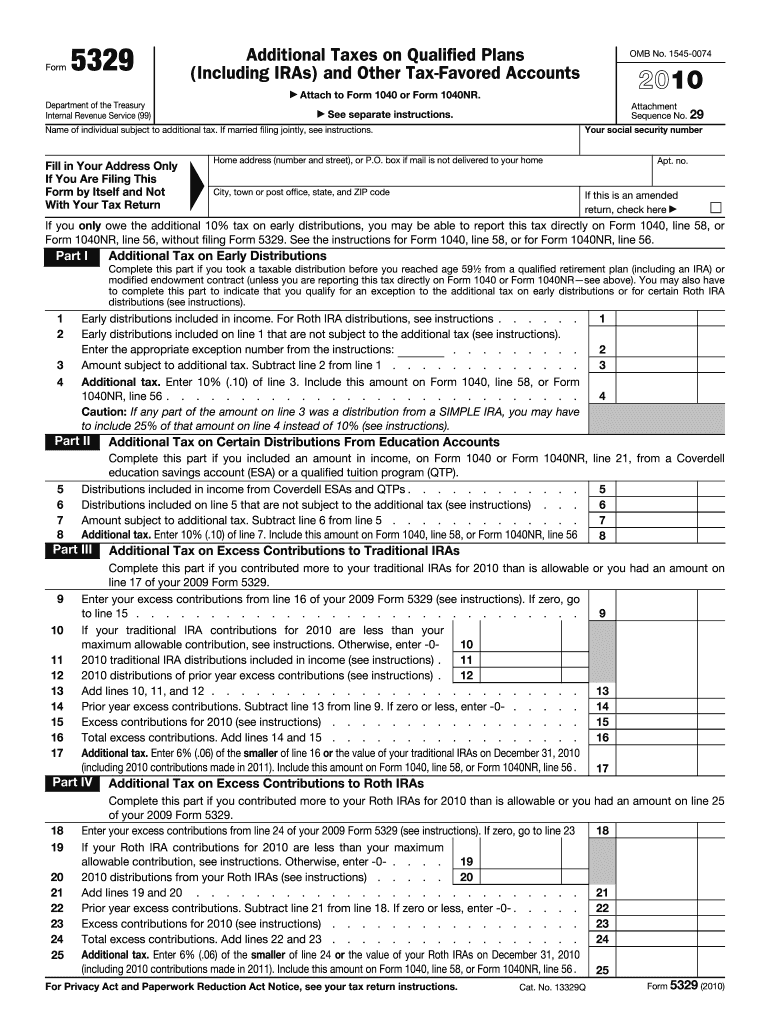
Form 5329 is a tax document used to report additional taxes related to qualified plans, like IRAs and other tax-favored accounts, including for the 2010 tax year. Specifically, it accounts for additional taxes on premature distributions, excess contributions to traditional and Roth IRAs, Coverdell ESAs, Archer MSAs, and HSAs. This form also details penalties associated with missed required minimum distributions. Accurate completion and submission of this form are essential to ensure compliance with the IRS regulations.
How to Use the 2 Form
To use the 2010 Form 5329, taxpayers must identify the particular sections applicable to their financial situation. The form covers early distributions, excess contributions, and failure to take mandatory distributions. Taxpayers begin by gathering all necessary financial records that support each of these aspects, such as account statements and prior tax filings. After filling out the relevant sections, taxpayers attach the completed Form 5329 to their main tax return, either Form 1040 or 1040NR.
Steps to Complete the 2 Form
- Gather Documents: Collect financial records, such as account statements showing contributions and distributions.
- Identify Sections: Determine applicable sections for your financial activities related to early withdrawals, excess contributions, or missed distributions.
- Fill Out Form: Input details into each corresponding section of Form 5329, take note of any calculations for additional taxes.
- Attach to Tax Return: Once filled, attach Form 5329 to your Form 1040 or 1040NR.
- Finalize and Submit: Ensure all numbers are accurate and that the form is correctly completed before submitting it along with your tax return.
Who Typically Uses the 2 Form
Individuals who utilize tax-favored retirement accounts like IRAs often need Form 5329. This includes people who have taken early distributions, contributed beyond the annual limits, or missed required minimum distributions. Retirees, investors, and individuals managing health savings accounts or education savings accounts may also find this form relevant when unexpected tax issues arise due to these activities.

Important Terms Related to the 2 Form
- Early Distribution: Withdrawals taken from retirement accounts before the age of 59½ that are not exceptions and are subject to additional taxes.
- Excess Contributions: Contributions to retirement accounts exceeding the IRS allowable limits for the year.
- Required Minimum Distributions (RMDs): The minimal amount that must be withdrawn each year starting at age 72 from certain retirement accounts.
- Coverdell ESAs: Educational savings accounts that provide tax advantages for educational expenses.
- Archer MSAs and HSAs: Accounts designed to pay for medical expenses with associated tax benefits.
IRS Guidelines
The IRS provides specific guidelines on how, when, and where to file Form 5329. The form must be filed with the taxpayer's annual income tax return. For accuracy in reporting, individuals are encouraged to reference IRS instructions specific to Form 5329, ensuring they follow the prescribed calculations for additional taxes. The guidelines help taxpayers stay compliant and avoid possible penalties due to inaccurate filing.
Filing Deadlines / Important Dates
Form 5329 should be filed with an individual's tax return, typically due by April 15 following the tax year. Extensions may be available, but the form must be filed promptly to prevent penalties. It is important to file before this date, or if seeking an extension, adhere to the IRS’s procedures for requesting one.
Penalties for Non-Compliance
Failing to file a correct Form 5329 can lead to significant IRS penalties. Penalties may include charges for underpayment of taxes due to incorrect reporting of early distributions, excess contributions, or missed RMDs. To avoid these, taxpayers should ensure full compliance and consider professional assistance if they are unsure about their tax obligations related to these issues.
Form Submission Methods (Online / Mail / In-Person)
Form 5329 can be submitted physically through the mail or electronically alongside the main tax return using approved e-filing platforms. Many tax preparation software programs are compatible with Form 5329 and guide users through its detailed requirements. Utilizing trusted electronic submission services can ensure faster processing and reduce the possibility of errors compared to manual completion and filing.