




01. Edit your form 314 federal online
Type text, add images, blackout confidential details, add comments, highlights and more.

Type text, add images, blackout confidential details, add comments, highlights and more.

Draw your signature, type it, upload its image, or use your mobile device as a signature pad.

Send form 314 via email, link, or fax. You can also download it, export it or print it out.
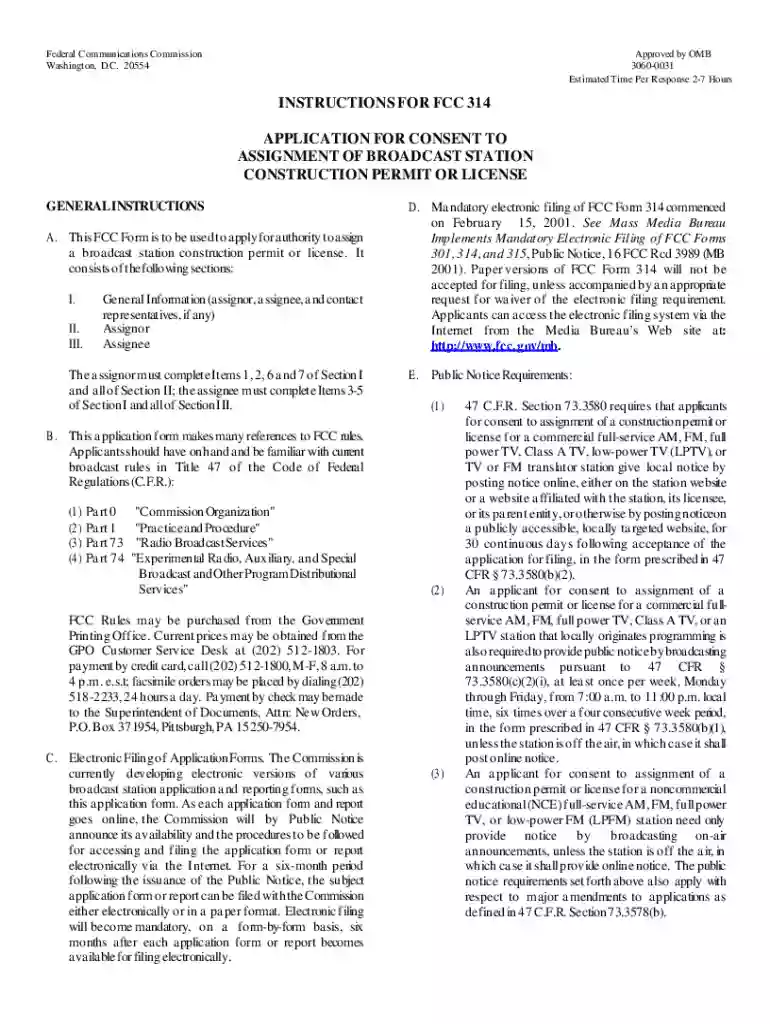
FCC Form 314 is an essential document used for securing consent from the Federal Communications Commission (FCC) to assign a broadcast station construction permit or license. This form is crucial for entities looking to transfer ownership or control of a broadcast station. The assignment might involve the transfer of station assets or the transfer of a controlling interest in a licensee corporation. By submitting FCC Form 314, applicants seek approval to ensure compliance with the FCC's regulatory framework, which promotes fair broadcasting practices and ensures that the public interest is served.
The need for this form underscores the regulatory oversight the FCC maintains over broadcasting entities in the U.S. It includes various certifications related to financial qualifications, character issues, and ownership restrictions, providing a safeguard against unqualified or non-compliant entities gaining control of broadcasting licenses. Understanding its requirements is vital for any entity involved in the broadcasting industry.
Using FCC Form 314 requires careful attention to detail and adherence to specific guidelines. The form is comprehensive, designed to gather all necessary information to evaluate the proposed assignment of a broadcast station.
Access and Preparation: Applicants should first access the form through the FCC's website. It is advisable to gather all necessary information related to the assignor and assignee, including financial statements and ownership structures, before beginning the form.
Section Completion: Navigate through the form, ensuring each section, such as general information, certifications, and public notice requirements, is thoroughly completed. Each section must be accurate and reflect current, verifiable information.
Review: Before submission, review the form for completeness and accuracy to prevent delays or rejections.
Submission: Submit the completed form electronically, as per the FCC's requirement for mandatory electronic filing.
By meticulously following these steps, applicants can ensure a smooth submission process and increase their chances of a favorable outcome.
Completing FCC Form 314 involves several key steps, each requiring precise execution to meet federal requirements.
Gather Required Information: Collect demographic, financial, and structural details about the broadcast station and the entities involved. This includes the licensee's and assignee's legal names, addresses, and FCC registration numbers.
Certifications: Address all required certifications. This includes affirming compliance with FCC rules on ownership, character qualifications, and financial capability.
Public Notice: Provide evidence of compliance with public notice obligations, including any related community or public interest disclosures.
File Electronically: Use the FCC’s Licensing and Management System (LMS) to submit the form. Ensure you have an account set up to facilitate this.
Confirmation and Follow-up: After filing, confirm the receipt of the application and monitor any queries or additional information requests from the FCC.
By following this structured approach, applicants can ensure all facets of the application are addressed, reducing potential barriers to approval.
Several terminologies are integral to understanding FCC Form 314. These terms clarify the form's scope and application:
Grasping these terms equips applicants with the necessary vocabulary to understand and accurately complete FCC Form 314.
FCC Form 314 is used legally within the framework of the United States' communication regulatory landscape. It allows for the transfer of broadcast licenses while ensuring adherence to federal standards intended to maintain a diverse, competitive, and ethical media environment.
Entities submitting this form must affirm their understanding of and compliance with several legal obligations, including:
Navigating these legal requirements is crucial to successfully utilizing FCC Form 314.
FCC Form 314 contains various critical components designed to gather comprehensive information on the license transfer. Key elements include:
These elements are essential for the FCC to assess the transaction's impact and ensure alignment with regulatory standards.
To apply for an assignment using FCC Form 314, entities must meet specific eligibility criteria, ensuring only qualified applicants proceed with station assignments:
Fulfillment of these criteria is critical before any proceedings with FCC Form 314, as they establish suitability to oversee a broadcast license responsibly.


The application process for FCC Form 314 requires methodical preparation and submission, with specific timelines impacting approval:
Pre-Submission Preparation: Gather all necessary documentation and evidence that buttresses the public interest alignment of the transfer.
Submission Window: While there are no predetermined deadlines for submission, strategic timing can impact approval speed, particularly if aligned with FCC processing cycles.
Review Period: Post-submission, expect a review period where the FCC evaluates the application for compliance and eligibility. This can range from a few weeks to several months, depending on complexity and FCC workload.
Approval Notification: Applicants will receive direct notification of the FCC's decision, which may include conditions to be met prior to finalizing the license transfer.
By adhering to this process and timelines, applicants can manage expectations and better predict the outcome of their license assignment application.
We've got more versions of the form 314 federal form. Select the right form 314 federal version from the list and start editing it straight away!
At DocHub, your data security is our priority. We follow HIPAA, SOC2, GDPR, and other standards, so you can work on your documents with confidence.
Elements RCA outputs are true Line Outputs. The Headphone Amplifiers knob adjusts the headphone output. DAC line-level output may be adjusted at your PC,Read more
(c) Application for consent to the assignment of construction permit or license must be filed on FCC Form 2100 Schedule 314 Assignment of License orRead more
Generally, applicants seeking to assign licenses or permits of AM, FM, or TV broadcast stations are required to submit a fee with the filing of FCC Form 314.Read more


