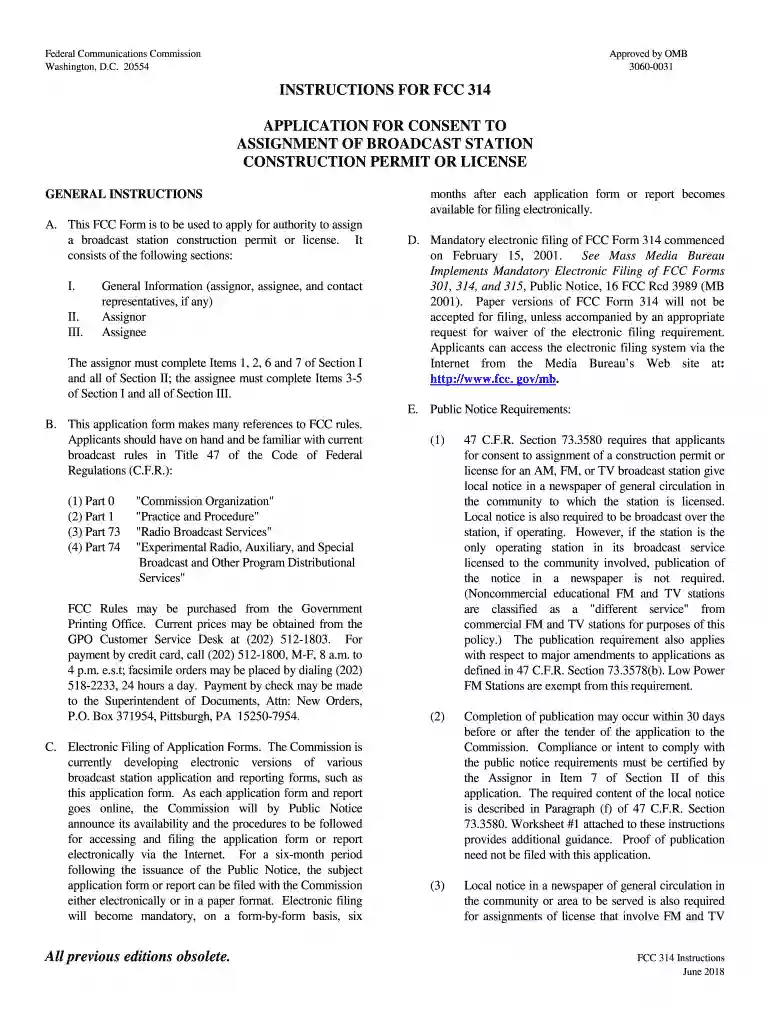
ASSIGNMENT OF BROADCAST STATION 2026

Get Form
ASSIGNMENT OF BROADCAST STATION Preview on Page 1

Here's how it works

01. Edit your form online
Type text, add images, blackout confidential details, add comments, highlights and more.

02. Sign it in a few clicks
Draw your signature, type it, upload its image, or use your mobile device as a signature pad.

03. Share your form with others
Send it via email, link, or fax. You can also download it, export it or print it out.

How to use or fill out ASSIGNMENT OF BROADCAST STATION with our platform

Form edit decoration
9.5
Ease of Setup
DocHub User Ratings on G2
9.0
Ease of Use
DocHub User Ratings on G2
  1. Click ‘Get Form’ to open the ASSIGNMENT OF BROADCAST STATION in the editor.
  2. Begin with Section I, General Information. Fill in the assignor's details including name, address, and contact information. Ensure accuracy as this information is critical for processing.
  3. Next, complete Items 1 through 4 under Section II for the Assignor. This includes certifying that all agreements for sale are included and comply with FCC rules.
  4. In Section III, Assignee, provide similar details for the assignee. Make sure to include any necessary certifications regarding character issues and financial qualifications.
  5. Review all entries carefully. Use our platform’s features to highlight any sections that require additional documentation or explanations.
  6. Once completed, save your form and utilize the signing feature to ensure all parties have signed where required before submission.

Start using our platform today to streamline your ASSIGNMENT OF BROADCAST STATION process!

See more ASSIGNMENT OF BROADCAST STATION versions

We've got more versions of the ASSIGNMENT OF BROADCAST STATION form. Select the right ASSIGNMENT OF BROADCAST STATION version from the list and start editing it straight away!
Versions Form popularity Fillable & printable
2020 4.8 Satisfied (72 Votes)
2018 4.3 Satisfied (31 Votes)
2012 4.4 Satisfied (79 Votes)
2010 4.3 Satisfied (50 Votes)
be ready to get more

Complete this form in 5 minutes or less

Get form

Got questions?

We have answers to the most popular questions from our customers. If you can't find an answer to your question, please contact us.
Contact us
However, broadcast stations (radio or television) perform six main functions. These are the news, opinions, education, propaganda, commercial and entertainment functions.
Different types of broadcast media include radio production, broadcast television, advertising films, slides, and video advertising. As technology advances, broadcast media continues to grow and adapt using digital media and social platforms to provide people with information.
These are known as the Five Cs of Radio Communications: Conciseness, Clarity, Confidence, Control and Capability. Keep the messages short and concise.
Basically, broadcasting serves three broad purposes; it informs, educate and entertain the audience. However, broadcast stations (radio or television) perform six main functions. These are the news, opinions, education, propaganda, commercial and entertainment functions.
Each department is headed by a manager who reports to the General Manager. The Marketing department sells air time to generate revenue. The Production department produces all content and advertisements. The Technical department manages broadcast equipment and ensures smooth transmission.

Security and compliance

At DocHub, your data security is our priority. We follow HIPAA, SOC2, GDPR, and other standards, so you can work on your documents with confidence.

Learn more
ccpa2
pci-dss
gdpr-compliance
hipaa
soc-compliance

People also ask

Obtaining the proper broadcast license is a crucial step for anyone operating a radio station. With music, talk shows, sports, and more being transmitted over the airwaves and the internet, broadcast licensing ensures radio stations stay legally compliant while supporting both artists and organizations.
Some examples of media are newspapers, magazines, books, radio, television, cinema, internet, social media, mobile phones, etc. Media can be used for various purposes, such as education, entertainment, information, persuasion, advertising, marketing, public relations, etc.
Broadcast technology uses transmitters to send signals over the airwaves. These signals are received by receivers, such as televisions or radios, which decode the signals and convert them into audio, video, or data that can be consumed by the audience.

Related links