




01. Edit your form online
Type text, add images, blackout confidential details, add comments, highlights and more.

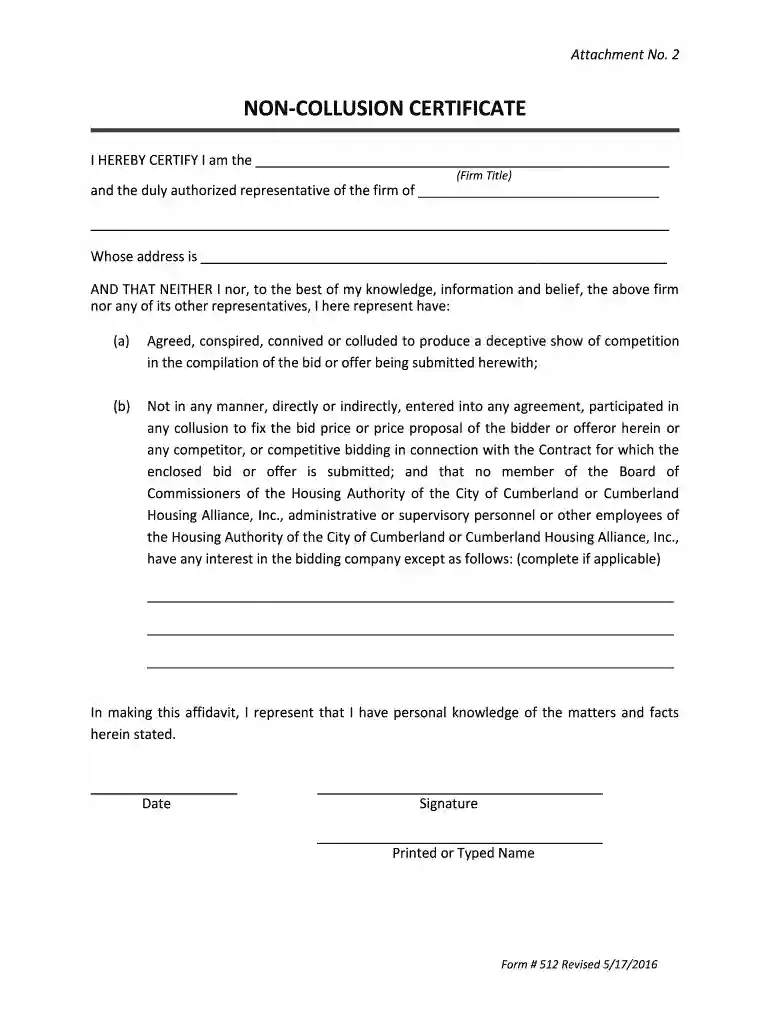
Type text, add images, blackout confidential details, add comments, highlights and more.

Draw your signature, type it, upload its image, or use your mobile device as a signature pad.

Send it via email, link, or fax. You can also download it, export it or print it out.
The "2016 MD Cumberland Housing Form 512" is a crucial document used primarily by housing authorities within Maryland, specifically targeting compliance with non-collusion regulations for contract bidding processes. It serves as a Non-Collusion Certificate, ensuring the integrity of the bidding environment by requiring representatives of firms to attest to the absence of collusion or deceptive practices. This form is pivotal in maintaining fair competition and transparency within public sector projects.
The form's primary function is to affirm that firms involved in bidding for housing projects have not engaged in collusive behavior. Although straightforward, completing the form accurately is crucial.
Completing this form requires careful attention to detail to avoid any misunderstanding or rejection.
While specific to a regional purpose, this form sees varied usage across a spectrum of businesses and individuals involved in housing projects.


This form serves as a legal document ensuring that all participating parties are committing to ethical standards during the public bidding phase of projects.
Understanding the core components of this form is essential for accurate completion.
A thorough submission process demands certain accompanying documents to enhance and support the form.
Failure to submit the form or submitting a fraudulent certificate can lead to significant ramifications.
We've got more versions of the 2016 MD Cumberland Housing Form 512 form. Select the right 2016 MD Cumberland Housing Form 512 version from the list and start editing it straight away!
Of course, electronically drawing your signature is acceptable, but only if you utilize a tool that complies with industry regulations and policies. Try DocHub, which ensures eSignature validity under ESIGN and UETA requirements. All you need to eSign your 2016 MD Cumberland Housing Form 512 is an account with DocHub and an internet connection. Once you open your document in our editor, click Sign and choose the Draw option.
You need only a web connection and a web browser to complete your 2016 MD Cumberland Housing Form 512 by using an iOS phone. Open the DocHub website and authenticate. Then, add your file or select it from the list in your dashboard. Then use our editing instruments to complete your form and preserve all your adjustments. You can also send it to a dedicated recipient right away.
At DocHub, your data security is our priority. We follow HIPAA, SOC2, GDPR, and other standards, so you can work on your documents with confidence.
The Blight Action Plan identified 512 dilapidated and/or vacant buildings in the City of Cumberland. City are single-family homes.
by E Thaden 2017 Cited by 80 Inclusionary housing refers to any programs or policies that require or incentivize the creation of affordable housing when new developmentRead more


