




Here's how it works

01. Edit your std window period online
Type text, add images, blackout confidential details, add comments, highlights and more.

02. Sign it in a few clicks
Draw your signature, type it, upload its image, or use your mobile device as a signature pad.

03. Share your form with others
Send it via email, link, or fax. You can also download it, export it or print it out.
How to use or fill out COUNSELING ASSESSMENT FOR HIV, STD AND HEPATITIS C TESTING with DocHub

- Click ‘Get Form’ to open it in the editor.
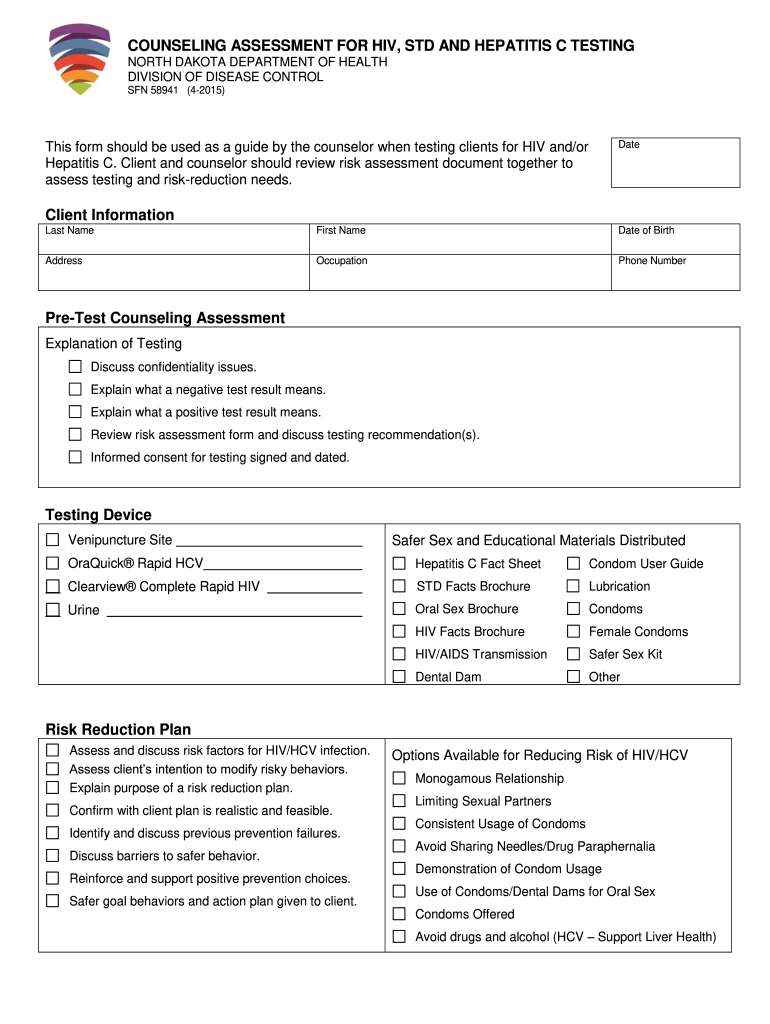
- Begin by entering the client information, including last name, first name, date of birth, address, occupation, and phone number. Ensure accuracy for effective communication.
- In the Pre-Test Counseling Assessment section, discuss confidentiality issues and explain the implications of both negative and positive test results. Make sure to review the risk assessment document together.
- For the Testing Device section, select the appropriate testing method used (e.g., OraQuick® Rapid HCV) and indicate the venipuncture site if applicable.
- In the Risk Reduction Plan section, assess risk factors and discuss intentions to modify behaviors. Confirm that the plan is realistic and provide support for positive prevention choices.
- Finally, complete the Test Result section by documenting results for HIV, HCV, and STDs. Ensure clients receive copies of their test results and address any questions they may have.
Start using our platform today to streamline your form completion process for free!
Fill out COUNSELING ASSESSMENT FOR HIV, STD AND HEPATITIS C TESTING online
It's free
It's free
See more COUNSELING ASSESSMENT FOR HIV, STD AND HEPATITIS C TESTING versions
We've got more versions of the COUNSELING ASSESSMENT FOR HIV, STD AND HEPATITIS C TESTING form. Select the right COUNSELING ASSESSMENT FOR HIV, STD AND HEPATITIS C TESTING version from the list and start editing it straight away!
Got questions?
We have answers to the most popular questions from our customers. If you can't find an answer to your question, please contact us.
Contact us
What are HIV risk assessment questions?
Have you had sex with someone who was HIV positive? Have you ever worked as a sex worker? Have you ever received a blood transfusion? Have you ever used intravenous drugs?
What is the post test Counselling for HIV positive people?
Post-test counselling for those testing HIV-positive should focus on promoting adherence to achieve viral suppression with ART, including messages about the prevention benefits of being on ART (Undetectable = Untransmittable) and on offering network-based testing, including partner services, support for disclosure and/
What types of questions are required in a risk assessment?
HIV risk assessment facilitates discussion of risk reduction behaviors to reduce HIV transmission and provides the opportunity for timely HIV antibody counseling and testing. Unfortunately, HIV risk assessment may only be performed when it is perceived that the client is at high risk for HIV infection.
Who is an HIV counselor tester?
An HIV counselor offers support to patients who have human immunodeficiency virus (HIV) or acquired immune deficiency syndrome (AIDS). If you work at a testing clinic, you provide counseling to patients before or after testing.
What are the 5 core principles of HIV testing and Counselling?
KEY POINTS. The 5 Cs are essential for all HTS: consent, confidentiality, counselling, correct test results and connection to HIV prevention, treatment and care (see section 1.7).
Security and compliance
At DocHub, your data security is our priority. We follow HIPAA, SOC2, GDPR, and other standards, so you can work on your documents with confidence.
Learn more


Related forms
CPE EE 421 521 Fall 2004 Chapter 4 - Electrical and Computer - ece uah
The document provides an overview of the 68000 CPU hardware model, detailing its interface, timing diagrams, and minimal ...

Centipedegrass Lawn Maintenance CalendarNC State Extension
The document provides a comprehensive lawn care calendar specifically for tall fescue grass, detailing maintenance pract ...

Honors Graduation Completion Form - College of Engineering
The document is a certification form for Honors College graduation at the University of Arkansas College of Engineering. ...

Effectiveness of Online Learning Research Proposal - University of
This research proposal aims to evaluate the effectiveness of online learning compared to traditional classroom instructi ...

CrisisinScholarlyCommunications Journals - library arizona
The document discusses the ongoing crisis in scholarly communications, particularly focusing on the rising costs of jour ...

Linear Algebra and Linear Models
The document provides an in-depth overview of linear algebra and its application in quantitative genetics, focusing on l ...

3E3EE70A-5487-184447 doc
The document is a Subcontractor Agreement outlining the terms between a Contractor and a Subcontractor for a specific pr ...

Receiving checklist template
The document outlines a checklist and procedures for the receipt and inspection of laboratory items as part of the GLI S ...
People also ask
What is the risk assessment of HIV?
HIV and AIDS - Basic facts 1) What is HIV? 2) What is AIDS? 3) What are the symptoms of HIV? 4) When does a person have AIDS? 5) How quickly do people infected with HIV develop AIDS? 6) Where is HIV found? 7) How can HIV be transmitted? 8) What is the risk of transmitting HIV through kissing or deep kissing?
What are some good questions to ask about HIV?
All HIV testing services should continue to be provided in line with WHOs essential 5 Cs: Consent, Confidentiality, Counselling, Correct test results, and Connection/linkage to prevention, care and treatment.