Counseling hiv hepatitis 2026

Get Form
counseling hiv hepatitis Preview on Page 1

Here's how it works

01. Edit your form online
Type text, add images, blackout confidential details, add comments, highlights and more.

02. Sign it in a few clicks
Draw your signature, type it, upload its image, or use your mobile device as a signature pad.

03. Share your form with others
Send it via email, link, or fax. You can also download it, export it or print it out.

How to use or fill out counseling hiv hepatitis with our platform

Form edit decoration
9.5
Ease of Setup
DocHub User Ratings on G2
9.0
Ease of Use
DocHub User Ratings on G2
  1. Click ‘Get Form’ to open the counseling hiv hepatitis document in the editor.
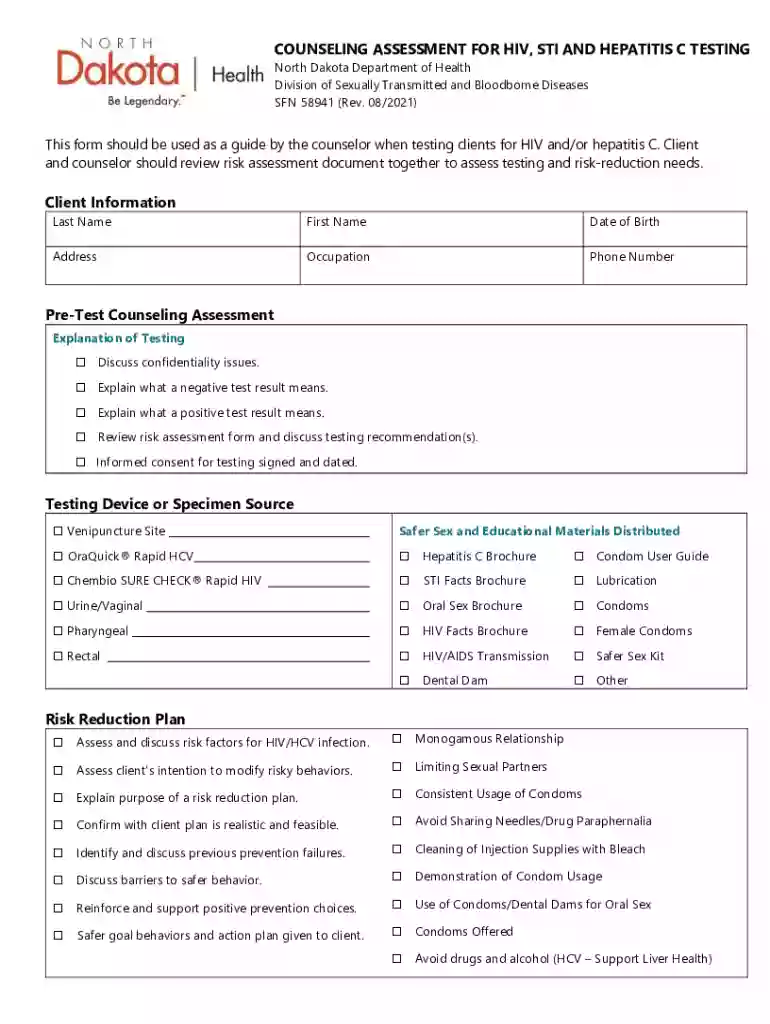
  2. Begin by filling out the Client Information section. Enter the client's Last Name, First Name, Date of Birth, Address, Occupation, and Phone Number.
  3. Move to the Pre-Test Counseling Assessment. Discuss confidentiality issues and explain both negative and positive test results. Ensure that informed consent for testing is signed and dated.
  4. In the Testing Device or Specimen Source section, select the appropriate testing method such as Venipuncture Site or Rapid Tests like OraQuick®.
  5. Distribute Safer Sex and Educational Materials by checking off items provided to the client, ensuring they receive relevant brochures and kits.
  6. Assess risk factors in the Risk Reduction Plan section. Discuss intentions to modify risky behaviors and confirm that the plan is realistic.
  7. Document test results for HIV, HCV, and STIs in their respective sections. Ensure to note if a copy of test results was given to the client.
  8. Finally, provide referrals based on test outcomes and ensure all necessary signatures are completed before saving your work.

Start using our platform today for free to streamline your counseling process!

See more counseling hiv hepatitis versions

We've got more versions of the counseling hiv hepatitis form. Select the right counseling hiv hepatitis version from the list and start editing it straight away!
Versions Form popularity Fillable & printable
2021 4.8 Satisfied (159 Votes)
2015 4.3 Satisfied (138 Votes)
be ready to get more

Complete this form in 5 minutes or less

Get form

Got questions?

We have answers to the most popular questions from our customers. If you can't find an answer to your question, please contact us.
Contact us
DO get plenty of rest and eat a well-balanced diet. DO use condoms when having sex. DO avoid exposing others to your blood and other body fluids. DO call your health care provider if symptoms dont go away in 4 or 6 weeks or new symptoms develop.
A case illustration will show how to apply the six steps: (1) exploration of clients feelings and perceptions around being sexually active; (2) assessment of clients knowledge about /AIDS; (3) exploration of clients barriers to having safer sex; (4) exploration of clients perceptions of what constitutes risk
People with who have underlying liver disease are at risk for severe disease from hepatitis A virus (HAV) infection. People with who become infected with hepatitis B virus (HBV) or hepatitis C virus (HCV) are at increased risk for liver-related morbidity and mortality.
1 The five prevention pillars are: (a) combination prevention for adolescent girls and young women and their male partners in high-prevalence locations; (b) combination prevention programmes for all key populations; (c) strengthened national and related behavioural change programmes; (d) voluntary medical male
The 5 Cs are essential for all HTS: consent, confidentiality, counselling, correct test results and connection to prevention, treatment and care (see section 1.7).
be ready to get more

Complete this form in 5 minutes or less

Get form

People also ask

KEY POINTS. The 5 Cs are essential for all HTS: consent, confidentiality, counselling, correct test results and connection to prevention, treatment and care (see section 1.7).
The UNAIDS 95-95-95 targets aim to ensure that by 2030, 95% of all people living with know their status, 95% of all people diagnosed with receive sustained antiretroviral therapy, and 95% of all people receiving antiretroviral therapy have viral suppression.

Related links