Utah protective order form 2026

Get Form
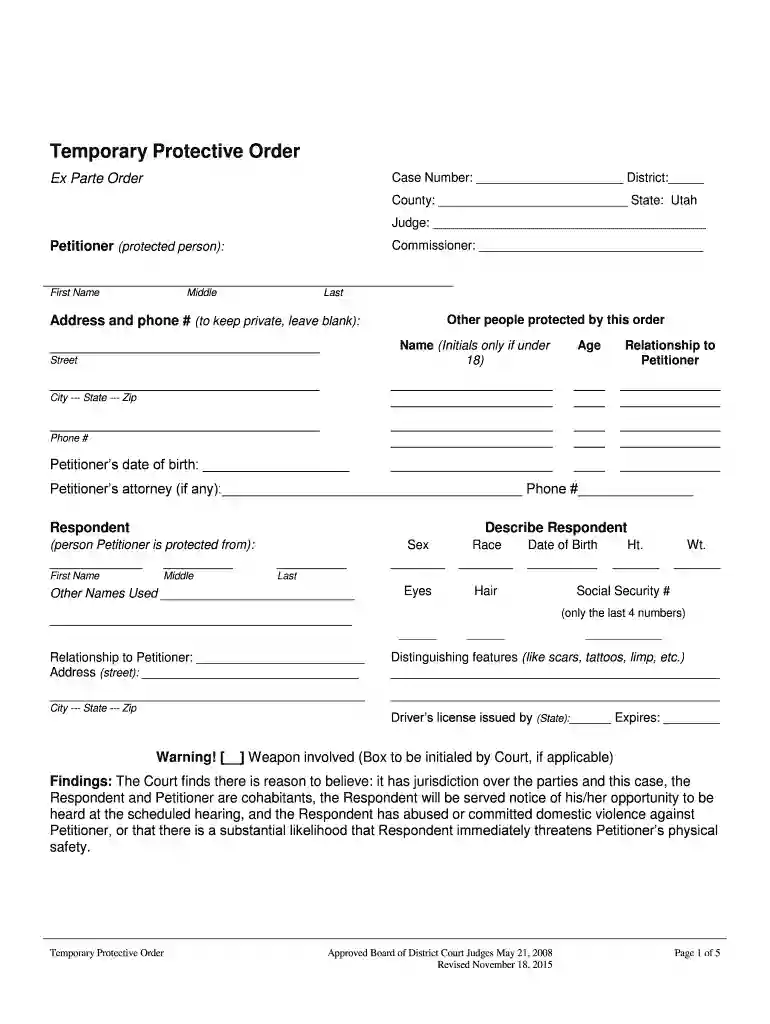
no contact order utah Preview on Page 1

Here's how it works

01. Edit your no contact order utah online
Type text, add images, blackout confidential details, add comments, highlights and more.

02. Sign it in a few clicks
Draw your signature, type it, upload its image, or use your mobile device as a signature pad.

03. Share your form with others
Send restraining order utah via email, link, or fax. You can also download it, export it or print it out.

How to use or fill out the Utah Protective Order Form with DocHub

Form edit decoration
9.5
Ease of Setup
DocHub User Ratings on G2
9.0
Ease of Use
DocHub User Ratings on G2
  1. Click ‘Get Form’ to open the Utah Protective Order form in our editor.
  2. Begin by filling in the case number, district, and county at the top of the form. This information is crucial for identifying your case.
  3. In the 'Petitioner' section, enter your first name, middle name, last name, and date of birth. If there are other individuals protected by this order, provide their initials and relationship to you.
  4. Next, describe the respondent by entering their full name, date of birth, physical characteristics (height, weight), and any distinguishing features. This helps ensure accurate identification.
  5. Review the findings section carefully. Ensure that all necessary boxes are checked based on your situation regarding contact and safety measures.
  6. Complete any additional orders as applicable. Specify property orders or custody arrangements if relevant to your case.
  7. Finally, save your completed form and share it directly from our platform for free to ensure it reaches the appropriate court.

Start using our platform today to easily fill out your Utah Protective Order form!

See more utah protective order form versions

We've got more versions of the utah protective order form form. Select the right utah protective order form version from the list and start editing it straight away!
Versions Form popularity Fillable & printable
2020 4.8 Satisfied (170 Votes)
2015 4.4 Satisfied (119 Votes)
2014 4.3 Satisfied (40 Votes)
be ready to get more

Complete this form in 5 minutes or less

Get form

Got questions?

We have answers to the most popular questions from our customers. If you can't find an answer to your question, please contact us.
Contact us
In civil litigation, an order that prevents the disclosure of certain information. A party or person, such as a non-party recipient of a subpoena, may move for a protective order by showing good cause that the court should not permit the requested discovery because the discovery request is: Annoying.
Despite this seemingly less severe initial punishment, no contact orders carry more intense final penalties. If a no contact order is violated, the violator may spend up to six months in jail and may also be required to pay the attorney fees for the other party.
The primary difference lies in the relationship between the parties. Restraining orders are typically used in non-domestic situations involving harassment, stalking, or civil disputes. Protective orders are used in cases of domestic violence or abuse where the abuser has a close personal relationship with the victim.
Restraining orders can be very broad and may restrict all kinds of behaviors. From contacting the other party to any other behavior that might affect the case, a restraining order can be applied. Protective orders apply mostly to violent or threatening behavior and seek to protect petitioners from future harm.

Security and compliance

At DocHub, your data security is our priority. We follow HIPAA, SOC2, GDPR, and other standards, so you can work on your documents with confidence.

Learn more
ccpa2
pci-dss
gdpr-compliance
hipaa
soc-compliance
be ready to get more

Complete this form in 5 minutes or less

Get form