




01. Edit your 1065 form online
Type text, add images, blackout confidential details, add comments, highlights and more.

Type text, add images, blackout confidential details, add comments, highlights and more.

Draw your signature, type it, upload its image, or use your mobile device as a signature pad.

Send form 1065 via email, link, or fax. You can also download it, export it or print it out.
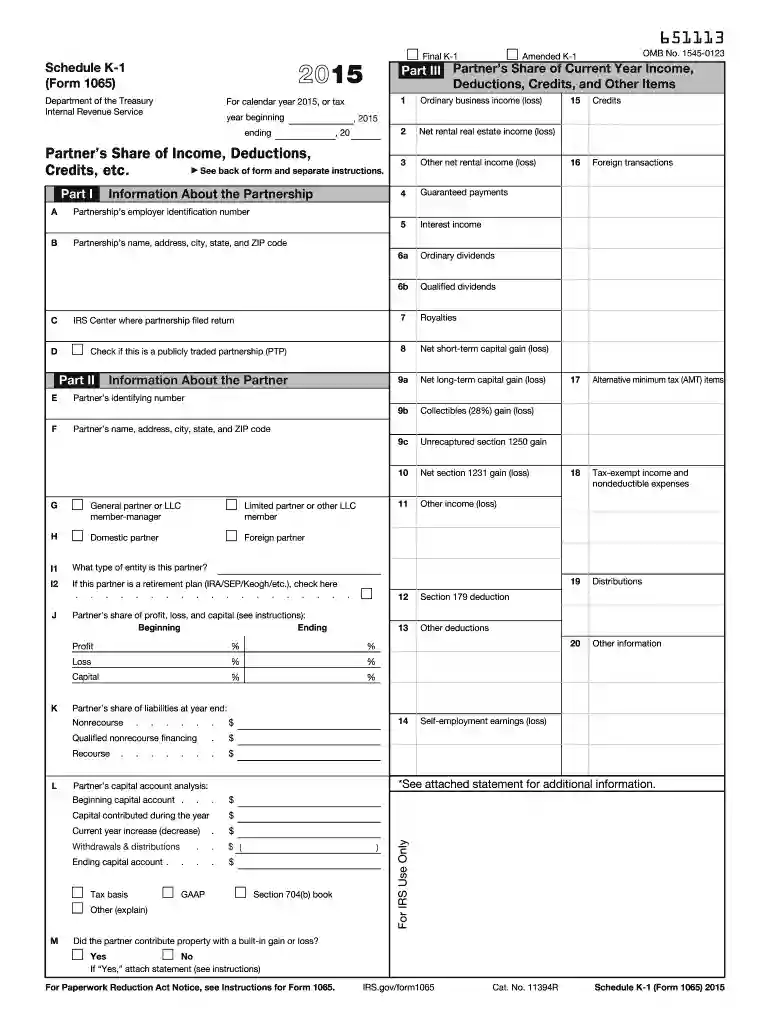
Form 1065 for the 2015 tax year is a U.S. Internal Revenue Service (IRS) tax return document used by partnerships to report their income, deductions, gains, losses, etc. Partnerships, being pass-through entities, use this form to declare their operations as they pass the tax burden to individual partners. Each partner's Share of these elements is detailed in a Schedule K-1, which must be filed along with Form 1065.
This form is legally required when two or more individuals share in running a business and distributing profits and losses. Failing to file can result in IRS penalties or, in severe cases, legal actions. Moreover, submitting Form 1065 validates the partnership's tax obligations and ensures compliance with U.S. tax laws.
Failing to file Form 1065 on time may result in penal fines. Typically, the IRS imposes a penalty per month for each month the form is late multiplied by the number of partners, up to a maximum duration. Ensuring timely and accurate submission is crucial to avoid these financial burdens.
Businesses like LLCs or general partnerships with multiple partners will use Form 1065. For instance, a software development firm structured as an LLC, bringing in income from contracts and requiring distribution of profits among its founders, would complete this form. Additionally, an architecture firm structured as a general partnership also benefits from accurate filing to distribute income to its partners appropriately.
This form predominantly applies to partnerships, but LLCs classified as partnerships and certain foreign partnerships involved in U.S. operations and generating income must file. The classification determines tax obligations and affects each partner's tax reporting.
Tax preparers often use software programs like TurboTax, QuickBooks, or others that integrate seamlessly with IRS electronic filing. These programs can guide users through the step-by-step process, ensuring adherence to complex requirements and minimizing data entry errors.
Filing requires detailed internal reporting, including transaction records, partner capital accounts, and individual partner dealings. The accuracy and completeness of these disclosures ensure partners are taxed only on appropriate proportions and safeguard against IRS scrutiny.
We've got more versions of the 1065 form form. Select the right 1065 form version from the list and start editing it straight away!
| Versions | Form popularity | Fillable & printable |
|---|---|---|
| 2025 | 2.4 Satisfied (129 Votes) | |
| 2024 | 4.4 Satisfied (34 Votes) | |
| 2023 | 4.9 Satisfied (20 Votes) | |
| 2022 | 4.3 Satisfied (33 Votes) | |
| 2021 | 4.8 Satisfied (85 Votes) | |
| 2020 | 4.4 Satisfied (100 Votes) | |
| 2019 | 4.3 Satisfied (142 Votes) | |
| 2018 | 4.4 Satisfied (236 Votes) | |
| 2017 | 4.3 Satisfied (181 Votes) | |
| 2016 | 4.3 Satisfied (163 Votes) | |
| 2015 | 4.4 Satisfied (728 Votes) | |
| 2014 | 4 Satisfied (54 Votes) | |
| 2013 | 4 Satisfied (80 Votes) | |
| 2012 | 4 Satisfied (26 Votes) | |
| 2011 | 4 Satisfied (60 Votes) |
At DocHub, your data security is our priority. We follow HIPAA, SOC2, GDPR, and other standards, so you can work on your documents with confidence.



Jul 13, 2016 For tax years beginning on or after January 1, 2015, the Division created two new Partnership. Tax returns, Forms NJ-1065 and NJ-CBT-1065. FormRead more
Aug 25, 2017 All small partnerships should file timely Form 1065s. Tax year 2017 forms will be due March 15, 2018. This filing is especially important inRead more
Jan 15, 2016 The 2015 Form 1065 is an information return for calendar year 2015 and fiscal years that begin in 2015 and end in 2016. For a fiscal year orRead more


