




01. Edit your 2008 k 1 online
Type text, add images, blackout confidential details, add comments, highlights and more.

Type text, add images, blackout confidential details, add comments, highlights and more.

Draw your signature, type it, upload its image, or use your mobile device as a signature pad.

Send form k1 via email, link, or fax. You can also download it, export it or print it out.
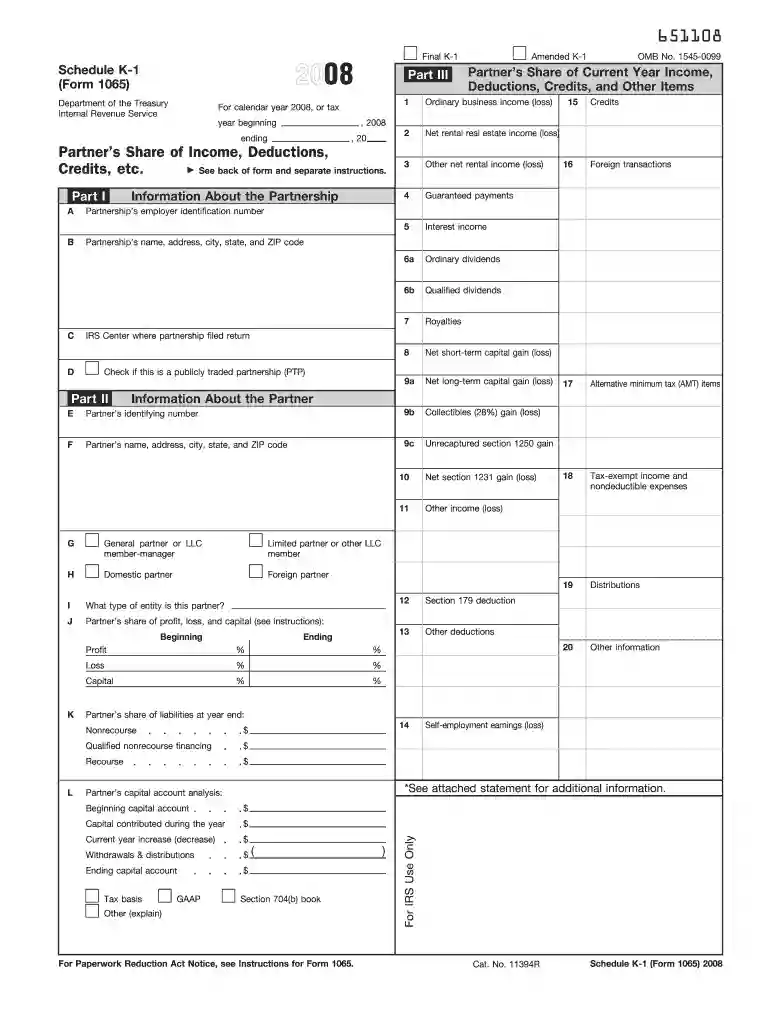
The 2008 K-1 form is specifically known as Schedule K-1 (Form 1065). It documents a partner's share of income, deductions, credits, and other pertinent items from a partnership. This form is pivotal for tax reporting, ensuring partners accurately account for any income derived from the partnership in their individual tax returns. It includes various types of income, from ordinary business income to capital gains, providing a comprehensive rundown of a partner's fiscal responsibilities.
The 2008 K-1 form serves as an essential component in a partner's individual tax filings. After receiving it from the partnership, the partner is responsible for integrating this information into their personal tax return, specifically on IRS Form 1040. By accurately reporting the figures from the K-1 form, individuals ensure compliance with tax laws, thereby avoiding potential discrepancies or penalties.
Partners are advised to have several documents readily available to facilitate the completion of the 2008 K-1 form:
The IRS provides comprehensive guidelines to aid taxpayers in accurately reporting partnership income through the K-1 form. These guidelines ensure taxpayers correctly cite each section to prevent errors and omissions, thereby streamlining the filing process. It is crucial to reference IRS materials linked to Schedule K-1 (Form 1065) for precision.
Failing to accurately report information on the 2008 K-1 form can result in significant penalties by the IRS, including fines and increased scrutiny in future tax filings. Partners must ensure rigorous adherence to reporting guidelines and deadlines to prevent these outcomes.
This form is most commonly utilized by individuals involved in partnerships, including traditional business partnerships, limited liability companies (LLCs) taxed as partnerships, and certain estate or trust arrangements. The K-1 is key for these individuals to disclose their share of partnership income on their personal tax returns.


Partnerships are responsible for providing each partner with a completed K-1 form annually. Partners typically receive these forms by the partnership's tax filing deadline, offering ample time to incorporate the information into their personal tax filings. Should an individual require a blank version or supplemental guidance, these resources can be sourced directly from the IRS website.
We've got more versions of the 2008 k 1 form. Select the right 2008 k 1 version from the list and start editing it straight away!
| Versions | Form popularity | Fillable & printable |
|---|---|---|
| 2025 | 2.4 Satisfied (129 Votes) | |
| 2024 | 4.4 Satisfied (34 Votes) | |
| 2023 | 4.9 Satisfied (20 Votes) | |
| 2022 | 4.3 Satisfied (33 Votes) | |
| 2021 | 4.8 Satisfied (85 Votes) | |
| 2020 | 4.4 Satisfied (100 Votes) | |
| 2019 | 4.3 Satisfied (142 Votes) | |
| 2018 | 4.4 Satisfied (236 Votes) | |
| 2017 | 4.3 Satisfied (181 Votes) | |
| 2016 | 4.3 Satisfied (163 Votes) | |
| 2015 | 4.4 Satisfied (728 Votes) | |
| 2014 | 4 Satisfied (54 Votes) | |
| 2013 | 4 Satisfied (80 Votes) | |
| 2012 | 4 Satisfied (26 Votes) | |
| 2011 | 4 Satisfied (60 Votes) |
At DocHub, your data security is our priority. We follow HIPAA, SOC2, GDPR, and other standards, so you can work on your documents with confidence.
This list identifies the codes used on Schedule K-1 for all partners and provides summarized reporting information for partners who file. Form 1040.Read more
A partner that has a loss reported on a Form 1065 (Schedule K-1) issued (or to be issued) to the partner by the partnership for a prior partnership taxable yearRead more
Mar 1, 2012 Technical Guidance. DATE. 3/1/2012. Page 2. Version: 1.0. March 1, 2012. TABLE OF CONTENTS. TECHNICAL GUIDANCE .Read more


