




01. Edit your 2018 form k 1 online
Type text, add images, blackout confidential details, add comments, highlights and more.

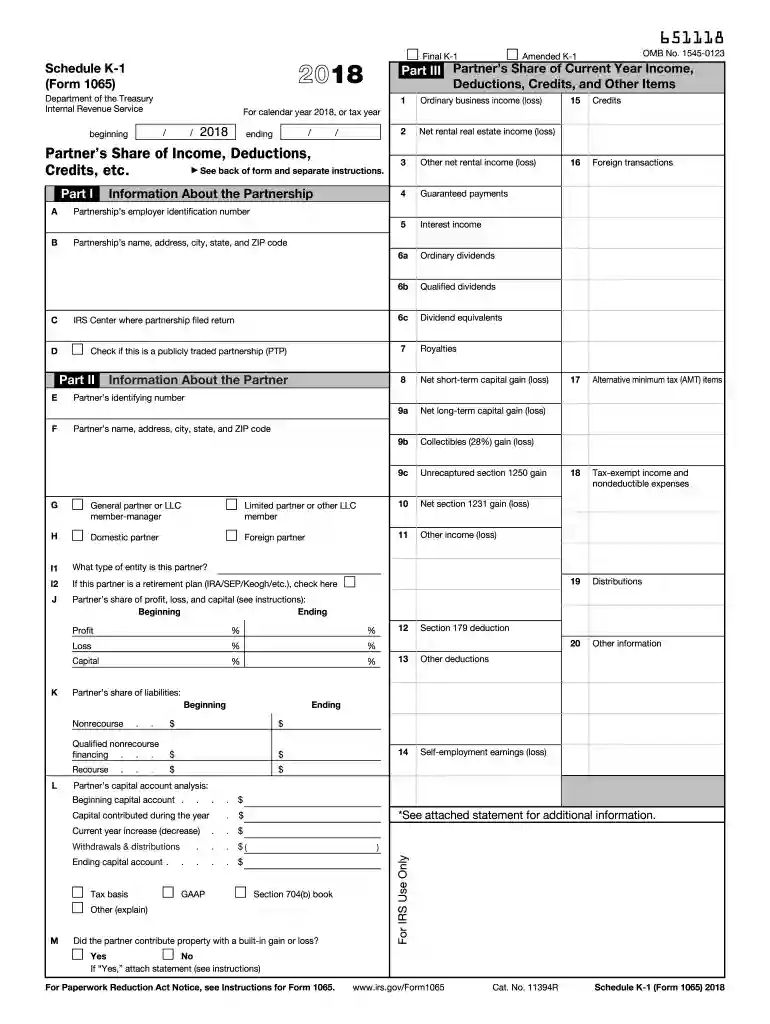
Type text, add images, blackout confidential details, add comments, highlights and more.

Draw your signature, type it, upload its image, or use your mobile device as a signature pad.

Send 1065 k1 form2018 via email, link, or fax. You can also download it, export it or print it out.
Form 1065, also known as the U.S. Return of Partnership Income, is used by partnerships in the United States to report their financial information to the IRS. For the 2014 tax year, it requires reporting a partnership’s income, deductions, credits, and other significant financial details. The purpose of this form is to ensure that partnerships accurately declare financial activities as they affect each partner's tax obligations, allocating profits and losses among them.
Form 1065 is composed of several sections, each capturing different financial aspects of a partnership. Key elements include:
Filling out Form 1065 accurately is crucial as partnerships do not pay taxes at the entity level; instead, profits and losses are passed through to partners. Completing this form correctly informs individuals about their share of earnings, guiding them in filing their personal tax returns. Partnerships must ensure compliance to avoid penalties and ensure each partner pays the correct amount of taxes on their share of the income.
Completing Form 1065 involves a multi-step process that partnerships must follow diligently to ensure accuracy and compliance.
For the 2014 fiscal year, partnerships needed to file Form 1065 by March 16, 2015. Filing on time is essential to avoid late penalties. If more time was needed to compile the necessary information, partnerships could have filed for an extension, which provided until September 15, 2015, to submit the complete form.
Understanding certain key terms is fundamental in effectively handling Form 1065.
For example, a partnership might consist of three partners: two individuals and one corporation. Each partner receives a Schedule K-1 outlining their portion of the income and expenses, which they subsequently use when filing their individual or corporate tax returns.
Legal adherence to Form 1065 processes ensures correct payment of taxes and limits liability for inaccuracies that can attract penalties. Partnerships must follow IRS guidelines diligently to prepare and file the form, ensuring they maintain records that can verify income and deductions reported.
Partners should consult with tax professionals or use reputable tax software to ensure compliance and accuracy.
Partnerships can submit Form 1065 through traditional mail or electronically. Each method has its benefits and considerations.
Electronic filing is usually preferred for its speed and the convenience of direct confirmation from the IRS.
Failing to comply with IRS requirements can lead to significant penalties for a partnership. Common infractions include late filing, providing incorrect information, or failing to furnish Schedule K-1 to partners on time. Each violation brings a financial penalty, underscoring the importance of careful adherence to filing procedures.
Ensuring compliance is vital to minimizing financial penalties and maintaining a smooth filing process.
We've got more versions of the 2018 form k 1 form. Select the right 2018 form k 1 version from the list and start editing it straight away!
| Versions | Form popularity | Fillable & printable |
|---|---|---|
| 2025 | 2.4 Satisfied (129 Votes) | |
| 2024 | 4.4 Satisfied (34 Votes) | |
| 2023 | 4.9 Satisfied (20 Votes) | |
| 2022 | 4.3 Satisfied (33 Votes) | |
| 2021 | 4.8 Satisfied (85 Votes) | |
| 2020 | 4.4 Satisfied (100 Votes) | |
| 2019 | 4.3 Satisfied (142 Votes) | |
| 2018 | 4.4 Satisfied (236 Votes) | |
| 2017 | 4.3 Satisfied (181 Votes) | |
| 2016 | 4.3 Satisfied (163 Votes) | |
| 2015 | 4.4 Satisfied (728 Votes) | |
| 2014 | 4 Satisfied (54 Votes) | |
| 2013 | 4 Satisfied (80 Votes) | |
| 2012 | 4 Satisfied (26 Votes) | |
| 2011 | 4 Satisfied (60 Votes) |
At DocHub, your data security is our priority. We follow HIPAA, SOC2, GDPR, and other standards, so you can work on your documents with confidence.



by V AVDEEV 2015 Cited by 3 Compare U.S. Dept of the Treasury Internal Revenue Serv., I.R.S. Form 1065: Schedule K-1: Partners Share of Income, Deductions, Credits, Etc.Read more
Jan 15, 2015 The 2014 Form 1065 is an information return for calendar year 2014 and fiscal years that begin in 2014 and end in 2015. For a fiscal year orRead more
Apr 15, 2015 partnership that was not engaged in a trade or business in the United States during 2014 and your Schedule K-1. (Form 1065) includes only income.Read more


