






Definition and Purpose of Schedule K-1 (Form 1065)
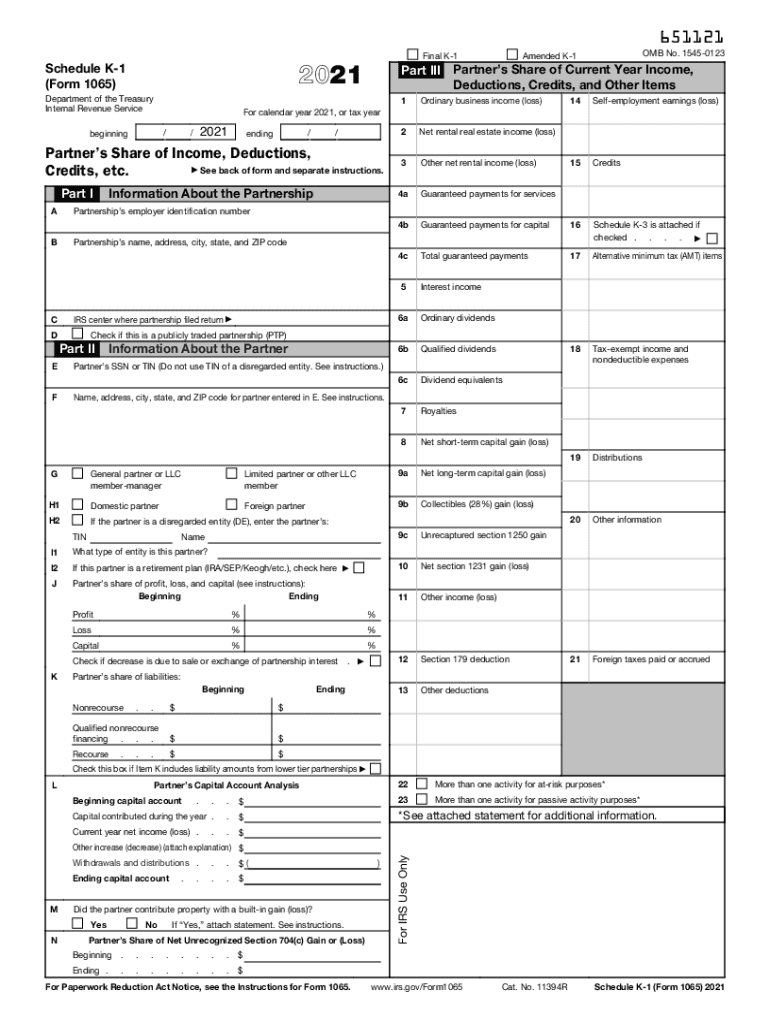
Schedule K-1 (Form 1065) is a tax form used in the United States to report income, deductions, credits, and other pertinent financial items related to a partnership. Each partner in a partnership receives a Schedule K-1, which serves to convey individual shares of the partnership's financial activities. The form ensures accurate tax reporting by detailing each partner's contributions, liabilities, and share of the partnership’s profits or losses. Particularly critical for transparent tax assessment, the Schedule K-1 enables partners to include this information on their personal tax returns.
Key Elements of Schedule K-1
Several essential components make up a Schedule K-1, each providing insight into the partnership's financial dealings and the recipient partner's tax responsibilities:
-
Ordinary Business Income or Loss: This reflects the partner's share of general profits or losses from normal business operations.
-
Guaranteed Payments: These are payments made to partners that are independent of the partnership's income and should be reported as ordinary income.
-
Interest and Dividend Income: Partners must report their share of interest and dividend income earned by the partnership.
-
Capital Gains or Losses: The form accounts for any capital asset transactions, specifying short-term and long-term gains or losses.
-
Partner-specific Information: This includes contributions, liabilities, and any unique allocations or adjustments pertinent to the individual partner.
How to Use Schedule K-1
Using Schedule K-1 correctly is critical for partners to file their tax returns accurately. Here’s how partners can use this form effectively:
-
Incorporate Data into Tax Returns: Partners must enter the amounts reported on their K-1 into the appropriate sections of their personal income tax return, typically on Form 1040 or its equivalent.
-
Verify Information for Accuracy: It’s vital to ensure that the information reported on the K-1 aligns with your own records and the partnership’s financial statements.
-
Consult Tax Professionals: Due to the complexities associated with interpreting K-1 forms, partners may benefit from consulting tax professionals to avoid errors.
Steps to Complete Schedule K-1
-
Gather Partnership Financial Information: Compile all necessary financial records, including partnership agreements and accounting documents.
-
Allocate Financial Items: Accurately allocate income, deductions, and credits between partners as stipulated by the partnership agreement.
-
Fill Out the Form: Input the financial data into the appropriate sections of the Schedule K-1 for each partner.
-
Review and Verify: Ensure all calculations are correct and review all information for clarity and precision.
-
Distribute to Partners: Provide each partner with their individualized Schedule K-1 for inclusion in their personal tax filings.
Importance of Schedule K-1
Schedule K-1 serves several critical purposes for partnerships and the IRS:
-
Ensures Accurate Tax Reporting: By detailing each partner's financial responsibilities, the form aids in precise tax processing and compliance.
-
Facilitates Partnership Transparency: The distribution of K-1 forms to partners fosters openness in financial management.
-
Aids IRS in Tax Assessment: The IRS utilizes the information reported on K-1 forms to verify partner income and ensure proper tax liability reporting.
Types of Business Entities that Use Schedule K-1
Business entities structured as partnerships commonly use Schedule K-1 to distribute financial information among partners. Specific business types include:
-
Limited Liability Companies (LLCs): When taxed as partnerships, LLCs issue Schedule K-1 forms to members.
-
General Partnerships: All partners in a general partnership receive a K-1 form.
-
Limited Partnerships: Both general and limited partners in a limited partnership are issued K-1 forms for their share of the business activities.
IRS Guidelines and Compliance
Understanding IRS guidelines surrounding Schedule K-1 is essential for compliance:
-
Timely Distribution: Partnerships must distribute K-1 forms to partners by the appropriate deadlines, typically March 15 for calendar year filers.
-
Record-Keeping: Partnerships should maintain detailed records to substantiate the allocations made on K-1 forms.
-
Adjustment of Mistakes: Corrections to any errors found on a K-1 form should be promptly addressed with an amended form.
-
Penalty Risk for Non-Compliance: Partnerships and partners risk incurring penalties for late filing or inaccuracies on their Schedule K-1 forms.
Obtaining and Issuing Schedule K-1
To ensure compliance, partnerships must effectively manage the process of obtaining and issuing Schedule K-1 forms:
-
Secure Software Solutions: Use tax software like TurboTax or QuickBooks for streamlined form generation and distribution.
-
Coordination with Partners: Maintain clear communication with partners for timely receipt and prior year form comparisons.
-
Regular Monitoring: Partnerships should continually monitor IRS regulations for any changes affecting Schedule K-1 requirements or procedures.