




01. Edit your 1065 form online
Type text, add images, blackout confidential details, add comments, highlights and more.

Type text, add images, blackout confidential details, add comments, highlights and more.

Draw your signature, type it, upload its image, or use your mobile device as a signature pad.

Send wellstar doctors excuse for work via email, link, or fax. You can also download it, export it or print it out.
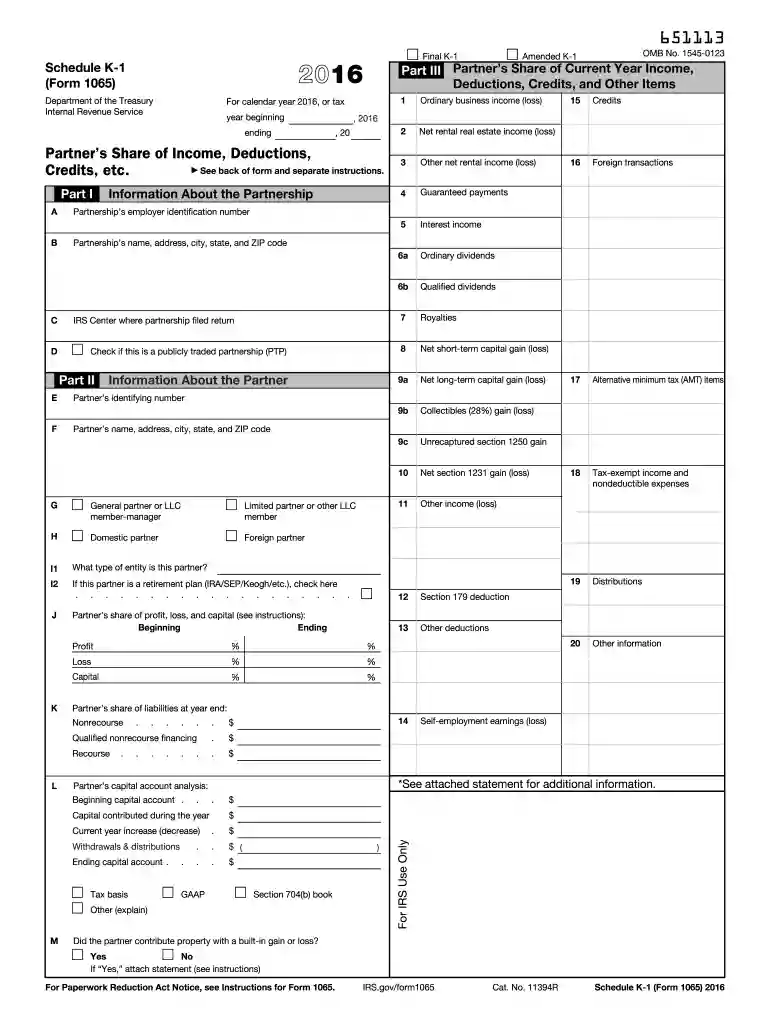
The 1065 form, also known as the U.S. Return of Partnership Income, is utilized by partnerships to report their income, deductions, gains, losses, and tax credits. It provides a comprehensive account of a partnership's financial activity, including the allocation of income among partners. Specific to the 2016 tax year, it captures the unique financial information and tax policies applicable during that period, ensuring accurate tax filings for partnership businesses. The form allows partnerships to declare their financial standing and fulfill their obligations to the IRS.
To acquire the 1065 form for the 2016 tax year, partnerships can visit the IRS official website, where the form is available for download in PDF format. Alternatively, print copies may be requested by contacting the IRS directly. Tax preparation software such as TurboTax or QuickBooks may also provide access to the form, streamlining the process of filling and submission. It is crucial to ensure that the 2016 version is used to address any specific tax provisions or rules effective that year.
Filing a 1065 form is a legal requirement for partnerships. It ensures compliance with U.S. tax laws by providing transparency over fiscal activities. Proper filing allows partnerships to legally outline income distribution, which can impact personal tax returns for each partner. Accurate reporting helps avoid penalties and audits, contributing to the smooth operation of the partnership.
The 1065 form is primarily used by partnerships, including general partnerships, limited partnerships, and limited liability partnerships. It is also applicable to some joint ventures and certain limited liability companies (LLCs) classified as partnerships for tax purposes. Businesses with two or more partners who actively participate in the operation and financial outcomes of the company must utilize this form to report to the IRS.
The IRS provides specific guidelines outlining how to correctly complete the 1065 form. Partnerships must adhere to detailed instructions about what constitutes income, the permissible deductions, and how to report partner distributions. The IRS emphasizes accuracy, as mistakes or omissions can result in penalties. It is advisable to consult the IRS instructions for Form 1065, especially for complex financial scenarios or when new tax provisions apply.
For the 2016 tax year, the standard deadline for filing the 1065 form was March 15, 2017. Partnerships could file for an extension, moving the deadline to September 15, 2017. Meeting these deadlines is crucial, as late submissions may incur penalties. Planning ahead to ensure all financial records are in order before these dates is a recommended practice for partnership businesses.
Failure to file the 1065 form timely results in penalties. As of 2016, the IRS imposed a penalty for each month or part of a month the return is late, with fees assessed per partner. Additionally, inaccuracies or incomplete information can lead to further financial repercussions. Ensuring compliance by keeping up-to-date with IRS regulations and deadlines is essential to avoid these costly penalties.
Different states have distinct requirements when it comes to partnership filings. Some states may require additional forms or impose state-specific taxes and fees. Understanding local obligations, even after the federal 1065 form has been filed, is vital. Partnerships should consult state tax authorities to ensure compliance at both federal and state levels.
The 1065 form can be submitted either digitally through the IRS e-file system or by mail. E-filing is advantageous as it ensures quicker processing times and confirmation of receipt. Many tax preparation software options support e-filing, offering a more streamlined and less error-prone alternative to traditional paper submissions.
Each state has unique requirements for partnerships, which might include additional forms or particular tax obligations. Beyond the federal requirements, partnerships often need to file locally relevant forms depending on their state of operation. Consulting state-specific guidelines helps ensure that partnerships fulfill all necessary obligations.
While the 1065 form is integral for partnerships, other forms like 1120S might apply if the business has elected to be taxed as an S corporation. Understanding the differences and nuances between these forms is critical for accurate reporting. Evaluate the partnership’s status and financial activities to select the appropriate form.
While primarily used by partnerships, various business structures benefit from the 1065 form. These include LLCs taxed as partnerships and joint ventures fulfilling the criteria. Deciphering the correct entity status ensures proper reporting and tax compliance, crucial for businesses looking for transparency and legal adherence in their financial disclosures.
We've got more versions of the 1065 form form. Select the right 1065 form version from the list and start editing it straight away!
| Versions | Form popularity | Fillable & printable |
|---|---|---|
| 2025 | 2.4 Satisfied (129 Votes) | |
| 2024 | 4.4 Satisfied (34 Votes) | |
| 2023 | 4.9 Satisfied (20 Votes) | |
| 2022 | 4.3 Satisfied (33 Votes) | |
| 2021 | 4.8 Satisfied (85 Votes) | |
| 2020 | 4.4 Satisfied (100 Votes) | |
| 2019 | 4.3 Satisfied (142 Votes) | |
| 2018 | 4.4 Satisfied (236 Votes) | |
| 2017 | 4.3 Satisfied (181 Votes) | |
| 2016 | 4.3 Satisfied (163 Votes) | |
| 2015 | 4.4 Satisfied (728 Votes) | |
| 2014 | 4 Satisfied (54 Votes) | |
| 2013 | 4 Satisfied (80 Votes) | |
| 2012 | 4 Satisfied (26 Votes) | |
| 2011 | 4 Satisfied (60 Votes) |
At DocHub, your data security is our priority. We follow HIPAA, SOC2, GDPR, and other standards, so you can work on your documents with confidence.


This list identifies the codes used on Schedule K-1 for all partners and provides summarized reporting information for partners who file Form 1040. For detailedRead more
For calendar year 2016, or tax year beginning. , 2016, . 2016 ending. , 20. Department of the Treasury. Internal Revenue Service.Read more
Jan 19, 2017 This publication discusses common business expenses and explains what is and is not de ductible. The general rules for deducting busi.Read more


