




01. Edit your schedule k 1 2017 online
Type text, add images, blackout confidential details, add comments, highlights and more.

Type text, add images, blackout confidential details, add comments, highlights and more.

Draw your signature, type it, upload its image, or use your mobile device as a signature pad.

Send k1 tax form via email, link, or fax. You can also download it, export it or print it out.
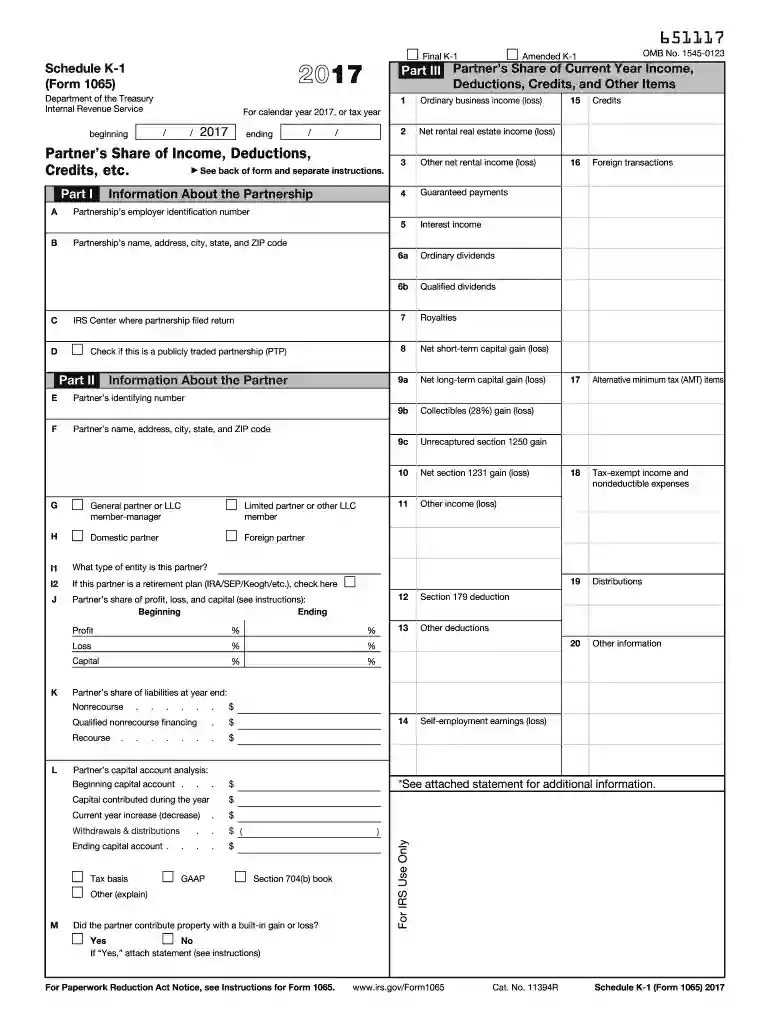
Schedule K-1 (Form 1065) is a tax document required by the IRS to report a partner's share of income, deductions, credits, and other items from a partnership. This form serves as a crucial record for partners to understand their individual tax obligations arising from the partnership's overall financial activities in the 2017 tax year. It details ordinary business income, rental income, dividends, and capital gains, among other financial elements. Understanding these sections helps partners accurately report their taxable income on personal tax returns.
Gather Necessary Information:
Fill Out Personal Details:
Report Income and Deductions:
Review Partnership Distributions:
Check for Additional Schedules:
Finalize and Submit:
Partnership Information: Includes basic identification details of the partnership, such as its name and federal ID number.
Partner’s Share of Income: Highlights each partner’s respective share of the income from the partnership.
Credits and Deductions: Lists applicable tax credits and deductions specific to the partner.
Distributions Information: Outlines distributions received by the partner during the year.
Each section requires accuracy to ensure compliance with IRS requirements and to avoid potential penalties.
The IRS provides comprehensive guidance on accurately completing and filing Schedule K-1 (Form 1065). Key areas include:
Understanding Allocation Rules: Ensure income and deductions are allocated according to the partnership agreement.
Filing Instructions: Follow IRS instructions for submission alongside your personal tax return.
Reporting Requirements: Comply with specific reporting guidelines for special income types or issues such as foreign transactions.
Record-Keeping: Retain copies of the filled Schedule K-1 and supporting documents for at least seven years.
Pass-Through Entity: Partnerships are pass-through entities, meaning they do not pay income taxes directly. Instead, income and losses pass through to partners.
Ordinary Business Income: Income derived from regular business operations, excluding extraordinary items.
Self-Employment Income: Income subject to self-employment tax for individual partners.
Familiarity with these terms enhances understanding and accurate completion of the form.
Schedule K-1 (Form 1065) is generally provided to each partner by the partnership itself. Steps to obtain it include:
Request from Partnership: Reach out to the designated partner or accountant responsible for tax filings within the partnership.
Internal Partnership Systems: Many partnerships use internal systems or software to generate these forms.
Online Portals: Some partnerships provide access to annual tax documents through secure online portals.
It is essential to ensure receipt before personal tax filing deadlines.
Failure to properly report or submit Schedule K-1 (Form 1065) can result in penalties from the IRS. Penalties might include:
Late Filing Penalties: For delays in submitting forms past the official deadline.
Inaccurate Reporting Penalties: If the information reported is incorrect or misleading.
Negligence Penalties: For failing to comply with IRS instructions and guidelines.
Understanding these penalties emphasizes the importance of accuracy and timely submission.
Several software platforms can assist in completing and filing a Schedule K-1. These include:
TurboTax and QuickBooks: Often used by individuals and small businesses to manage and file tax documents.
H&R Block Software: Offers features to aid in accurate data entry and filing.
TaxAct: Provides tools specifically for handling partnership scenarios and related forms.
Using these platforms can simplify the process and minimize errors.
We've got more versions of the schedule k 1 2017 form. Select the right schedule k 1 2017 version from the list and start editing it straight away!
| Versions | Form popularity | Fillable & printable |
|---|---|---|
| 2025 | 2.4 Satisfied (129 Votes) | |
| 2024 | 4.4 Satisfied (34 Votes) | |
| 2023 | 4.9 Satisfied (20 Votes) | |
| 2022 | 4.3 Satisfied (33 Votes) | |
| 2021 | 4.8 Satisfied (85 Votes) | |
| 2020 | 4.4 Satisfied (100 Votes) | |
| 2019 | 4.3 Satisfied (142 Votes) | |
| 2018 | 4.4 Satisfied (236 Votes) | |
| 2017 | 4.3 Satisfied (181 Votes) | |
| 2016 | 4.3 Satisfied (163 Votes) | |
| 2015 | 4.4 Satisfied (728 Votes) | |
| 2014 | 4 Satisfied (54 Votes) | |
| 2013 | 4 Satisfied (80 Votes) | |
| 2012 | 4 Satisfied (26 Votes) | |
| 2011 | 4 Satisfied (60 Votes) |
At DocHub, your data security is our priority. We follow HIPAA, SOC2, GDPR, and other standards, so you can work on your documents with confidence.


Jan 6, 2017 Schedule K-1 (Form 1065), box 14, code A; and Schedule K-1 (Form 1065-B), box 9, code J1. -6-. Form 1040-ES (2017). Page 7. 2017 Tax RateRead more
pages and schedules of the 2017 business return including Schedule L (balance sheet), Schedule K-. 1(s) and form 8825. If the business has rental property orRead more
1. Ordinary business income (loss). Determine whether the income (loss) is passive or nonpassive and enter on your return as follows.Read more


