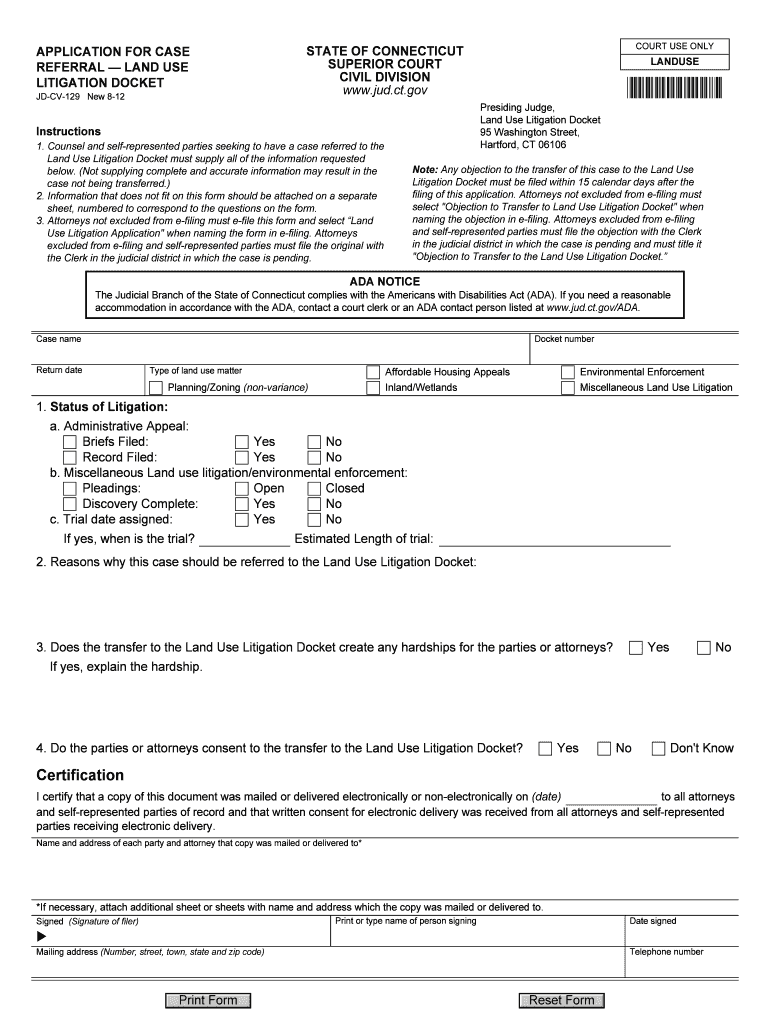
APPLICATION FOR CASE REFERRAL - LAND USE LITIGATION ... - jud ct 2026

Get Form
APPLICATION FOR CASE REFERRAL - LAND USE LITIGATION ... - jud ct Preview on Page 1

Here's how it works

01. Edit your form online
Type text, add images, blackout confidential details, add comments, highlights and more.
02. Sign it in a few clicks
Draw your signature, type it, upload its image, or use your mobile device as a signature pad.
03. Share your form with others
Send it via email, link, or fax. You can also download it, export it or print it out.

How to use or fill out APPLICATION FOR CASE REFERRAL - LAND USE LITIGATION with our platform

Form edit decoration
9.5
Ease of Setup
DocHub User Ratings on G2
9.0
Ease of Use
DocHub User Ratings on G2
  1. Click ‘Get Form’ to open it in the editor.
  2. Begin by entering the case name, return date, and docket number at the top of the form. Ensure all information is accurate to avoid delays.
  3. Select the type of land use matter from the provided options, such as Planning/Zoning or Environmental Enforcement.
  4. In the 'Status of Litigation' section, indicate whether briefs have been filed and if discovery is complete. Provide trial date details if applicable.
  5. Articulate reasons for referring this case to the Land Use Litigation Docket in section two. Be concise yet thorough.
  6. Address any potential hardships that may arise from transferring to this docket in section three.
  7. Confirm consent for transfer in section four by selecting 'Yes' or 'No'.
  8. Complete the certification section by providing your name, signature, and date signed. Include contact information as required.

Start using our platform today to streamline your document editing and submission process for free!

See more APPLICATION FOR CASE REFERRAL - LAND USE LITIGATION ... - jud ct versions

We've got more versions of the APPLICATION FOR CASE REFERRAL - LAND USE LITIGATION ... - jud ct form. Select the right APPLICATION FOR CASE REFERRAL - LAND USE LITIGATION ... - jud ct version from the list and start editing it straight away!
Versions Form popularity Fillable & printable
2018 4.8 Satisfied (96 Votes)
2012 4.3 Satisfied (73 Votes)
be ready to get more

Complete this form in 5 minutes or less

Get form

Got questions?

We have answers to the most popular questions from our customers. If you can't find an answer to your question, please contact us.
Contact us
Any judge of the Superior Court and any judge trial referee who has the power to render judgment, who has commenced the trial of any civil cause, shall have power to continue such trial and shall render judgment not later than one hundred and twenty days from the completion date of the trial of such civil cause.
Connecticut Renaissances Community Work Release Programs serve individuals referred by the Connecticut Department of Correction who are preparing to transition back into the community.
An Application for a Prejudgment Remedy (also known as a PJR Connecticut General Statutes 52-278a et seq.) is a unique civil motion in Connecticut that allows a Plaintiff to seek to attach a Defendants assets in most cases before a case even starts.
A CT judicial forms caseflow request is a document filed with the court to request a specific action or information related to the caseflow of a particular court case.
You may also call the Centralized Services Unit at 860-263-2750. All requests for files must include the name of the case and docket number. Docket numbers may be available on-line at .jud.ct.gov by utilizing the case look-up function. Files should be available within one or two business days.

Security and compliance

At DocHub, your data security is our priority. We follow HIPAA, SOC2, GDPR, and other standards, so you can work on your documents with confidence.

Learn more
ccpa2
pci-dss
gdpr-compliance
hipaa
soc-compliance

People also ask

At the hearing, the judge or magistrate will hear the arguments for and against the motion. He or she may issue a ruling or order at that time from the bench, or he or she may issue a written ruling or order within 120 days following the hearing.
Divisions of Superior Court - CT Judicial Branch. The Superior Court hears civil, criminal, family and juvenile matters. Civil Division hears cases in which someone is being sued to protect civil, personal or property rights.

Related links