




01. Edit your form online
Type text, add images, blackout confidential details, add comments, highlights and more.

Type text, add images, blackout confidential details, add comments, highlights and more.

Draw your signature, type it, upload its image, or use your mobile device as a signature pad.

Send it via email, link, or fax. You can also download it, export it or print it out.
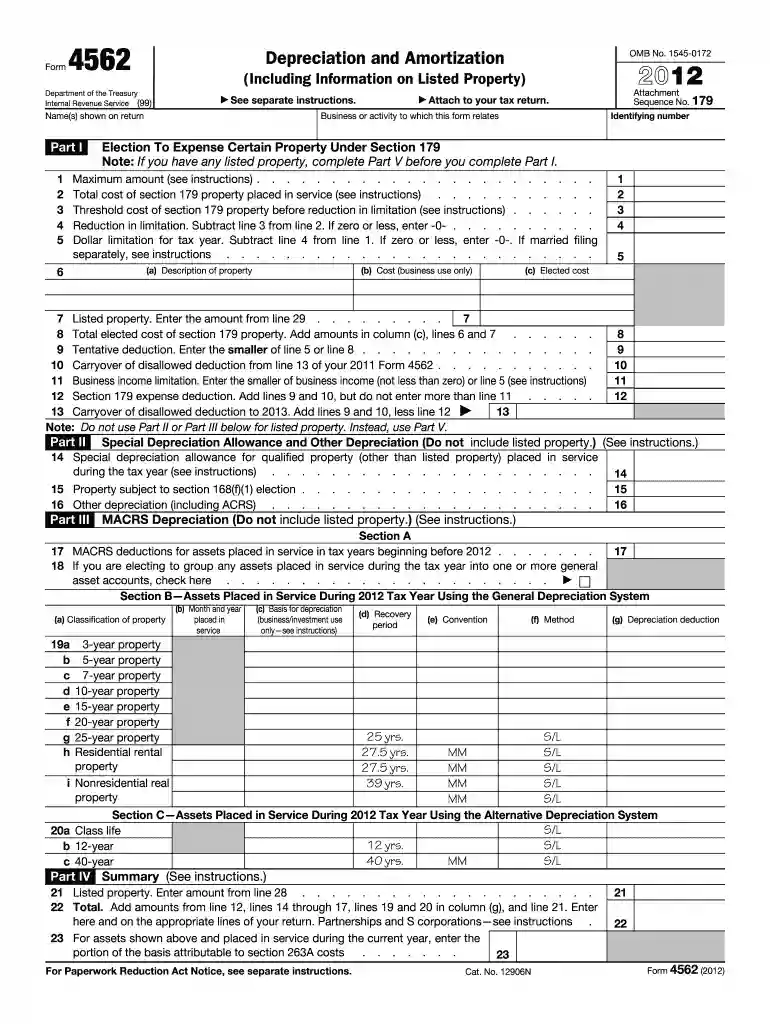
Form 4562, for the year 2012, is primarily used for reporting taxpayer deductions related to depreciation and amortization. This form allows individuals and businesses to deduct the cost of depreciable business assets over time. It includes provisions for electing to expense certain property under Section 179 and outlines the processes for claiming special depreciation allowances and Modified Accelerated Cost Recovery System (MACRS) deductions.
The 2012 Form 4562 is generally utilized by businesses and individuals who own tangible property used in a trade or business. This includes:


There are several ways to access the 2012 Form 4562:
Completing the form requires precise financial documentation and an understanding of tax regulations:
Understanding the IRS's expectations for form submission can significantly impact the accuracy of your tax filings. The IRS provides strict guidelines regarding:
A small business purchases $50,000 worth of machinery. By using Form 4562, they can depreciate these costs over the machinery's useful life, reducing taxable income each year.
Familiarity with key terms can greatly aid in form comprehension:
Failure to accurately complete and submit the 2012 Form 4562 can result in penalties, including:
We've got more versions of the 2012 form 4562 form. Select the right 2012 form 4562 version from the list and start editing it straight away!
| Versions | Form popularity | Fillable & printable |
|---|---|---|
| 2025 | 4.7 Satisfied (38 Votes) | |
| 2024 | 4.6 Satisfied (34 Votes) | |
| 2023 | 4.1 Satisfied (58 Votes) | |
| 2022 | 4.9 Satisfied (49 Votes) | |
| 2021 | 4.9 Satisfied (52 Votes) | |
| 2020 | 4.4 Satisfied (230 Votes) | |
| 2019 | 4.4 Satisfied (245 Votes) | |
| 2018 | 4.4 Satisfied (205 Votes) | |
| 2017 | 4.4 Satisfied (95 Votes) | |
| 2016 | 4.4 Satisfied (257 Votes) | |
| 2015 | 4.4 Satisfied (45 Votes) | |
| 2014 | 4 Satisfied (59 Votes) | |
| 2013 | 4 Satisfied (22 Votes) | |
| 2012 | 4 Satisfied (56 Votes) | |
| 2011 | 4 Satisfied (32 Votes) |
At DocHub, your data security is our priority. We follow HIPAA, SOC2, GDPR, and other standards, so you can work on your documents with confidence.
13. Carryover of disallowed deduction to 2012. Add lines 9 and 10, less line 10. Carryover of disallowed deduction from line 13 of your 2010 Form 4562 .Read more
Part I. Election To Expense Certain Property Under Section 179. Note: If you have any listed property, complete Part V before you complete Part I.Read more
ICAO initiated in 2012 the deployment of a conceptual framework of internal control that includes a risk management system. ICAOs approach to risk managementRead more


