




01. Edit your form 4562 instructions 2016 online
Type text, add images, blackout confidential details, add comments, highlights and more.

Type text, add images, blackout confidential details, add comments, highlights and more.

Draw your signature, type it, upload its image, or use your mobile device as a signature pad.

Send it via email, link, or fax. You can also download it, export it or print it out.
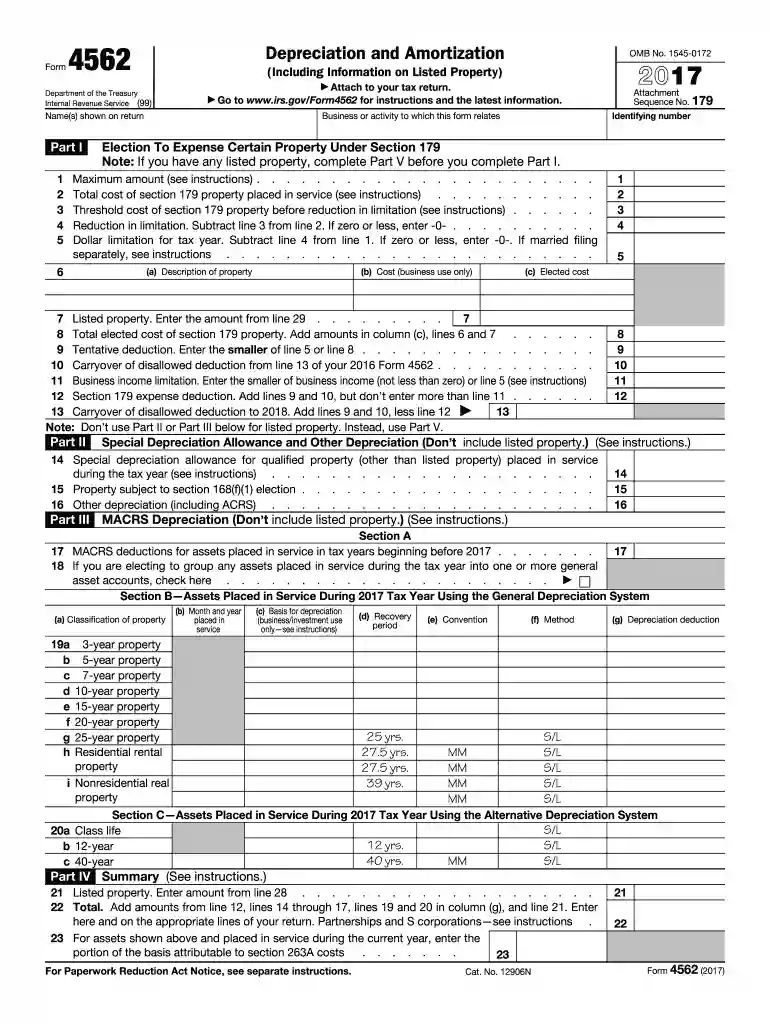
Form 4562 is utilized by businesses and individuals to report depreciation and amortization for tax purposes. This form plays a crucial role in allowing taxpayers to deduct the depreciation of assets over time, such as machinery, vehicles, and buildings. Moreover, it facilitates the election to expense certain properties under Section 179, enabling immediate deductions rather than spreading them across multiple years. Understanding Form 4562 is essential for effectively managing taxable income and ensuring compliance with IRS regulations.
Form 4562 consists of several sections, each focusing on different types of depreciation:
Section 179 Deduction: This section allows businesses to deduct the full purchase price of qualifying equipment and/or software purchased or financed during the tax year.
Special Depreciation Allowance: This provides for additional deductions on certain properties within the first year of service.
MACRS Depreciation: This is the Modified Accelerated Cost Recovery System, a detailed method of calculating depreciation spread over an asset's service life.
Each section requires detailed information regarding the type of property, cost, and the specific method of depreciation applied.
Completing Form 4562 involves several steps:
Gather Information: Compile data on all eligible properties, including cost, purchase date, and service date.
Determine Eligibility: Assess properties that qualify for Section 179 and special allowances.
Calculate Depreciation: Use MACRS tables to compute depreciation for each item.
Fill in the Form: Begin with Section 179 deductions, followed by special depreciation allowances, and conclude with standard depreciation.
Double-Check Entries: Ensure accuracy across all sections to prevent any discrepancies during submission.
Form 4562 is primarily utilized by businesses and individuals who need to account for the depreciation of tangible property. Common users include:
Several key terms are critical when dealing with Form 4562:
Depreciation: The allocation of the cost of a tangible asset over its useful life.
Amortization: The spreading of an intangible asset's cost over a specified period.
MACRS: A method of depreciation that allows for a greater deduction in the earlier years of an asset's life.
Understanding these terms ensures accurate reporting and compliance.
The IRS provides specific guidelines for completing Form 4562, focusing on:
Eligibility Criteria: Clearly defined requirements for assets and their usability.
Documentation: Maintaining records of purchase, service dates, and calculations.
Filing Instructions: Includes electronic submissions, mailing addresses for physical copies, and deadlines.
Adhering to these guidelines prevents issues such as penalties and errors during filing.
The IRS mandates timely submission of Form 4562, closely tied to your tax return, typically by April 15 for most taxpayers. Extensions may be granted, but adherence to deadlines ensures avoidance of penalties. Marking these dates aids in effective tax planning.
Form 4562 can be completed through various tax software programs like TurboTax and QuickBooks, simplifying the calculation and submission process. Online platforms also facilitate electronic filing, streamlining document management and reducing the likelihood of errors.
Failing to file Form 4562 accurately or by the deadline can result in penalties and interest. The IRS may impose fines on unreported depreciation or incorrect usage of Section 179 deductions. Understanding and adhering to all compliance responsibilities is critical for avoiding these financial burdens.
We've got more versions of the form 4562 instructions 2016 form. Select the right form 4562 instructions 2016 version from the list and start editing it straight away!
| Versions | Form popularity | Fillable & printable |
|---|---|---|
| 2025 | 4.7 Satisfied (38 Votes) | |
| 2024 | 4.6 Satisfied (34 Votes) | |
| 2023 | 4.1 Satisfied (58 Votes) | |
| 2022 | 4.9 Satisfied (49 Votes) | |
| 2021 | 4.9 Satisfied (52 Votes) | |
| 2020 | 4.4 Satisfied (230 Votes) | |
| 2019 | 4.4 Satisfied (245 Votes) | |
| 2018 | 4.4 Satisfied (205 Votes) | |
| 2017 | 4.4 Satisfied (95 Votes) | |
| 2016 | 4.4 Satisfied (257 Votes) | |
| 2015 | 4.4 Satisfied (45 Votes) | |
| 2014 | 4 Satisfied (59 Votes) | |
| 2013 | 4 Satisfied (22 Votes) | |
| 2012 | 4 Satisfied (56 Votes) | |
| 2011 | 4 Satisfied (32 Votes) |
At DocHub, your data security is our priority. We follow HIPAA, SOC2, GDPR, and other standards, so you can work on your documents with confidence.
Part I. Election To Expense Certain Property Under Section 179. Note: If you have any listed property, complete Part V before you complete Part I.Read more
2017 Form 4562, Depreciation and Amortization, and its instructions. The election is made separately by each person owning qualified property (for exampleRead more
16a Depreciation (if required, attach Form 4562) . . . . . . 16a b Less depreciation reported on Form 1125-A and elsewhere on return 16b. 16c. 17. DepletionRead more


