




01. Edit your 4562 form 2011 online
Type text, add images, blackout confidential details, add comments, highlights and more.

Type text, add images, blackout confidential details, add comments, highlights and more.

Draw your signature, type it, upload its image, or use your mobile device as a signature pad.

Send 2011 form 4562 via email, link, or fax. You can also download it, export it or print it out.
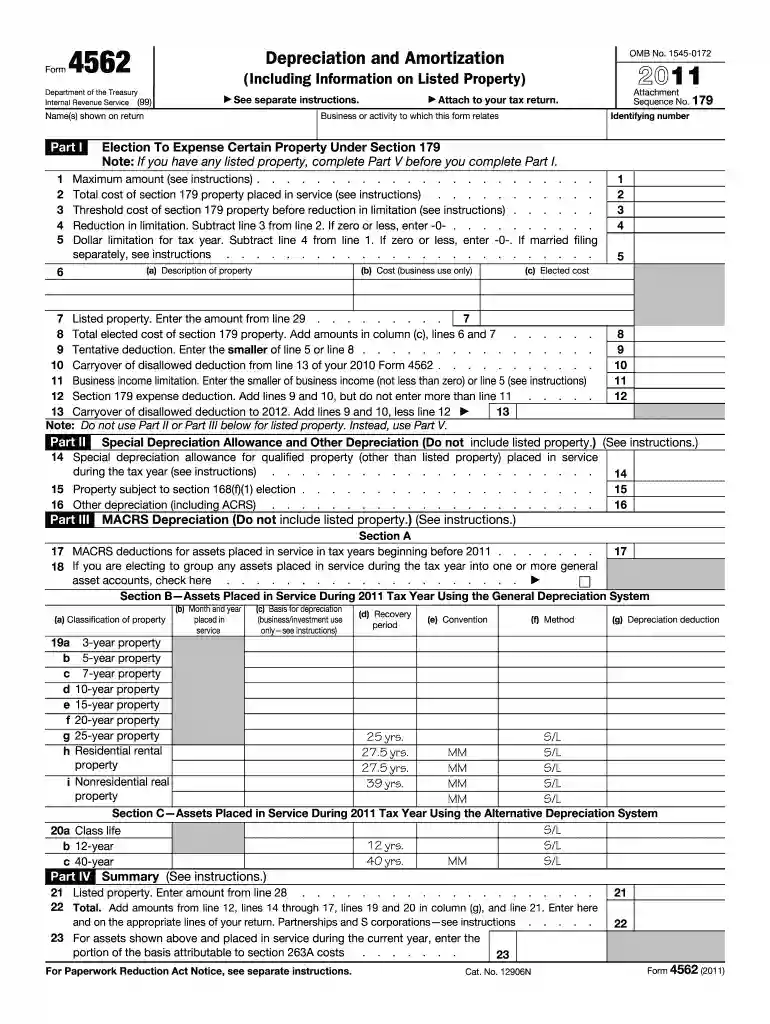
Form 4562 is a U.S. Internal Revenue Service (IRS) document used for reporting depreciation and amortization to reduce taxable income. Specifically, the 2011 version of this form helps taxpayers document the depreciation of property placed in service that year. This form allows businesses and individuals to deduct the expense of tangible personal property over a period of years, thus lowering their taxable income made during that tax year. Depreciation refers to the allocation of the cost of specific business assets over their useful life. Understanding how to use Form 4562 effectively ensures compliance with IRS regulations while optimizing tax deductions.
Using the 2011 Form 4562 involves a detailed understanding of the business assets that qualify for depreciation and special deductions. Here's a step-by-step overview that can guide you through the process:
Inventory Assessment: Begin by identifying business assets that are eligible for depreciation. This includes machinery, equipment, buildings, and vehicles placed in service during the tax year.
Section 179 Deduction: Decide if you want to take advantage of the Section 179 deduction, which allows immediate expense deduction for qualified property up to a certain limit instead of spreading the costs over several years.
Calculate Special Depreciation Allowance: Certain assets may qualify for the special depreciation allowance if they meet specific criteria such as new property, not subject to any other depreciation method, and placed in service during the designated time frame.
MACRS Calculation: Use the Modified Accelerated Cost Recovery System (MACRS) to determine annual depreciation deductions. MACRS consists of different classes and methods determined by asset type and recovery period.
Report & File: Fill in the applicable sections of the form based on the above calculations and ensure it aligns with your business's overall tax filing strategy.
Filing the Form 4562 entails several detailed steps:
Fill in Section I: Record amounts you elect to expense under Section 179. Include the total cost of Section 179 property and any carryover amounts.
Complete Section II: If applicable, enter any special depreciation allowance amounts for qualified property.
Provide Section III Information: Report details of property being depreciated using the MACRS system, including class life and depreciation method.
Fill out Section IV: List any other depreciation and amortization amounts not captured in the previous sections.
Summarize in Section V: Record gross income details to show how depreciation affects taxable income.
Review & Submit: Carefully review the completed form for accuracy and ensure it accompanies other necessary filings.
Several critical components are incorporated into the 2011 Form 4562 to facilitate comprehensive reporting:
Section 179 Deduction: This allows businesses to deduct the full purchase price of qualifying equipment bought or financed during the fiscal year from their gross income.
Special Depreciation Allowance: A deduction permitted for property meeting specific criteria, offering significant immediate tax relief in the initial service year.
MACRS Depreciation Information: Includes distinct class lives and methods (GDS or ADS), and affects how property depreciation is calculated and reported.
Amortization Reporting: Details how various intangible costs are expensed over time.
Property Usage Details: Requires an indication of property usage percentage for both business and personal purposes.
The form follows strict IRS guidelines to ensure that businesses and individuals accurately calculate and report depreciation and amortization. The IRS provides detailed instructions for understanding the qualifications for special deductions, property classification under MACRS, and the maximum amounts allowed under Section 179. As tax laws are subject to change, referencing the IRS guidelines for the specific tax year is essential for compliance and accuracy in financial reporting.
Completing the 2011 Form 4562 requires several supporting documents, including:
The filled form can be submitted through various channels:
Different taxpayers benefit from leveraging Form 4562:
Small Business Owners: Utilize the Section 179 deduction to write-off equipment costs.
Corporations: Employ MACRS to manage long-term asset depreciation.
Self-Employed Individuals: Use depreciation to offset income through business-related expenses tied to new equipment or vehicles.
Form 4562 is integral for accurate and provision-compliant financial reporting. Understanding its use ensures taxpayers maximize allowable deductions while adhering to the fiscal criteria set by the IRS.


We've got more versions of the 4562 form 2011 form. Select the right 4562 form 2011 version from the list and start editing it straight away!
| Versions | Form popularity | Fillable & printable |
|---|---|---|
| 2025 | 4.7 Satisfied (38 Votes) | |
| 2024 | 4.6 Satisfied (34 Votes) | |
| 2023 | 4.1 Satisfied (58 Votes) | |
| 2022 | 4.9 Satisfied (49 Votes) | |
| 2021 | 4.9 Satisfied (52 Votes) | |
| 2020 | 4.4 Satisfied (230 Votes) | |
| 2019 | 4.4 Satisfied (245 Votes) | |
| 2018 | 4.4 Satisfied (205 Votes) | |
| 2017 | 4.4 Satisfied (95 Votes) | |
| 2016 | 4.4 Satisfied (257 Votes) | |
| 2015 | 4.4 Satisfied (45 Votes) | |
| 2014 | 4 Satisfied (59 Votes) | |
| 2013 | 4 Satisfied (22 Votes) | |
| 2012 | 4 Satisfied (56 Votes) | |
| 2011 | 4 Satisfied (32 Votes) |
At DocHub, your data security is our priority. We follow HIPAA, SOC2, GDPR, and other standards, so you can work on your documents with confidence.
Part I. Election To Expense Certain Property Under Section 179. Note: If you have any listed property, complete Part V before you complete Part I.Read more
Form 4562 (2011). Page 2. Section ADepreciation and Other Information (Caution: See the instructions for limits for passenger automobiles.) 24a Do you haveRead more
Dec 13, 2025 The 4 pillars of JOIFF aiming to support its Membership in preventing and/or mitigating hazardous incidents in Industry are: Shared Learning.Read more


