




01. Edit your 4562 instructions online
Type text, add images, blackout confidential details, add comments, highlights and more.

Type text, add images, blackout confidential details, add comments, highlights and more.

Draw your signature, type it, upload its image, or use your mobile device as a signature pad.

Send 2016 form 4562 via email, link, or fax. You can also download it, export it or print it out.
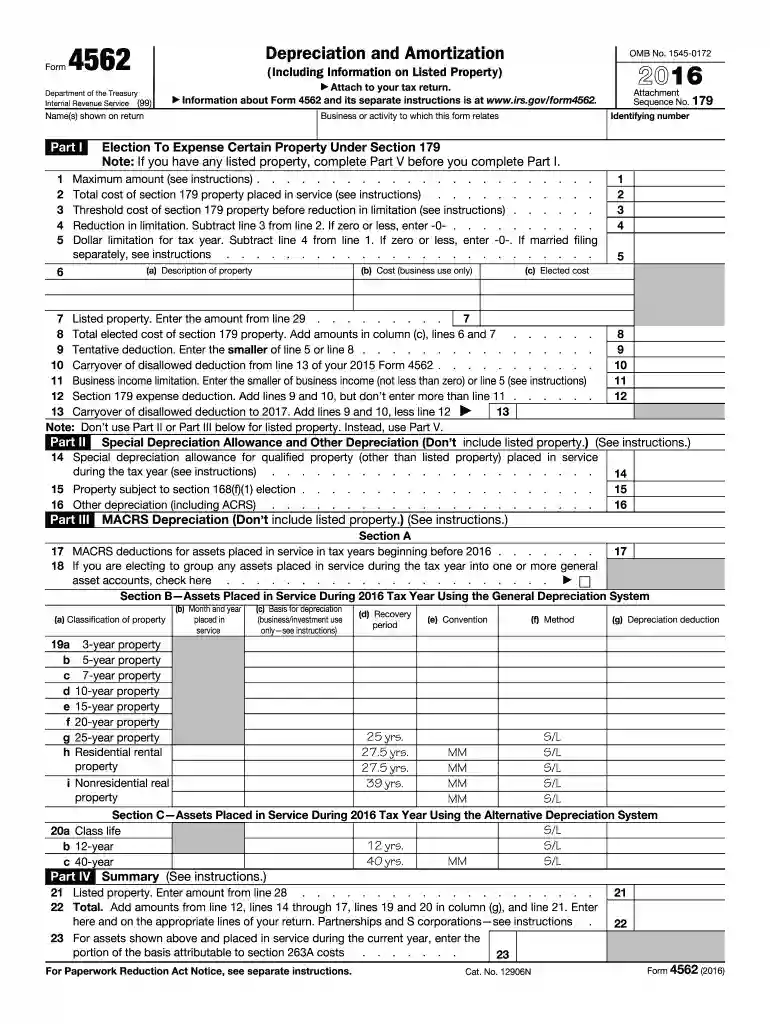
The 2016 Form 4562, named "Depreciation and Amortization," is primarily used by taxpayers to report depreciation and amortization on their tax returns. This form is crucial for detailing the election to expense certain property under Section 179. It includes various sections for listing property, claiming special depreciation allowances, MACRS depreciation, and amortization costs. Understanding the purpose of this form can help taxpayers accurately report and potentially reduce taxable income by accounting for deductions related to property placed in service during the 2016 tax year.
Determine Eligible Property: Identify all properties placed in service during the tax year. Make sure these qualify for depreciation or amortization deductions.
Complete Section I: Use this section to elect an immediate expense deduction for certain property under Section 179. Report the total cost of the property and calculate the allowable deduction.
Fill Out Section II: This part is for special depreciation allowance and other depreciation, including MACRS. Calculate the accumulated depreciation for your assets.
Enter Information in Section III: If any assets are being amortized, detail the type and amount here.
Review & Submit: Double-check all entries, ensuring compliance with IRS standards, before submitting along with your tax return.
Business owners, especially those with significant investments in equipment or real estate, frequently use Form 4562. It is commonly utilized by:


The IRS provides specific guidelines for claiming depreciation and amortization:
Failing to properly complete or file the 2016 Form 4562 can result in:
While Form 4562 is specific to certain property deductions, there are related forms that might be applicable in different scenarios, such as:
Form 4562 applies to various situations, including:
Carefully follow these guidelines and examples to better understand the full range of financial and compliance implications related to the 2016 Form 4562. Accurate reporting ensures maximum allowable depreciation deductions, positively impacting financial outcomes.

We've got more versions of the 4562 instructions form. Select the right 4562 instructions version from the list and start editing it straight away!
| Versions | Form popularity | Fillable & printable |
|---|---|---|
| 2025 | 4.7 Satisfied (38 Votes) | |
| 2024 | 4.6 Satisfied (34 Votes) | |
| 2023 | 4.1 Satisfied (58 Votes) | |
| 2022 | 4.9 Satisfied (49 Votes) | |
| 2021 | 4.9 Satisfied (52 Votes) | |
| 2020 | 4.4 Satisfied (230 Votes) | |
| 2019 | 4.4 Satisfied (245 Votes) | |
| 2018 | 4.4 Satisfied (205 Votes) | |
| 2017 | 4.4 Satisfied (95 Votes) | |
| 2016 | 4.4 Satisfied (257 Votes) | |
| 2015 | 4.4 Satisfied (45 Votes) | |
| 2014 | 4 Satisfied (59 Votes) | |
| 2013 | 4 Satisfied (22 Votes) | |
| 2012 | 4 Satisfied (56 Votes) | |
| 2011 | 4 Satisfied (32 Votes) |
At DocHub, your data security is our priority. We follow HIPAA, SOC2, GDPR, and other standards, so you can work on your documents with confidence.
Due to the complexity of Form 4562 and depreciation deductions generally, it is highly recommended that the sole proprietor seek professional tax assistance.Read more
Part I. Election To Expense Certain Property Under Section 179. Note: If you have any listed property, complete Part V before you complete Part I.Read more
Reserved surplus totalling CAD 15.8 million includes an amount of CAD 18.8 million to finance 2015 outstanding commitments and appropriations carried over to.Read more


