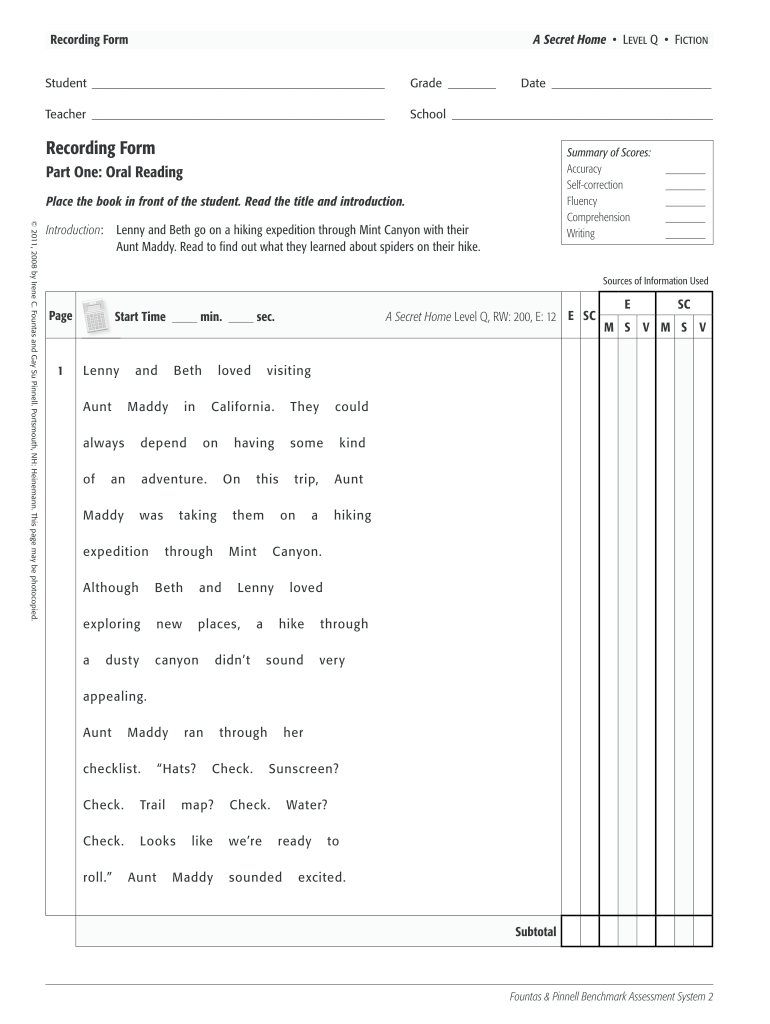







Definition and Meaning of A Secret Home Running Record
A secret home running record primarily acts as a tool for assessing reading proficiency, specifically for elementary-level students. It captures a student’s ability to read fluently and comprehend a fictional story, which in this case, revolves around the narrative "A Secret Home." The record is instrumental for educators to gauge reading levels and to adapt teaching methods accordingly.
Key Components of the Running Record
- Fluency Assessment: This involves measuring the student’s reading speed and expression. Educators may listen to students read aloud and note their natural intonation and pauses.
- Comprehension Check: Following the reading, teachers often conduct a conversation focusing on critical understanding and recall of the story.
- Skill Levels: The record should include a grading scale to indicate the proficiency level of the reader, such as Fountas and Pinnell levels.
The comprehensive assessment process ensures that each student's reading abilities are effectively documented, allowing for tailored educational strategies.
Steps to Use the A Secret Home Running Record
-
Preparation: Select the reading material – in this case, "A Secret Home" – and ensure the text is appropriate for the student’s reading level according to established benchmarks such as Fountas and Pinnell.
-
Administration:
- Have the student read the story aloud to an educator.
- Observe and make notes while the student reads, particularly on errors, self-corrections, and hesitations.
-
Score and Analyze:
- Rate the reading based on fluency and accuracy. An error rate calculation can be used to determine reading levels.
- Assess the comprehension through questions targeting the main idea, supporting details, and overall understanding of the narrative.
-
Documentation: Enter all data into the "a secret home running record" form, ensuring to capture both quantitative scores and qualitative observations.
-
Feedback: Provide constructive feedback to the student, addressing strengths and areas for growth based on their performance on the running record assessment.
Utilizing these steps ensures a straightforward and informative assessment process that aids in monitoring and enhancing student literacy skills.
Importance of the Running Record in Education
The use of running records, including the "a secret home running record," serves distinct purposes in educational settings.
Tracking Progress Over Time
- Benchmarking: Educators can utilize these records to track student growth in reading abilities over time.
- Individualized Instruction: By identifying specific areas of improvement, teachers can offer personalized guidance and interventions tailored to each student’s needs.
Informing Instructional Decisions
- Curriculum Adaptation: The data collected can inform necessary curricular modifications or adaptations to suit the varying literacy levels within a classroom.
- Group Placement: Results can guide decisions on grouping students for targeted reading instruction, facilitating peer learning opportunities among similar proficiency levels.
Ultimately, the running record is a vital assessment tool that helps educators make informed decisions regarding student literacy development.
Common Errors and Misinterpretations
When assessing using the "a secret home running record," it is crucial to be aware of potential errors or misinterpretations that can skew the results.
Misunderstanding Reading Errors
- False Positives: Some errors may occur due to unfamiliar vocabulary or tricky phonetics in the text, rather than a lack of comprehension.
- Comprehension vs. Fluency: It is important to differentiate between struggles with fluency and true comprehension difficulties. Students may read fluently but misunderstand the material.
Documentation Errors
- Incomplete Records: Failing to note key elements of the reading experience, such as errors or comprehension responses, may lead to a misleading assessment of skills.
- Inconsistency in Rating: Standardizing the rating across different sessions ensures reliability. Any deviation may lead to inaccurate assessments of progress.
Educators should remain vigilant about these common missteps to ensure an accurate representation of students’ reading abilities.
Aligning with Educational Standards
The "a secret home running record" is not just an assessment tool; it is also a means of aligning classroom practices with educational standards, such as those outlined by the Common Core State Standards (CCSS).
Key Standards Alignment
- Reading Literature: Assessing comprehension involves evaluating how students interpret and analyze story elements, closely aligning with CCSS expectations.
- Fluency Development: The focus on fluency supports CCSS benchmarks aimed at ensuring students read on grade level by the end of each school year.
Educators can leverage the insights gained from running records to ensure adherence to such standards, ultimately enhancing the quality of reading instruction provided to students.
Examples of Using A Secret Home Running Record
Practical Classroom Scenarios
- Individual Assessments: Teachers may utilize running records during individual reading sessions, observing student interactions with the text in a controlled environment.
- Group Learning Activities: In collaborative settings, clinicians can arrange groups based on similar reading levels and assess their collective performance on shared texts.
These applications not only reinforce the importance of running records but also demonstrate their utility in various instructional formats, enhancing overall literacy development across diverse student populations.
Real-World Applications
- Data-Driven Decision Making: Schools can compile data from multiple running records to inform broader literacy initiatives or target additional resources to underperforming students.
- Parental Engagement: Summarizing running record outcomes can empower parents with insights into their child's reading journey, fostering greater involvement in literacy practices at home.
By addressing these potential scenarios, educators can creatively incorporate the "a secret home running record" into their instructional repertoire.