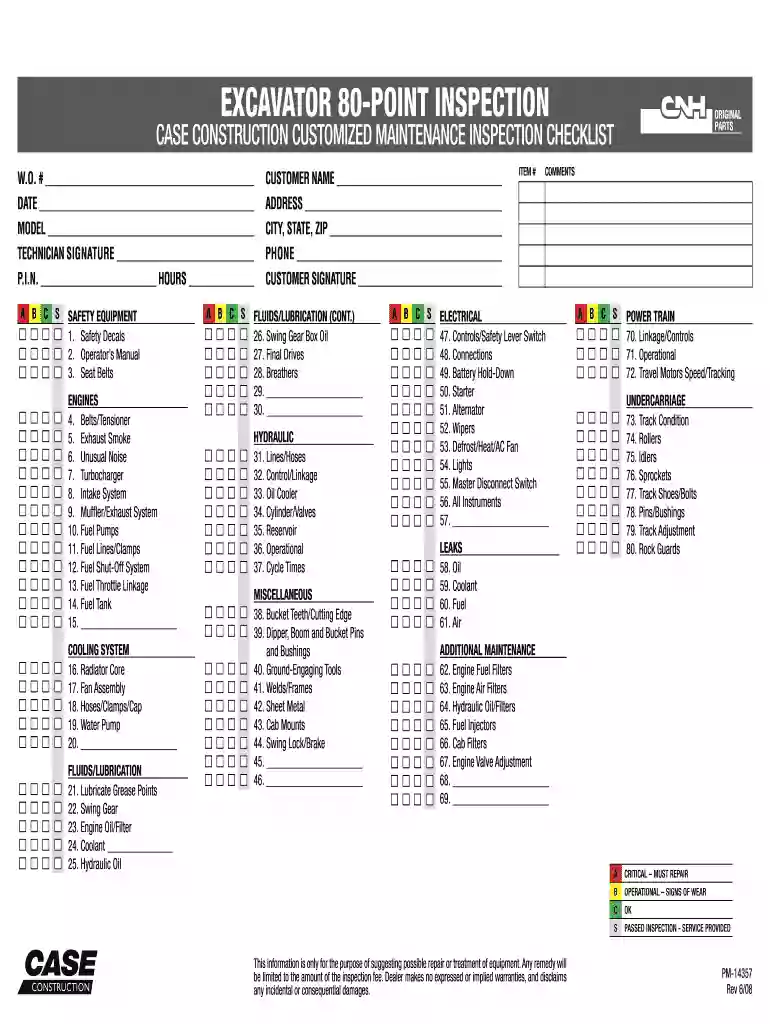
EXCAVATOR 80-POINT INSPECTION - nb5znet - n b5z 2026

Get Form
80 point vehicle inspection checklist Preview on Page 1

Here's how it works

01. Edit your 80 point vehicle inspection checklist online
Type text, add images, blackout confidential details, add comments, highlights and more.

02. Sign it in a few clicks
Draw your signature, type it, upload its image, or use your mobile device as a signature pad.

03. Share your form with others
Send 80 point check via email, link, or fax. You can also download it, export it or print it out.

How to use or fill out EXCAVATOR 80-POINT INSPECTION - nb5znet - n b5z

Form edit decoration
9.5
Ease of Setup
DocHub User Ratings on G2
9.0
Ease of Use
DocHub User Ratings on G2
  1. Click ‘Get Form’ to open the EXCAVATOR 80-POINT INSPECTION checklist in our editor.
  2. Begin by filling in the Work Order number, date, model, technician signature, P.I.N., and hours at the top of the form. This information is crucial for tracking and accountability.
  3. Proceed to the Safety Equipment section. Check off items like safety decals and operator’s manual as you verify their presence on the excavator.
  4. Continue through each category—Engines, Cooling System, Fluids/Lubrication, Hydraulic, Electrical, Leaks, Power Train, Undercarriage—ensuring to mark any issues with A (Critical), B (Operational), C (OK), or S (Passed Inspection).
  5. In the Comments section at the end of each category, note any specific observations or recommendations for repairs.
  6. Finally, fill in customer details including name, address, phone number, and obtain their signature to complete the inspection process.

Start using our platform today to streamline your document editing and ensure a thorough inspection process!

See more EXCAVATOR 80-POINT INSPECTION - nb5znet - n b5z versions

We've got more versions of the EXCAVATOR 80-POINT INSPECTION - nb5znet - n b5z form. Select the right EXCAVATOR 80-POINT INSPECTION - nb5znet - n b5z version from the list and start editing it straight away!
Versions Form popularity Fillable & printable
2014 4.1 Satisfied (23 Votes)
2008 4 Satisfied (56 Votes)
be ready to get more

Complete this form in 5 minutes or less

Get form

Got questions?

We have answers to the most popular questions from our customers. If you can't find an answer to your question, please contact us.
Contact us
How Do You Perform Excavator Inspection Walk around the work area to ensure theres enough space for the machine to work within. Before turning on the machine, inspect the boom, the dipper arm, and the bucket. Look for any cracks or dents. Inspect the undercarriage area. Check the hydraulic fluid and coolant level.
The 70 Point Inspection Includes: Many of the same components addressed in the 150-Point inspection are covered in the 70-Point inspections to a lesser degree, depending on what parts are examined. Less points means less areas are inspected and less parts are checked for functionality.
Also known as the North American Standard Inspection, the Level 1 inspection is the most comprehensive and commonly performed out of the six DOT inspection levels. Level 1 involves a thorough 37-step procedure that checks both the driver and the vehicle, as well as any illegal cargo.
Headlights, brake lights, turn signals, reverse lights, side marker lights and even the little license plate bulbs are some of the most common reasons cars fail inspection.
62-point and 90-point inspections provide comprehensive assessments of a vehicles condition. These detailed inspections cover: Undercarriage and Engine Compartments: Checking for leaks and wear. Suspension and Steering Components: Ensuring proper alignment and handling.

Security and compliance

At DocHub, your data security is our priority. We follow HIPAA, SOC2, GDPR, and other standards, so you can work on your documents with confidence.

Learn more
ccpa2
pci-dss
gdpr-compliance
hipaa
soc-compliance
be ready to get more

Complete this form in 5 minutes or less

Get form

People also ask

A 72-point inspection is an in-depth assessment of a vehicles condition. It covers all the critical aspects of the car to ensure that everything is functioning properly and to identify any potential issues before you make a purchase.
A multi-point inspection checks all of the belts and hoses in your car, including the timing belt, drive belt, fuel lines, vacuum lines, and hoses that connect to the radiator, air conditioner, heater, and power steering.